Introduction
In our last lesson, we examined the phantom limb phenomenon in detail. We saw how Merleau-Ponty uses it to dismantle the traditional mind-body dualism, showing that the lived experience of the body cannot be reduced to either a purely psychological event (a belief or memory) or a purely physiological one (faulty nerve signals). The phantom limb, as the persistence of the "habitual body" and its motor intentions, powerfully illustrates that our lived body has its own reality, distinct from the objective, physical body.
Today, we will build directly on that foundation to address a core tenet of Merleau-Ponty's philosophy. Our learning outcome is to describe why, for Merleau-Ponty, the body is a subject of perception rather than merely an object. We will move from the specific evidence of the phantom limb to the general, and more radical, claim that the body is not something we have, but something we are. It is the very center and vehicle of our being-in-the-world, the active subject that perceives, rather than a passive object to be perceived.
1. The Body Is Not an Object Among Others
To grasp Merleau-Ponty's position, we must first understand what he is arguing against. The dominant tradition in Western philosophy, exemplified by Descartes, treats the body as an object—a complex machine that is part of the physical world and observed, used, or "piloted" by a separate, non-physical mind (a res cogitans or "thinking thing").

Merleau-Ponty argues that from a phenomenological standpoint—that is, from the standpoint of lived experience—this picture is fundamentally wrong. My body doesn't appear to me as just another object alongside the tables, chairs, and books in the world. It has a unique and privileged status.
The following video lecture explains this point with remarkable clarity, drawing a distinction that may resonate with your background in mathematics and formal systems: the difference between a factual necessity and a transcendental necessity.
Merleau-Ponty, Phenomenology of Perception 3: The Habit Body (Phenomenology Lecture 7)
In this segment from a lecture on Merleau-Ponty's 'Phenomenology of Perception', John Russon explores why the body's constant, invariable presence in our experience means it cannot be considered an object in the ordinary sense.
Please watch the segment from 20:35 to 30:13. Focus on these key points: An object is defined, phenomenologically, as something that can be perspectivally viewed but can also disappear from my perceptual field. Why can't the body meet this condition? The body is always on the 'margins' of perception, the unobserved standpoint from which I observe. It's never fully 'in front of me' to be observed as a complete object. The crucial distinction between 'factual necessity' and 'transcendental necessity' (a Kantian concept). Why is the body's presence for me a transcendental necessity—a condition for the possibility of experiencing any facts at all?
As Russon explains, the body is not just another object in our perceptual field; it is the condition for having a perceptual field in the first place. It is the zero-point of all our spatial and perceptual coordinates, the immovable center from which the world unfolds. An object is something for a subject; since the body is the very structure of our subjectivity, it cannot be reduced to a mere object.
2. The Body as the "I Can": The Source of a Meaningful World
If the body isn't primarily an object, what is it? For Merleau-Ponty, the body is fundamentally a power, a capacity for action. It is the source of what we've called motor intentionality. The core of our consciousness is not "I think," but "I can."
This practical engagement is what gives the world its meaning and structure. Objects are not neutral things that we later assign a function to; they appear to us from the outset through the lens of our body's possible actions.
This short video clip makes the point concisely.
Phil 492: Merleau-Ponty The Ambiguity of Being-in-the-world: Phantom Limb and Bodily Intentionality
Lecturer Kyle Banick explains how our body schema, as a set of possible movements, actively structures the way our world appears.
Please watch from 06:20 to 08:28. Pay close attention to the example of the coffee mug. Its location ('right here') is not a geometric fact but a bodily one, defined by the possibility of reaching for it. Note the powerful conclusion: 'My body is that by virtue of which there's objects rather than primarily being an object.'
This is a radical reversal of the traditional view. The world is not a pre-given, objective space in which my body happens to be located. Rather, the world is organized around my body's projects. A path is not a strip of dirt; it is "to be walked upon." A hammer is not wood and steel; it is "for hammering." The world appears as a field of solicitations for my embodied action.
In this sense, the body is the active subject that constitutes the meaning of the world through its projects and possibilities. The world is a world for a body. As John Russon puts it in the lecture series we've been using, your body, as you experience it, is the "I can."
3. The Body's Intelligence: "Organic Thought"
So far, we have a body that is the center of the perceptual world and the active source of its meaning. But is this an intelligent subject, or just a blind force? Merleau-Ponty argues for the former. He posits a form of pre-reflective, practical intelligence that resides in the body itself.
This challenges the Cartesian split between a "thinking" mind and a "mechanical" body. For Merleau-Ponty, the body itself understands, adapts, and solves problems without the need for conscious, intellectual deliberation.
Merleau-Ponty, Phenomenology of Perception 3: The Habit Body (Phenomenology Lecture 7)
Returning to John Russon's lecture, this segment introduces the idea of 'organic thought'—an intelligence inherent to living bodies.
Please watch from 44:43 to 51:20. Focus on the example of the insect that has lost a leg. The insect's body adapts its movements. Merleau-Ponty argues this adaptation is neither: A purely mechanical reflex (since it doesn't happen if the leg is merely tied). A conscious, intellectual decision (the insect isn't 'thinking' about a new way to walk).\nInstead, it is the body itself, as a living, goal-directed system, intelligently reconfiguring itself to carry out its task. This is 'organic thought'—a thinking that is bodily.
This concept of bodily intelligence is crucial. It shows that the capacities we normally associate with a "subject"—understanding, goal-directedness, responsive adaptation—are not exclusive to a disembodied mind. They are properties of the lived body. The body is not a puppet; it is the puppeteer. It is a subject in its own right, possessing a practical knowledge (praktognosia) of its world.
4. Synthesis: The Body-Subject
We can now bring these arguments together to define the body-subject. The body is a subject, not an object, because it is:
- The Transcendental Condition of Perception: It is the fixed, non-objectifiable center from which a world is perceived, not just another object in that world.
- The Source of Motor Intentionality: It is the active "I can" that structures the world as a meaningful field of possibilities and projects.
- The Locus of Practical Intelligence: It possesses a pre-reflective "organic thought" and practical knowledge (praktognosia) that allows it to understand and navigate its environment.
To formalize this key concept, please read the introduction to the following paper, which succinctly defines the "body-subject" in contrast to Cartesian dualism.
[PDF] MERLEAU-PONTY AND THE PHENOMENOLOGY OF THE BODY
The paper 'Merleau-Ponty and the Phenomenology of the Body' by Russell Keat offers a clear introduction to the concept of the 'body-subject'.
Please read the first section, '1. Merleau-Ponty, Husserl and phenomenology' (pages 1-4). This will consolidate what we've learned, formally introduce the term 'body-subject', and place it in its historical context as a response to both scientific realism and Cartesian dualism.
The distinction between the body-as-object (a physiological system, viewed from a 3rd-person, "naturalistic attitude") and the body-as-subject (the lived center of experience, from a 1st-person, "personalistic attitude") is fundamental. Phenomenology, for Merleau-Ponty, is the exploration of the latter.
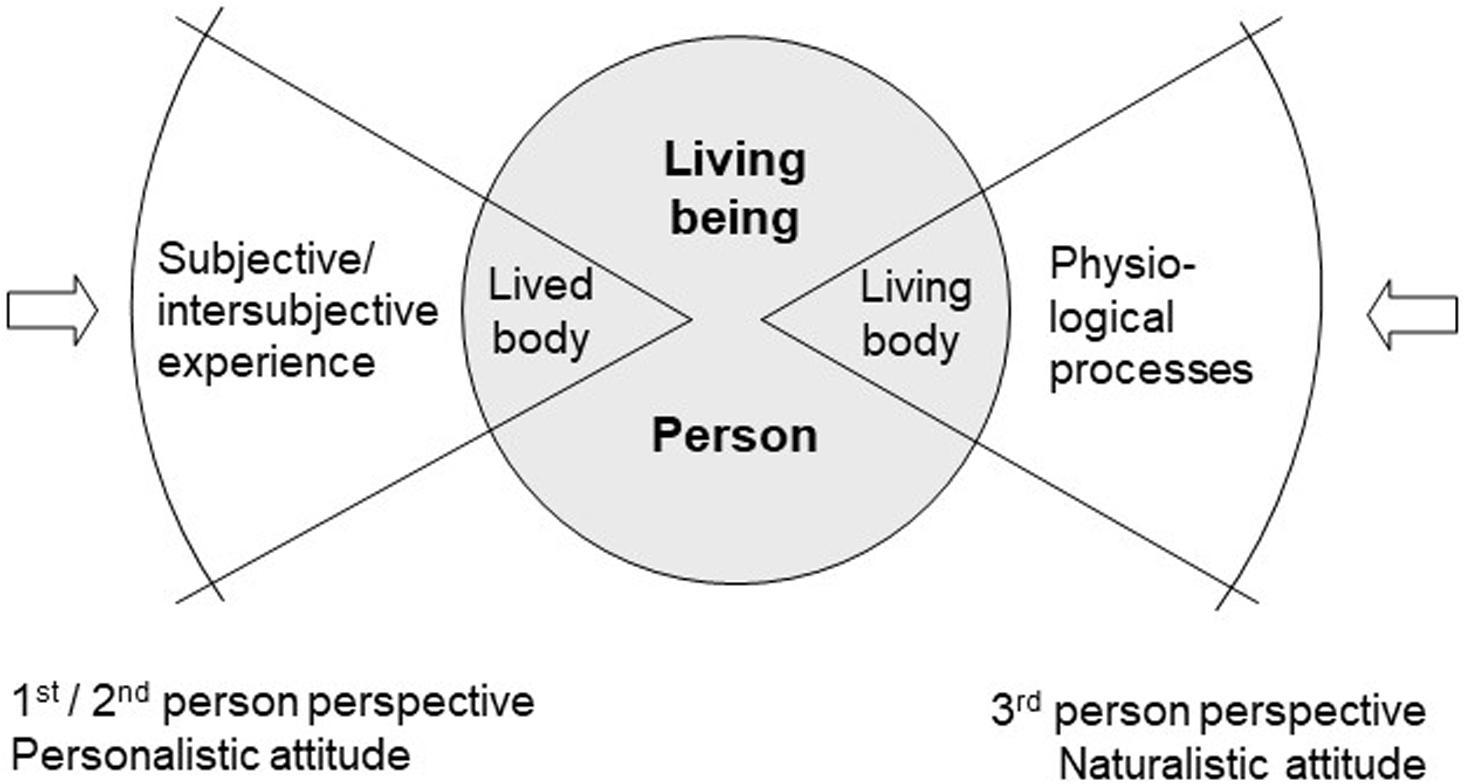
Finally, the scholar Taylor Carman provides a perfect concluding statement on this matter. In his paper "The Body in Husserl and Merleau-Ponty," he summarizes the argument by stating that for Merleau-Ponty, "strictly speaking, we do not have bodies, rather 'we are our body' ... In effect, 'the body is a natural self and, as it were, the subject of perception'" (LINK).
Conclusion
In this lesson, we have moved from the specific case of the phantom limb to the general principle that the body is the subject of perception. We have seen that this is not a simple assertion but a conclusion supported by a series of rigorous phenomenological arguments.
Key Takeaways:
- The traditional view, inherited from Descartes, treats the body as a mechanical object separate from the mind.
- Phenomenologically, the body is not an object like others because it is the transcendental center of the perceptual world—the condition for the possibility of there being objects at all.
- The body is the active source of motor intentionality, the "I can" that constitutes the world as a meaningful field of practical possibilities.
- The body possesses its own pre-reflective, practical intelligence, which Merleau-Ponty calls "organic thought".
- These three points converge on the concept of the body-subject: an embodied, intelligent agent that is the true subject of perception.
Preview of the Next Lesson:
Having established this theoretical framework, our next and final lesson in this module will be a practical exercise. We will apply these concepts by performing a phenomenological description of a concrete bodily experience, such as learning a new motor skill. This will allow us to see how the abstract ideas of the body schema, motor intentionality, and the body-subject manifest in our own lived experience.