Bonjour ! Welcome to the first lesson of our second module.
In the previous module, we built a solid foundation for French pronunciation. You learned how to pronounce vowels, consonants, and how to read simple words aloud. Now that you have the tools to pronounce French words, we will start learning how to use them to build sentences.
This lesson marks our first step into French grammar. We'll tackle a fundamental concept: noun gender. Our goal is to learn how to identify the gender of common French nouns using their endings as clues. This skill is crucial because, in French, many other words in a sentence (like articles and adjectives) must change to match the gender of the noun. Mastering this will make your speech sound much more natural and professional—an essential skill for your goal of working in customer service.
1. What is Grammatical Gender?
In French, every noun, whether it refers to a person, a place, or an object, has a grammatical gender. It is either masculine (masculin) or feminine (féminin). There is no neutral gender.
As a native Arabic speaker, this concept should feel familiar. Just as in Arabic, where a noun is either masculine (مذكر) or feminine (مؤنث), the same is true in French. For example, "sun" (شمس) is feminine in Arabic, while "moon" (قمر) is masculine. French applies this idea to all nouns.
- For people and some animals, the gender is often logical (natural gender):
un homme(a man) is masculine.une femme(a woman) is feminine.
- For objects, the gender is often arbitrary:
un livre(a book) is masculine.une table(a table) is feminine.
So, how can we know the gender of a word like livre or table? While the best way is to learn the gender with the noun, there are very helpful patterns in the words' endings that can serve as clues.
To begin, let's watch a short video that introduces this concept and a very general first rule.
French Gender of Nouns - Masculine and Feminine / French Grammar Course Lesson 3
The video 'French Gender of Nouns' from the channel 'The perfect French with Dylane' gives a clear introduction to noun gender and a simple starting rule.
Please watch from 01:39 to 04:11. Pay attention to the distinction between 'obvious gender' and the '90% rule' concerning nouns that end with the letter 'e'.
As the video explains, a noun ending in -e is often feminine, while a noun ending in other letters is often masculine. However, this rule has many exceptions, so we need more reliable clues.
2. Common Endings for Masculine & Feminine Nouns
The most effective way to guess a noun's gender is by recognizing common patterns in its suffix (the ending). We'll now explore these patterns.
We will use an article from the Rosetta Stone blog as our main guide. It provides clear, organized tables of common endings for both genders.
The Ultimate List of French Gender Rules - Rosetta Stone Blog
The article 'The Ultimate List of French Gender Rules' is an excellent reference for identifying noun gender. We'll use its tables to learn the most frequent masculine and feminine endings.
First, scroll down to the section 'Common feminine noun endings' and review the table. Don't try to memorize everything, but notice the patterns like '-tion', '-sion', '-ure', and '-té'. Next, look at the following section, 'Common masculine noun endings', and review its table. Pay close attention to endings like '-age', '-ment', and '-eau'. Note the examples and the exceptions listed for both.
Now that you have an overview of the rules from the article, let's see them in action. The following video presents these rules in French, in a fun quiz format. This will help you hear the words pronounced correctly and see more examples.
Comment savoir si un mot est 🚹MASCULIN ou 🚺FÉMININ en français ? (QUIZ + EXPLICATIONS)
The video 'Comment savoir si un mot est MASCULIN ou FÉMININ en français ?' by Guillaume Posé is a fantastic way to practice. For each word, he explains the rule and any exceptions. The video has Arabic subtitles if you need them.
You don't need to watch the whole video now, but let's look at a few examples to reinforce what you just read: Masculine '-age': Watch the explanation for word #3, 'mercredi' (01:13), which then explains the '-age' rule. Then see the exception with word #4, 'cage' (01:45). Masculine '-ment': Watch the explanation for word #6, 'monument' (02:51). Feminine '-ion': Watch the explanation for word #8, 'opinion' (04:19). Feminine '-ette': Watch the explanation for word #9, 'cigarette' (05:27).
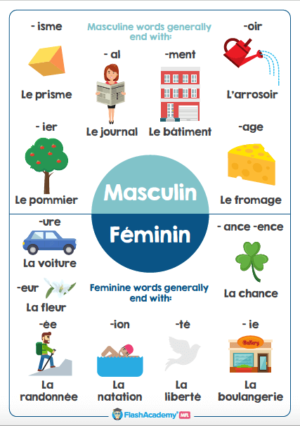
Here is a helpful infographic that summarizes some of the most common endings. You can use it as a quick reference.
Test your understanding!
Based on the endings you've just learned, try to guess the gender of the following nouns. Are they masculine or feminine?
le bâtiment(building)la situation(situation)le fromage(cheese)la voiture(car)une image(image)
Show answer
bâtimentends in -ment, which is typically masculine. Correct!situationends in -tion, which is typically feminine. Correct!fromageends in -age, which is typically masculine. Correct!voitureends in -ure, which is typically feminine. Correct!imageends in -age, but it's one of the common exceptions! It is feminine. This shows why it's important to be aware of exceptions.
3. Words That Change Meaning with Gender
Be aware that a few words in French, known as homonyms, are spelled the same but have different meanings depending on their gender. Confusing them can lead to misunderstandings.
For example, as explained in Guillaume's video (around 18:27):
le livreis masculine and means "the book".la livreis feminine and means "the pound" (a unit of weight or currency).
Here are a few other common examples:
le tour(the tour, the turn) vs.la tour(the tower)le mode(the method, the mode) vs.la mode(fashion)
You don't need to learn all of these now, but it's good to be aware that this can happen. Context will usually make the meaning clear.
Conclusion
Excellent work today! You've taken your first significant step into the world of French grammar.
Key takeaways from this lesson:
- Every noun in French is either masculine or feminine.
- The ending of a noun is a powerful clue to its gender.
- Common masculine endings include -age, -ment, -eau, -isme.
- Common feminine endings include -ion, -ure, -té, -ette, -ence.
- These are strong patterns, but there are always exceptions. When you learn a new noun, always learn its gender along with it.
You now have a method for making an educated guess about a noun's gender, which will be invaluable as we move forward.
In our next lesson, we will build directly on this knowledge. Now that we can identify a noun's gender, we'll learn how to use the correct definite articles (le, la, les)—the French words for "the". This will allow us to start naming specific objects and people correctly.
À très bientôt