Bonjour ! Welcome to your next lesson on building the foundations of French grammar.
In our last session, we learned how to identify the gender of French nouns by looking at their endings. You discovered that every noun is either masculine (masculin) or feminine (féminin), a crucial piece of information for building correct sentences.
Today, we will put that knowledge into action. This lesson focuses on using definite articles—the French equivalent of the word "the". Our goal is to learn how to choose and use le, la, l', and les correctly with any given noun. Mastering this is fundamental for speaking French clearly and professionally, which is essential for your goal of working in customer service.
1. The Four Forms of "The"
In English, we have one definite article: "the". In French, there are four, and the one you use depends on the gender (masculine/feminine) and number (singular/plural) of the noun it accompanies.
The four definite articles are:
- le (masculine singular)
- la (feminine singular)
- l' (masculine or feminine singular before a vowel or silent 'h')
- les (masculine or feminine plural)
To get a clear introduction to each of these, let's watch a video.
Practise your French DEFINITE ARTICLES - LE, LA, LES & L'
The video 'Practise your French DEFINITE ARTICLES' by Learn French With Alexa clearly explains how and when to use each of the four definite articles.
Watch the video from 00:31 to 04:09. Pay close attention to the examples Alexa gives for each article: le for masculine singular nouns (e.g., le stylo). la for feminine singular nouns (e.g., la table). l' for singular nouns starting with a vowel or silent 'h' (e.g., l'arbre, l'école). les for all plural nouns (e.g., les tables, les arbres).
Here is a quick summary of the rules in a visual format. It's a useful reference to have.
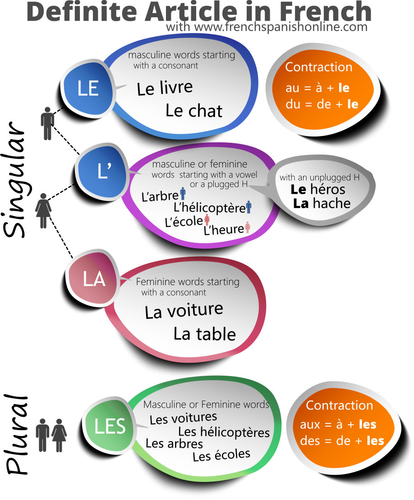
Key points to remember:
- You use
lebefore a masculine singular noun that starts with a consonant.- le client (the client, male)
- le livre (the book)
- You use
labefore a feminine singular noun that starts with a consonant.- la cliente (the client, female)
- la voiture (the car)
- You use
lesbefore any plural noun, regardless of its gender.- les clients (the clients)
- les voitures (the cars)
- You use
l'(this is called elision) before any singular noun (masculine or feminine) that starts with a vowel (a, e, i, o, u) or a silent 'h'.- l'ami (the friend, male) - from le ami
- l'école (the school, feminine) - from la école
- l'homme (the man) - from le homme
Test your understanding!
Let's combine what you learned in the last lesson with today's topic. Choose the correct definite article (le, la, l', or les) for each noun below. Think about the noun's ending to guess its gender first.
______ situation(situation)______ fromage(cheese)______ opinion(opinion)______ bâtiments(buildings)______ image(image)
Show answer
lasituation: The ending-tionis feminine.lefromage: The ending-ageis typically masculine.l'opinion: The ending-ionis feminine. Sinceopinionstarts with a vowel,labecomesl'.lesbâtiments: Thesat the end tells us it's plural, so we must useles. (bâtimentis masculine).l'image:imageis an exception to the-agerule and is feminine. Since it starts with a vowel,labecomesl'.
2. Practice with Pronunciation
Now that you understand the rules, let's practice applying them. The next part of the video you started watching is an interactive quiz. Try to say the answer out loud before Alexa does. This will help you practice both the grammar and your pronunciation.
Practise your French DEFINITE ARTICLES - LE, LA, LES & L'
Let's continue with the video 'Practise your French DEFINITE ARTICLES' to test your knowledge in a quiz format.
Watch the quiz section from 07:22 to 12:00. For each word shown on screen, pause the video and say which article you think is correct. Then, play the video to hear the right answer and pronunciation.
3. When to Use Definite Articles in French
One of the trickiest parts of articles is that French uses them in many situations where English does not. Besides talking about a specific item ("the book on the table"), French also uses definite articles to talk about things in a general sense.
For a detailed explanation, let's turn to another resource.
Le La Les (L') - French Definite Articles // French Grammar Course // Lesson 6 🇫🇷
The video 'Le La Les (L') - French Definite Articles' by The perfect French with Dylane explains the specific contexts where French requires a definite article, unlike English.
Watch the section from 02:09 to 07:40. Focus on the main categories where definite articles are used differently: Abstract nouns: l'amour (love), la science (science). General concepts: J'aime le café. (I like coffee in general). Languages and school subjects: J'apprends le français. (I am learning French). Countries and continents: la France, l'Afrique. Days of the week (for habits): le lundi (on Mondays). Parts of the body: J'ai mal à la tête. (I have a headache, literally 'I have pain to the head').
This last point is very important. In French, you rarely use possessive adjectives (my, your) with body parts. Instead, you use a definite article.
- English: I wash my hands.
- French: Je me lave les mains. (Literally: I wash myself the hands.)
The website associated with the video provides a good written summary of these rules. You can refer to it if you prefer reading.
French Definite Articles: Le - La - Les - L'
To review the rules on when to use definite articles, you can read the article 'French Definite Articles: Le - La - Les - L'' from The perfect French.
Scroll to the section 'When to Use the French Definite Articles?'. Review the bullet points and examples for using articles with abstract nouns, languages, countries, dates, and parts of the body.
Conclusion
Great job today! You've learned one of the most essential building blocks of French grammar. Correctly using le, la, l', and les will make your French sound much more accurate and natural.
Here are your key takeaways:
- French has four definite articles:
le(masculine singular),la(feminine singular),l'(singular before a vowel/silent 'h'), andles(plural). - The choice of article depends on the gender and number of the noun. This is why the previous lesson was so important.
- Elision (
l') happens whenleorlacomes before a word starting with a vowel or silenth. - French uses definite articles more often than English, especially when talking about things in a general sense (
J'aime le chocolat), expressing likes and dislikes, and referring to parts of the body.
In our next lesson, we will continue our study of articles by looking at indefinite articles: un, une, and des. These are the French words for "a," "an," and "some." You'll see how they compare and contrast with the definite articles you learned today.
À bientôt