Bonjour !
In our last lesson, you mastered the conjugation patterns for regular -ir and -re verbs. This was a big step in expanding your vocabulary. However, as in many languages, some of the most common and important verbs in French don't follow the rules. They are "irregular."
Today's lesson focuses on four of these essential irregular verbs. Our goal is to conjugate the essential irregular verbs: aller (to go), faire (to do/make), pouvoir (to be able to/can), and vouloir (to want) in the present tense. Mastering these verbs is non-negotiable for speaking French, as they appear constantly in everyday conversation and are fundamental to expressing plans, actions, abilities, and desires.
What Makes a Verb "Irregular"?
As a quick recap, regular verbs follow a predictable pattern. You remove the infinitive ending (-er, -ir, -re) and add a standard set of endings. Irregular verbs, on the other hand, break these patterns. Their stems might change, their endings can be unique, or both. The only way to learn them is through practice and memorization. Let's start with two verbs you'll use all the time to talk about activities.
1. Aller (to go) and Faire (to do/make)
These two verbs are crucial for talking about where you are going and what you are doing.
Let's start by listening to their conjugations and seeing them in a short dialogue.
This video from 'Atelier du Français' will first show you a conversation using 'aller' and 'faire', and then it will present their conjugations clearly.
First, watch the dialogue from 00:05 to 01:23 to see how the verbs are used naturally. Then, pay close attention from 01:23 to 01:51 where the conjugations are listed one by one. Try to repeat the words aloud.
Here are those conjugations written down for you. Notice how different they are from the regular verbs you've learned.
Conjugation of Aller (to go)
| Subject Pronoun | Conjugation | English |
|---|---|---|
je |
vais | I go / I am going |
tu |
vas | you go / you are going |
il/elle/on |
va | he/she/one goes |
nous |
allons | we go / we are going |
vous |
allez | you go / you are going |
ils/elles |
vont | they go / they are going |
Notice that the nous and vous forms look a bit like a regular -er verb, but the singular forms (je, tu, il) and the ils/elles form are completely different.
Conjugation of Faire (to do/make)
| Subject Pronoun | Conjugation | English |
|---|---|---|
je |
fais | I do / I am doing |
tu |
fais | you do / you are doing |
il/elle/on |
fait | he/she/one does |
nous |
faisons | we do / we are doing |
vous |
faites | you do / you are doing |
ils/elles |
font | they do / they are doing |
The verb faire is extremely versatile. You use it for hobbies (faire du sport - to play sports), chores (faire le ménage - to do the housework), and even the weather (il fait beau - the weather is nice).
Test your understanding!
You want to tell a friend that you are going to the cinema. Which of these is correct?
J'alle au cinéma.Je vais au cinéma.Je va au cinéma.
Show answer
The correct answer is 2. Je vais au cinéma.. The conjugation of aller for je is vais.
2. Pouvoir (to be able to/can) and Vouloir (to want)
These two verbs are often called "modal verbs" because they are typically used with another verb in its infinitive form to express ability or desire. For example, "I want to learn" (Je veux apprendre). They are essential for making requests and talking about possibilities, which will be very important for your customer service role.
Let's watch a video to learn their conjugations.
les verbes pouvoir, vouloir et devoir
This next video, also from 'Atelier du Français', presents the conjugations for 'pouvoir' and 'vouloir'. It also introduces 'devoir' (to have to), which we will focus on in the next lesson.
Watch the section from 01:24 to 01:40 for the verb 'vouloir', and then the section from 01:11 to 01:24 for the verb 'pouvoir'. Notice the similar sounds in their singular forms.
(Note: I've asked you to watch vouloir first to match the order below).
Here are the tables for pouloir and vouloir.
Conjugation of Vouloir (to want)
| Subject Pronoun | Conjugation | English |
|---|---|---|
je |
veux | I want |
tu |
veux | you want |
il/elle/on |
veut | he/she/one wants |
nous |
voulons | we want |
vous |
voulez | you want |
ils/elles |
veulent | they want |
Conjugation of Pouvoir (to be able to/can)
| Subject Pronoun | Conjugation | English |
|---|---|---|
je |
peux | I can |
tu |
peux | you can |
il/elle/on |
peut | he/she/one can |
nous |
pouvons | we can |
vous |
pouvez | you can |
ils/elles |
peuvent | they can |
Pronunciation Tip: For both verbs, the singular forms (je, tu, il) sound very similar (the final 'x' and 't' are silent). The plural forms (nous, vous, ils/elles) have a different stem sound. Listen to them again in the video to catch the difference.
Test your understanding!
A customer asks if you can help them. How would you say "We can help you"? (vous aider)
Nous pouvons vous aider.Nous pouvons vous aidez.Nous pouvent vous aider.
Show answer
The correct answer is 1. Nous pouvons vous aider.. The conjugation of pouvoir for nous is pouvons. The verb that follows a modal verb like pouvoir remains in the infinitive (aider).
Summary and Reference
You have just learned four of the most fundamental verbs in the French language! Because they are irregular, the best approach is to practice them until they become second nature.
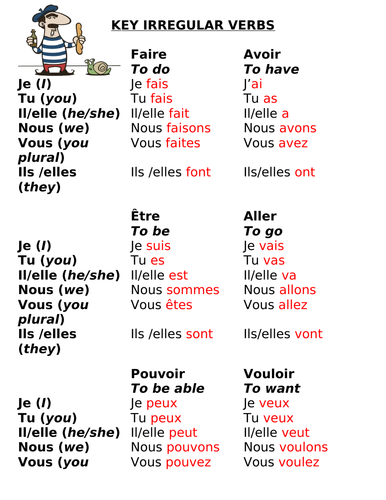
This image provides an excellent summary chart of today's verbs, plus the two other essential irregulars, être and avoir, which you already know. It's a great tool to save for quick reference.
For another clear, consolidated view of these verbs in a simple table, this resource is excellent.
French Irregular Verbs: List, Rules & Conjugations
The Promova grammar guide offers a fantastic table that lists the top 10 most common irregular verbs. It's a great way to review today's verbs and see them alongside others.
Please read the table under the heading 'The Most Common French Irregular Verbs'. Focus on the rows for 'Aller', 'Faire', 'Pouvoir', and 'Vouloir'. Notice the example sentences, which show the verbs in context.
Conclusion
Excellent work today! It can be challenging to learn verbs that don't follow rules, but you have just tackled four of the most important ones.
Key Takeaways:
- Irregular verbs must be memorized as they don't follow standard conjugation patterns.
Aller(to go) andFaire(to do/make) are used to talk about movement and activities.Pouvoir(to be able to/can) andVouloir(to want) are modal verbs used to express ability and desire, usually followed by an infinitive.- Their conjugations are unique:
aller:je vais, tu vas, il va, nous allons, vous allez, ils vontfaire:je fais, tu fais, il fait, nous faisons, vous faites, ils fontpouvoir:je peux, tu peux, il peut, nous pouvons, vous pouvez, ils peuventvouloir:je veux, tu veux, il veut, nous voulons, vous voulez, ils veulent
In our next lesson, we will build directly on what you've learned today. We'll explore how to use pouvoir and vouloir in more detail, and we'll add the verb devoir (must/to have to), to properly express ability, desire, and obligation.
Continue to practice these conjugations. À bientôt