Bonjour !
In our last few lessons, we've built a solid foundation. You've learned to introduce yourself, use essential verbs like être and avoir, and conjugate regular -er verbs. Most recently, you mastered counting up to 100, a critical skill for your goal of working in a call center.
Today, we will significantly expand your ability to describe actions by tackling the other two groups of regular verbs. The learning outcome for this lesson is to conjugate regular -ir and -re verbs in the present tense. By mastering these patterns, you'll be able to use a much wider range of verbs to form sentences.
A Quick Recap: How Verbs Work in French
Remember from our lesson on -er verbs, French verbs have an infinitive form (the basic, unconjugated verb, like parler - to speak). To use it in a sentence, we conjugate it:
- We identify the stem (or root) by removing the infinitive ending (
-er,-ir, or-re). - We add a new ending that matches the subject pronoun (
je,tu,nous, etc.).
You already know the pattern for -er verbs. Let's learn the next two.
1. Regular -ir Verbs (The 2nd Group)
The second major group of regular verbs are those ending in -ir. They follow a very consistent pattern.
A great way to start is by watching a quick explanation.
HOW TO CONJUGATE REGULAR FRENCH VERBS IN THE PRESENT TENSE // Conjugate the Present Tense in French
This video from the channel 'Bla Bla Kaity' clearly demonstrates the conjugation pattern for regular '-ir' verbs. Pay close attention to how the stem is found and what endings are added for each subject pronoun.
Watch the segment from 04:53 to 07:07. The example used is 'finir' (to finish).
As the video explained, the process is straightforward. You remove the -ir to find the stem and add the following endings:
| Subject Pronoun | Ending | Example: finir (to finish) |
Pronunciation Note |
|---|---|---|---|
je |
-is | je finis |
The 's' is silent |
tu |
-is | tu finis |
The 's' is silent |
il/elle/on |
-it | il/elle/on finit |
The 't' is silent |
nous |
-issons | nous finissons |
Pronounce the "-iss-" sound |
vous |
-issez | vous finissez |
Pronounce the "-iss-" sound |
ils/elles |
-issent | ils/elles finissent |
Pronounce the "-iss-" sound |
An Important Clue: The "-iss-" Sound
A key characteristic of these regular -ir verbs is the -iss- part that appears in the plural forms (nous, vous, ils/elles). This sound is your signal that you're dealing with a regular "2nd group" verb.
However, it's important to know that not all verbs ending in -ir are regular. Many common ones (like partir - to leave, or dormir - to sleep) are irregular and follow different patterns. We will cover those later. For now, focus on this regular pattern.
This next video explains this distinction and gives more examples.
Group 2 Regular French Verbs ending in "IR" (Present Tense)
The channel 'Learn French With Alexa' provides excellent insight into this topic. This clip explains why the '-iss-' sound is so important and warns you about irregular '-ir' verbs.
Watch two short clips: From 01:46 to 03:14 to hear the conjugation of 'finir' and the emphasis on the '-iss-' sound. From 04:43 to 05:52, which explains that you must be careful, as some '-ir' verbs are irregular.
Common regular -ir verbs include:
finir(to finish)choisir(to choose)réussir(to succeed)grandir(to grow)grossir(to gain weight)rougir(to blush)
Test your understanding!
Conjugate the verb choisir (to choose) for the subject nous.
nous choisitnous choisonsnous choisissons
Show answer
The correct answer is 3. nous choisissons. For nous, we remove the -ir and add the ending -issons.
2. Regular -re Verbs (The 3rd Group)
The last group of regular verbs are those ending in -re. This group is smaller, but includes very useful verbs.
Let's see the pattern in action.
HOW TO CONJUGATE REGULAR FRENCH VERBS IN THE PRESENT TENSE // Conjugate the Present Tense in French
Let's return to the 'Bla Bla Kaity' video to learn the pattern for regular '-re' verbs. The logic is the same: remove the ending, add the new one.
Watch from 07:07 to 08:30. The example used is 'descendre' (to go down).
To conjugate a regular -re verb, you remove the -re ending and add the following:
| Subject Pronoun | Ending | Example: vendre (to sell) |
Pronunciation Note |
|---|---|---|---|
je |
-s | je vends |
The 's' is silent |
tu |
-s | tu vends |
The 's' is silent |
il/elle/on |
(no ending) | il/elle/on vend |
Just the stem |
nous |
-ons | nous vendons |
Pronounce the ending |
vous |
-ez | vous vendez |
Pronounce the ending |
ils/elles |
-ent | ils/elles vendent |
The '-ent' is silent |
This image provides a great visual summary with other common -re verbs like attendre (to wait) and répondre (to answer)—verbs you will definitely use!

Test your understanding!
How do you say "He waits" in French, using the verb attendre?
Il attendeIl attendsIl attend
Show answer
The correct answer is 3. Il attend. For il/elle/on, you remove the -re from the infinitive and add no ending.
Summary: All Three Regular Verb Groups
You now know the rules for all three groups of regular verbs in the present tense! This is a huge step. This table provides a side-by-side comparison which is very useful for memorization.
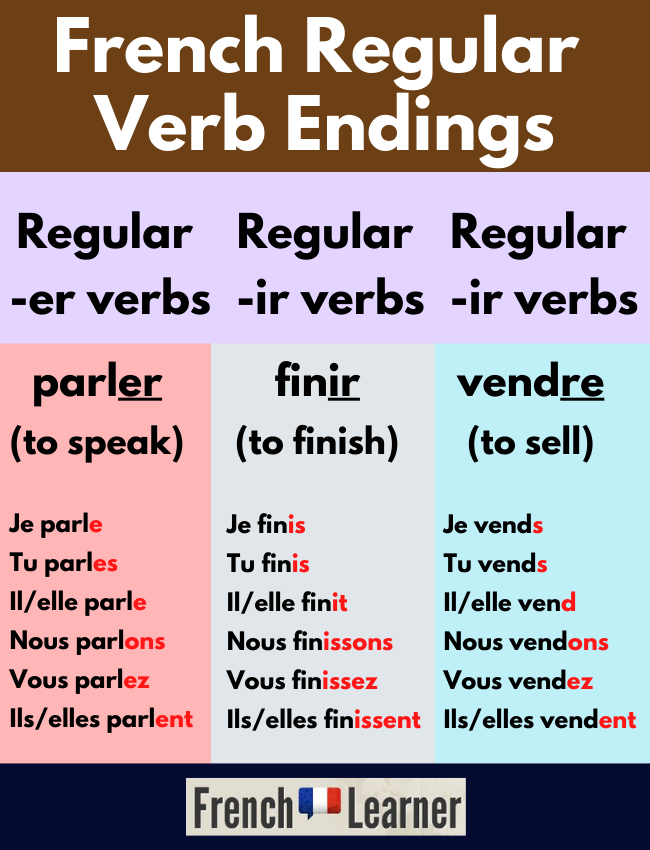
Take a moment to study this chart. See the similarities (like -ons for nous and -ez for vous in all groups) and the key differences (especially in the singular forms).
Conclusion
Congratulations on completing this important grammar lesson! You have now unlocked the ability to use hundreds of French verbs correctly.
Key Takeaways:
- Regular
-irverbs: Remove-irand add-is, -is, -it, -issons, -issez, -issent. The-iss-in plural forms is a key identifier. - Regular
-reverbs: Remove-reand add-s, -s, (nothing), -ons, -ez, -ent. - Mastering these patterns is fundamental, as they apply to a large number of verbs.
In our next lesson, we will begin to look at verbs that don't follow these patterns. We'll start with four of the most essential irregular verbs: aller (to go), faire (to do/make), pouvoir (to be able to), and vouloir (to want). They are crucial for everyday conversation.
À bientôt