Welcome to your first lesson in the fascinating world of neuroscience. Your goal is to gain a deep, foundational understanding of the brain, from its smallest components to the complex behaviors it generates. To get there, we must start with the absolute basics—the fundamental principles of chemistry and biology that govern everything in the nervous system.
This lesson will introduce the essential vocabulary needed to understand how neurons function. We will define what atoms, molecules, and ions are, and explore the fundamental concept of electrical charge. While this might seem far removed from topics like memory or perception, these tiny particles are the primary actors in the story of the brain. The electrical signals that underpin all thought and action are, at their core, the controlled movement of charged particles. By the end of this lesson, you will have a solid grasp of these building blocks, preparing you for our next topic: the structure of the cell.
The Building Blocks of Matter: Atoms
Everything in the universe, including our brains and bodies, is made of matter. The smallest unit of matter that retains the properties of an element is called an atom. To understand how the brain works at a chemical level, we first need to understand the structure of an atom.
Let's begin by watching a short video that provides a clear overview of what atoms are and what they're made of.
This video from The Organic Chemistry Tutor, titled "Atoms - Basic Introduction," offers a great starting point.
Please watch the first three minutes and seventeen seconds of the video. Focus on these key points: The definition of atoms as the basic building blocks of matter. The three subatomic particles that make up an atom: protons, neutrons, and electrons, and their respective locations and electrical charges. Pay close attention to the idea of electrostatic attraction between positive protons and negative electrons.
As the video explained, an atom has two main regions:
- The Nucleus: The dense, central core containing positively charged protons and uncharged neutrons.
- The Electron Cloud: The region surrounding the nucleus, which contains negatively charged electrons that orbit the nucleus at incredible speeds.
The vast majority of an atom's mass is concentrated in its tiny nucleus, since protons and neutrons are much more massive than electrons.
The Origin of Electrical Charge
The concept of electrical charge is perhaps the single most important idea in this introductory lesson.
- Protons have a positive electrical charge, which we denote as .
- Electrons have a negative electrical charge, which we denote as .
- Neutrons have no charge; they are neutral.
In a standard, neutral atom, the number of protons is equal to the number of electrons. The positive charges of the protons perfectly balance the negative charges of the electrons, resulting in a net electrical charge of zero. This balance is the default state for an atom. The fundamental law of electrostatics, "opposites attract, likes repel," is what holds the atom together: the positively charged nucleus attracts the negatively charged electrons, keeping them in orbit.
For a more formal definition of these particles and their properties, let's turn to a written resource.
[PDF] Chapter 1: Atoms, Molecules and Ions
This PDF provides a concise, textbook-style summary of the atom and its components.
Please read the first part of the chapter. Start from the beginning and focus on the section describing subatomic particles. You will find clear definitions for electrons, protons, and neutrons, including their symbols, locations, and charges. Note the final point that the charge of an electron is equal in magnitude but opposite in sign to that of a proton.
From Atoms to Molecules
Atoms rarely exist in isolation. They tend to interact and bond with other atoms to form more complex structures called molecules. A molecule consists of two or more atoms held together by chemical bonds.
For example, a molecule of water, written as H₂O, is formed when one oxygen atom bonds with two hydrogen atoms. Like the individual atoms they are made from, molecules are also electrically neutral overall.

The bonds that hold atoms together in a molecule involve the sharing of electrons. This sharing creates a stable arrangement that keeps the atoms linked.
Molecules and compounds overview | Atomic structure (article) | Khan Academy
This article from Khan Academy clearly explains how atoms combine to form molecules.
Please read the first part of the article, from the beginning down to the section titled "Ions and ion formation". Pay attention to the definition of a compound and the explanation of covalent bonds, where atoms share electrons to form a molecule.
Charged Atoms: The All-Important Ions
Now we arrive at the concept most critical for neuroscience: the ion.
While atoms and molecules are typically neutral, they can gain or lose electrons. When an atom gains or loses one or more electrons, the balance between protons and electrons is disrupted, and the atom becomes a charged particle called an ion.
- An atom that loses one or more electrons will have more protons than electrons. This results in a net positive charge. A positively charged ion is called a cation.
- An atom that gains one or more electrons will have more electrons than protons. This results in a net negative charge. A negatively charged ion is called an anion.
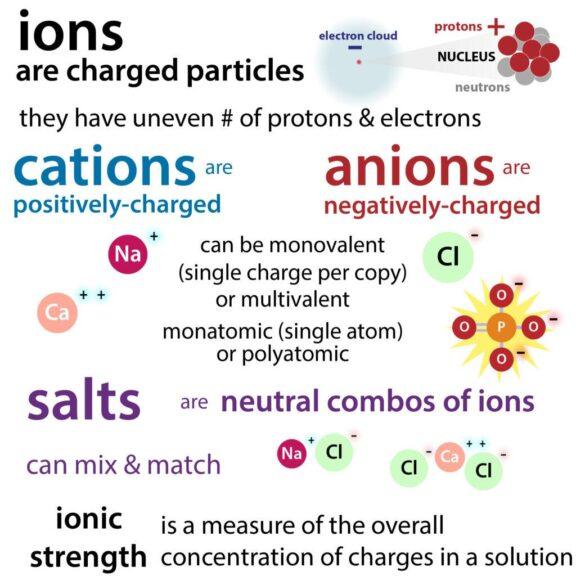
This process of forming ions is not random. Atoms tend to gain or lose electrons to achieve a more stable configuration. Let's watch a video that explains this motivation.
Atoms, Elements, and Ions | Biochemistry
This video, "Atoms, Elements, and Ions," explains why certain atoms tend to form ions.
Watch the segment from "what is an ion?". The speaker explains that many atoms "want" to be like the stable noble gases on the periodic table. To do this, they either lose or gain electrons, becoming ions in the process. This provides a great intuition for why ions like sodium (Na⁺) and chloride (Cl⁻) are so common.
The movement of ions like sodium (Na⁺), potassium (K⁺), calcium (Ca²⁺), and chloride (Cl⁻) across the membrane of a neuron is what generates electrical signals. The charge of the ion is everything!
To solidify your understanding of how cations and anions are formed, let's return to the Khan Academy article.
Molecules and compounds overview | Atomic structure (article) | Khan Academy
This part of the article provides excellent, clear diagrams illustrating ion formation.
Please read the section titled "Ions and ion formation". Study the examples of how a neutral sodium atom becomes a positive sodium cation (Na⁺) by losing an electron, and how a neutral chlorine atom becomes a negative chloride anion (Cl⁻) by gaining one.
Conclusion
In this introductory lesson, we have established the fundamental chemical principles that form the bedrock of neuroscience. You have learned that all matter is composed of atoms, which are themselves made of protons, neutrons, and electrons. We've defined electrical charge and seen how an imbalance of protons and electrons leads to the formation of ions—the charged particles that are the heroes of our story.
Here are the key takeaways:
- Atoms are the neutral, fundamental building blocks of matter, containing an equal number of positive protons and negative electrons.
- Molecules are neutral structures formed when two or more atoms bond together by sharing electrons.
- Ions are atoms (or molecules) that have a net electrical charge because they have gained or lost electrons.
- Cations are positively charged (lost electrons).
- Anions are negatively charged (gained electrons).
- Electrical charge is the physical property that causes these particles to interact and is the ultimate source of all electrical phenomena in the brain.
With this essential vocabulary in place, we are ready to move up one level in biological organization. In the next lesson, we will explore the basic components of an animal cell. We'll see how the cell creates a distinct environment where the chemical dance of ions can be carefully controlled, setting the stage for the unique functions of a neuron.