Hello! Welcome back to our module on Essential Concurrency Patterns.
In the previous lesson, we explored unbuffered channels and saw how they provide a powerful mechanism for both communication and synchronization. The "rendezvous" point, where a sender and receiver must meet for data to be exchanged, is perfect for tight coordination.
However, in many real-world systems, especially in DevOps automation and data processing, producers and consumers don't work at the same speed. A monitoring agent might generate metrics in bursts, while the component that writes them to a database does so at a steady pace. Forcing them to synchronize for every single data point would create a bottleneck.
This lesson introduces buffered channels, which solve this exact problem. You'll learn how to use them to implement the producer-consumer pattern effectively, creating resilient data pipelines that can handle varying loads. This is a fundamental pattern for building many kinds of automation tools, from log processors to parallel task schedulers.
1. What Are Buffered Channels?
While an unbuffered channel can be thought of as a direct handoff, a buffered channel is like a conveyor belt or a queue with a fixed capacity.
You create a buffered channel by providing a second argument to make:
// Creates a channel that can hold up to 10 strings without blocking the sender.
ch := make(chan string, 10)
The behavior of send and receive operations changes:
- Send (
ch <- value): Blocks only when the buffer is full. If there's space, the sender drops the value into the buffer and continues immediately. - Receive (
<-ch): Blocks only when the buffer is empty. If there are items in the buffer, the receiver takes one and continues.
This decoupling is crucial for performance. It allows the producer to "get ahead" of the consumer, smoothing out bursts of activity.
The following video and diagram provide a clear illustration of this concept.
#24 Golang - Concurrency: Unbuffered vs Buffered Channels
This short clip from codeHeim's channel explains the core concept of a buffered channel and its blocking behavior.
Watch from 01:21 to 02:15. Focus on the visualization of the queue and the conditions under which the send and receive operations block.
This diagram visualizes a sender goroutine filling a buffer and blocking only when it becomes full.
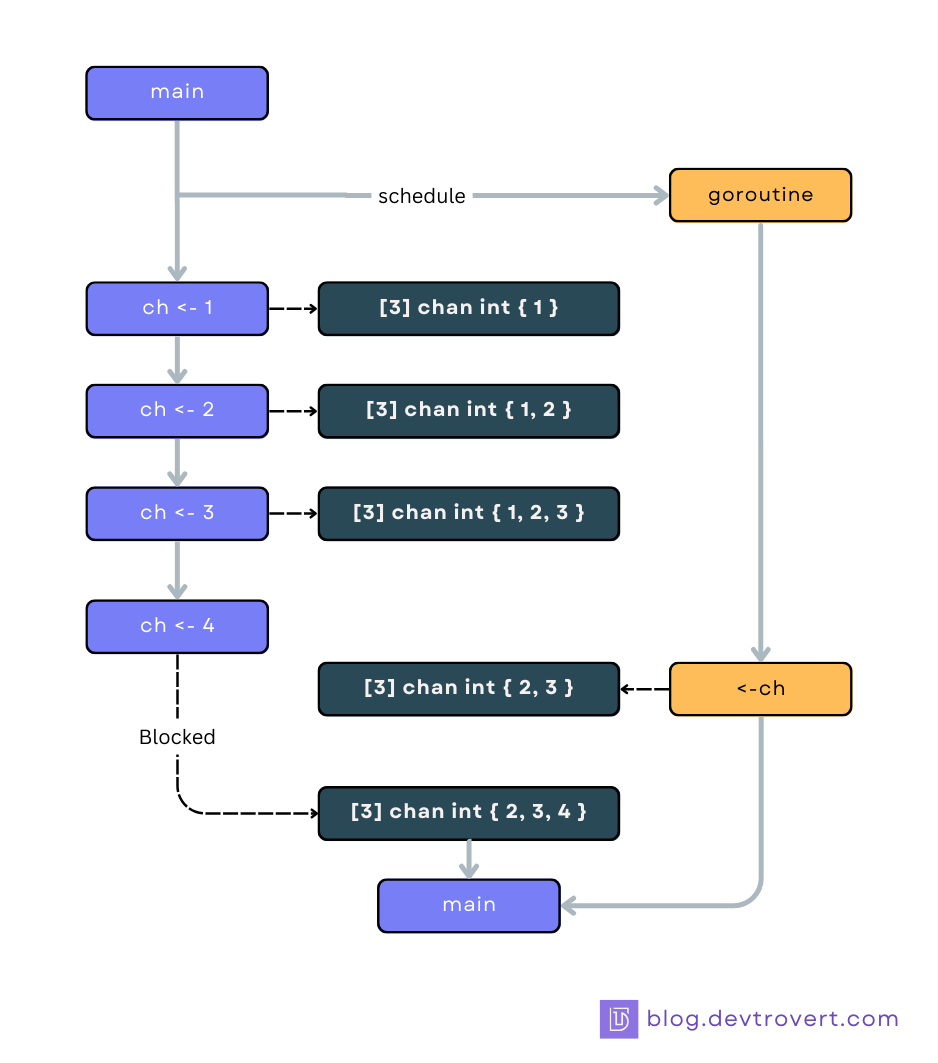
2. The Producer-Consumer Pattern with a Buffer
The producer-consumer pattern is a classic concurrency design. In the context of your work, imagine a script that tails a log file (the producer) and sends new lines to a processing function (the consumer) that forwards them to an observability platform.
Using a buffered channel here provides two key benefits:
- Burst Handling: If your application suddenly logs 100 lines in a millisecond, the producer can quickly put them all into the buffer without waiting for the consumer to make 100 individual network calls.
- Efficiency: The consumer can process logs at its own pace, perhaps even in batches, without slowing down the producer.
The article "Producer-Consumer in Go: Beyond the Basics" by Corentin GS provides an excellent, practical example of a log processing system.
Producer-Consumer in Go: Beyond the Basics
This article demonstrates a real-world application of the producer-consumer pattern using a buffered channel to handle a stream of log data.
Read the sections "Buffered Channels: A Game Changer", "Real-World Example: Log Processing System", and "Understanding the Benefits". Pay close attention to how the buffered channel decouples the logProducer from the logConsumer and enables batch processing.
As the article highlights, this pattern allows you to independently tune the buffer size (for handling bursts) and the batch size (for processing efficiency), which is a common requirement in performance-sensitive tools.
Test your understanding!
In the log processing example from the article, the channel buffer size is 5. What would happen if the producer tried to send 10 logs very quickly, and the consumer was slow to process them (e.g., due to a slow network)?
Show answer
The producer would successfully send the first 5 logs to the channel's buffer without blocking. When it attempts to send the 6th log, it would block because the buffer is full. It would remain blocked until the consumer receives at least one log from the channel, making space available in the buffer. The system would still work correctly, but the producer's execution would be throttled by the consumer's pace once the buffer is full.
3. Scaling the Pattern: The Worker Pool
The producer-consumer pattern isn't limited to a single producer and a single consumer. A powerful extension is the worker pool, where you have one producer and a fixed number of identical consumer goroutines (workers) running in parallel.
This is extremely useful for tasks like:
- Making concurrent API calls to different services.
- Processing multiple files from a directory.
- Running a set of infrastructure checks in parallel.
You create a buffered channel for the jobs, a producer to fill the channel with tasks, and then you start a fixed number of worker goroutines that all receive from that same channel. The buffered channel not only decouples the work but also naturally distributes it among the available workers.
The following video provides a complete walkthrough of building a robust worker pool in Go. This is a pattern you will likely implement many times when building your own DevOps tools.
#18 Golang - Building an Efficient Worker Pool: Mastering Concurrency in Go
This video from codeHeim demonstrates how to build a worker pool from scratch. It's a perfect example of a one-producer, many-consumer pattern.
Watch the entire video from 01:09 to 09:13. It's a comprehensive walkthrough, but focus on these key ideas: The Components (01:09 - 03:27): Understand the workerPool struct, especially the tasksChan (a buffered channel) and the sync.WaitGroup. The Worker (03:27 - 04:18): Notice how each worker is a goroutine running a loop that receives tasks from the tasksChan. Running the Pool (04:18 - 07:17): See how the run method starts the workers, sends all tasks to the channel, closes it, and then waits for the WaitGroup. Making it Generic (07:17 - 09:13): The final part shows how to use an interface for the Task. This is a fantastic technique that makes your worker pool reusable for different kinds of jobs.
The worker pool is a powerful application of the producer-consumer pattern that gives you fine-grained control over the degree of concurrency in your applications.
4. Practical Considerations: Choosing a Buffer Size
A common question is: "What size should my buffer be?". There is no single correct answer; it's a design trade-off.
- Small Buffer (e.g., 1): Provides minimal decoupling. It's useful if you want to prevent the producer from getting too far ahead of the consumer but still want to avoid the strict lockstep of an unbuffered channel.
- Large Buffer (e.g., 1000): Excellent for absorbing large, sudden bursts of work. The producer can offload a lot of data quickly and move on. The trade-off is higher memory consumption. A very large buffer can also hide underlying problems, like a stuck or slow consumer, because the producer won't block for a long time.
As a general rule, start with a modest buffer size (e.g., a few times your number of workers) and observe your system's behavior. In Go, you can check the current number of items in a buffer with len(ch) and its total capacity with cap(ch). Monitoring these values can give you insight into whether your buffer is appropriately sized for your workload.
Conclusion
You have now extended your concurrency toolkit with buffered channels, enabling you to build more flexible and efficient concurrent systems. By decoupling the sender and receiver, you can create data pipelines that smooth out irregular workloads and improve overall throughput.
Key Takeaways:
- Buffered channels have a capacity and act as a FIFO queue, decoupling producers and consumers.
- A sender blocks only when the buffer is full; a receiver blocks only when it's empty.
- This decoupling is key to the producer-consumer pattern, which helps handle bursts of work and balances disparate processing speeds.
- A common and powerful extension of this pattern is the worker pool (one producer, multiple consumers), which is ideal for parallelizing tasks.
- Choosing a buffer size is a design decision that balances memory usage against the need for decoupling.
Next Up
So far, our goroutines have listened to a single channel. But what if a worker needs to listen for new jobs on one channel, but also listen for a shutdown signal on another? The select statement provides a way for a goroutine to wait on multiple channel operations simultaneously. In the next lesson, we will dive into select to build even more responsive and controllable concurrent programs.