Hello! Welcome to the final lesson in our module on building HTTP services in Go.
In our last session, we built a server capable of serving static files and handling file uploads. However, our server has a critical weakness: if it receives a termination signal (like when you press Ctrl+C or when a container orchestrator like Kubernetes stops a pod), it shuts down immediately. This abrupt exit can drop active connections, corrupt in-progress file uploads, and leave the system in an inconsistent state.
Today, we'll fix that by implementing a graceful shutdown. This is a non-negotiable feature for any production-grade service, ensuring reliability and data integrity during restarts and deployments. Your experience in DevOps has likely shown you the importance of services that can shut down cleanly without losing data or failing requests.
By the end of this lesson, you will be able to implement a graceful shutdown for an HTTP server that stops accepting new connections but allows existing ones to finish, all within a configurable time limit.
1. The Problem: Blocking Server and Abrupt Shutdowns
Let's revisit the end of our main function from the previous lesson:
func main() {
    // ... setup mux ...

    log.Println("Starting server on :8080...")
    if err := http.ListenAndServe(":8080", mux); err != nil {
        log.Fatalf("Could not start server: %s\n", err)
    }
    // Any code here is unreachable!
}
The function http.ListenAndServe is a blocking call. It starts the server and blocks the execution of the main goroutine until the server crashes or is killed. When you press Ctrl+C, the operating system sends a SIGINT (interrupt signal), and the Go runtime terminates the program immediately, giving our active handlers no time to finish.
2. The Solution: A Graceful Shutdown Sequence
To shut down gracefully, we need to change our program's structure to follow this sequence:
- Start the HTTP server in a separate goroutine so it doesn't block the main flow.
- In the main goroutine, listen for OS termination signals (
SIGINT,SIGTERM). - When a signal is received, tell the server to stop accepting new requests.
- Wait for all in-flight requests to complete.
- If requests don't finish within a certain timeout, force the server to shut down to avoid hanging indefinitely.
- Clean up any other resources (like database connections) and exit.
Let's see how to implement this pattern.
3. Implementing the Graceful Shutdown Logic
The net/http package provides the server.Shutdown() method, which is the cornerstone of this process. It gracefully shuts down the server without interrupting any active connections.
The video below provides an excellent, detailed walkthrough of building a robust runServer function that encapsulates this logic. It covers starting the server in a goroutine, listening for signals, and managing timeouts.
Graceful Shutdown in Go: Key Patterns you need to know!
Watch this segment from the video 'Graceful Shutdown in Go' by Flo Woelki. It explains how to structure your code to manage the server's lifecycle and implement the complete shutdown mechanism.
Watch the section from 04:32 to 15:05. Pay close attention to these key elements: Starting the server in a goroutine so the main thread isn't blocked. Using a channel to capture errors from the server goroutine. Using os.Signal and signal.Notify to listen for os.Interrupt (from Ctrl+C) and syscall.SIGTERM (from Docker/Kubernetes). Using a select statement to wait for either a server error or a shutdown signal. Calling server.Shutdown() with a context.WithTimeout to enforce a deadline.
Let's break down the core components from the video.
Listening for OS Signals
As a DevOps engineer, you know that services are stopped by signals. Ctrl+C sends SIGINT, while orchestration tools like Docker and Kubernetes typically send SIGTERM. Our application needs to listen for both.
Go's os/signal package allows us to do this. While the video uses a manual channel, a more modern and idiomatic approach since Go 1.16 is signal.NotifyContext.
// Create a context that is canceled when a SIGINT or SIGTERM is received.
ctx, stop := signal.NotifyContext(context.Background(), syscall.SIGINT, syscall.SIGTERM)
defer stop() // When main returns, stop listening for signals.
This creates a context ctx. Its Done() channel will be closed when either of the specified signals arrives. We can then block our main goroutine until that happens:
// Wait for the shutdown signal.
<-ctx.Done()

// The signal has been received. Restore default behavior for subsequent signals.
stop()
log.Println("Shutdown signal received")
Calling server.Shutdown with a Timeout
Once the signal is received, we trigger the shutdown. It's crucial to provide a timeout to prevent the application from hanging forever if a request is stuck.
// Create a new context with a timeout for the shutdown process.
// This gives active requests 5 seconds to complete.
shutdownCtx, cancel := context.WithTimeout(context.Background(), 5*time.Second)
defer cancel()

// Ask the server to shut down gracefully.
if err := server.Shutdown(shutdownCtx); err != nil {
    // If Shutdown fails (e.g., timeout exceeded), log the error.
    log.Fatalf("Server shutdown failed: %+v", err)
}
log.Println("Server exited gracefully")
If server.Shutdown returns because the timeout was exceeded, the error will be context.DeadlineExceeded. This tells you that some connections were cut off.
Test your understanding!
Imagine your Kubernetes pod has a terminationGracePeriodSeconds of 30 seconds. What is a reasonable value for the server.Shutdown timeout, and why is it important that this timeout is less than the grace period?
Show answer
A reasonable timeout would be something like 25 seconds.
It's critical that the shutdown timeout is less than Kubernetes's terminationGracePeriodSeconds. When Kubernetes decides to terminate a pod, it sends SIGTERM and starts a countdown (the grace period). If the application doesn't exit on its own within that time, Kubernetes sends a non-catchable SIGKILL signal, which immediately terminates the process.
By setting our application's shutdown timeout to be shorter than the grace period, we give it a chance to finish its graceful shutdown, log any messages, and exit cleanly before the SIGKILL hammer falls. If we set it to 30 seconds or more, we risk being forcefully killed mid-shutdown.
4. Putting It All Together: A Complete Example
Let's refactor the main function from our previous lesson to include this graceful shutdown logic.
package main

import (
	"context"
	"log"
	"net/http"
	"os"
	"os/signal"
	"syscall"
	"time"
	// ... other imports from previous lesson
)

// ... APIError, AppHandler, and other handlers from previous lesson ...

func main() {
	// Create a context that is canceled when a SIGINT or SIGTERM is received.
	ctx, stop := signal.NotifyContext(context.Background(), syscall.SIGINT, syscall.SIGTERM)
	defer stop()

	mux := http.NewServeMux()
	mux.Handle("/", http.FileServer(http.Dir("./public")))
	mux.Handle("/upload", AppHandler(uploadFileHandler))

	server := &http.Server{
		Addr:    ":8080",
		Handler: mux,
	}

	// Start the server in a separate goroutine.
	go func() {
		log.Println("Starting server on http://localhost:8080")
		if err := server.ListenAndServe(); err != nil && err != http.ErrServerClosed {
			log.Fatalf("Could not start server: %s\n", err)
		}
	}()

	// Wait for the shutdown signal.
	<-ctx.Done()

	// The signal has been received, so stop listening for more signals.
	stop()
	log.Println("Shutdown signal received. Starting graceful shutdown...")

	// Create a new context with a 5-second timeout for the shutdown.
	shutdownCtx, cancel := context.WithTimeout(context.Background(), 5*time.Second)
	defer cancel()

	// Attempt to gracefully shut down the server.
	if err := server.Shutdown(shutdownCtx); err != nil {
		log.Fatalf("Server shutdown failed: %+v", err)
	}

	log.Println("Server exited gracefully.")
}
Now, if you run this server, start a large file upload, and press Ctrl+C, you'll see the log messages for the graceful shutdown. The server will wait for the upload to complete (or for the 5-second timeout) before exiting, rather than terminating it instantly.
5. Advanced Topic: Waiting for Background Tasks
There's one more catch. server.Shutdown() only waits for the HTTP handlers themselves to return. If a handler spawns its own background goroutine (e.g., to process a file after upload), Shutdown will not wait for that goroutine.
This is a common scenario in automation tools. To solve this, we use a sync.WaitGroup to track all active background tasks.
The following article gives a fantastic, practical example of this, set in the context of a Kubernetes deployment, which should be very familiar to you.
How to Terminate Go Programs Elegantly – A Guide to Graceful Shutdowns
The article 'How to Terminate Go Programs Elegantly' demonstrates how to use sync.WaitGroup to ensure all work is completed during a shutdown. This is a crucial pattern for building reliable automation.
Read the section 'How to Handle Signals in Go', focusing on the graceful-shutdown/main.go code block. Notice how wg.Add(1) is called before starting a goroutine, defer wg.Done() is used inside the goroutine, and wg.Wait() is called after server.Shutdown() to block until all tasks are finished.
The key logic is:
- Create a
sync.WaitGroup:var wg sync.WaitGroup - Increment the counter: Before starting a background task, call
wg.Add(1). - Decrement the counter: In the goroutine, use
defer wg.Done()to ensure the counter is decremented when the task finishes. - Wait for completion: After calling
server.Shutdown(), callwg.Wait(). This will block until the WaitGroup counter reaches zero.
Here's how you'd modify our main function and handler:
// In main, after server.Shutdown()
log.Println("Waiting for background tasks to finish...")
wg.Wait()
log.Println("All background tasks finished.")

log.Println("Server exited gracefully.")

// --- In your handler ---
func someHandler(w http.ResponseWriter, r *http.Request) error {
    wg.Add(1) // Increment counter before spawning goroutine
    go func() {
        defer wg.Done() // Decrement when done
        // ... do some long-running background work ...
        log.Println("Background task finished.")
        time.Sleep(10 * time.Second)
    }()

    w.WriteHeader(http.StatusAccepted)
    fmt.Fprintln(w, "Task accepted.")
    return nil
}
This ensures that your application doesn't exit until all essential background processing is complete.
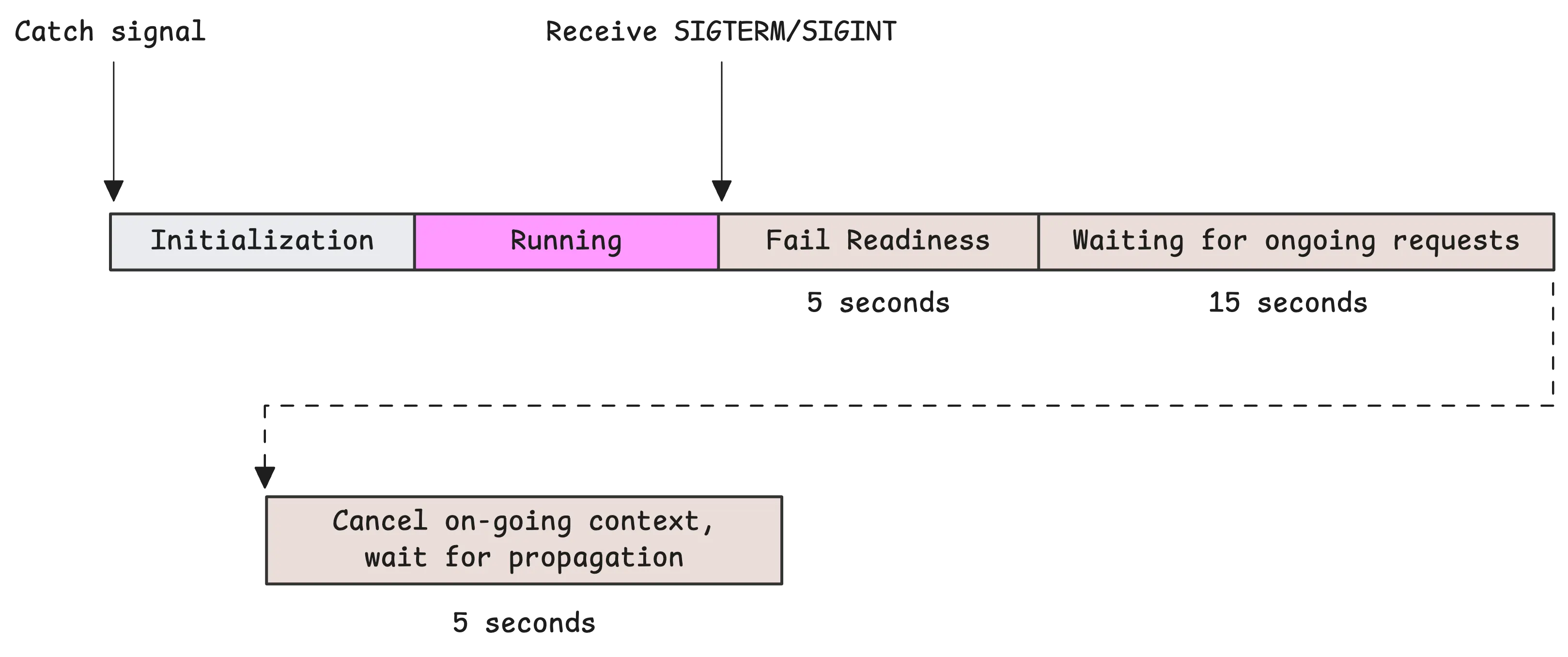
This timeline provides a great visual summary of the full process, including delays needed in environments like Kubernetes to allow load balancers to react.
Conclusion
You have now implemented one of the most important features of a production-ready web service. By handling termination signals and using server.Shutdown, you ensure your Go applications are reliable, resilient, and play well within modern containerized environments.
Key Takeaways:
- Problem:
http.ListenAndServeis a blocking call that leads to abrupt shutdowns, dropping active connections. - Solution Pattern: Run the server in a goroutine and use the main goroutine to listen for OS signals.
- Signal Handling: Use
signal.NotifyContextto create a context that is canceled onSIGINTorSIGTERM. - Graceful Shutdown: Use
server.Shutdown(ctx)with a timeout context to stop accepting new requests and wait for existing ones to finish. - Completing All Work: Use a
sync.WaitGroupto ensure any background tasks spawned by your handlers also complete before the application exits.
Next Up
This lesson concludes our module on building HTTP services. You now have a solid foundation for creating robust, production-grade web services and APIs in Go. In the next module, we'll shift our focus to Testing and Quality Assurance. We'll start by learning how to write effective unit tests for the handlers and logic we've just built, ensuring our tools are not only powerful but also correct and maintainable.