Здравствуйте! Welcome back to our lessons on the Russian dative case.
In our last session, you learned how to express likes and dislikes with the мне нравится construction. The key idea was that the person experiencing the feeling is in the dative case because something is "pleasing to them." Today, we'll see that Russian uses the exact same logic to talk about needs and obligations.
This lesson's goal is to learn how to express needs and obligations using 'на́до' and 'ну́жно' + dative. This is a fundamental structure for talking about what you have to do, whether it's for your studies, your hobbies, or daily life.
1. The Core Structure: Something is Necessary to Me
Just like with liking, when you need something in Russian, the grammatical logic is that it is "necessary to you." The person who has the need is always in the dative case.
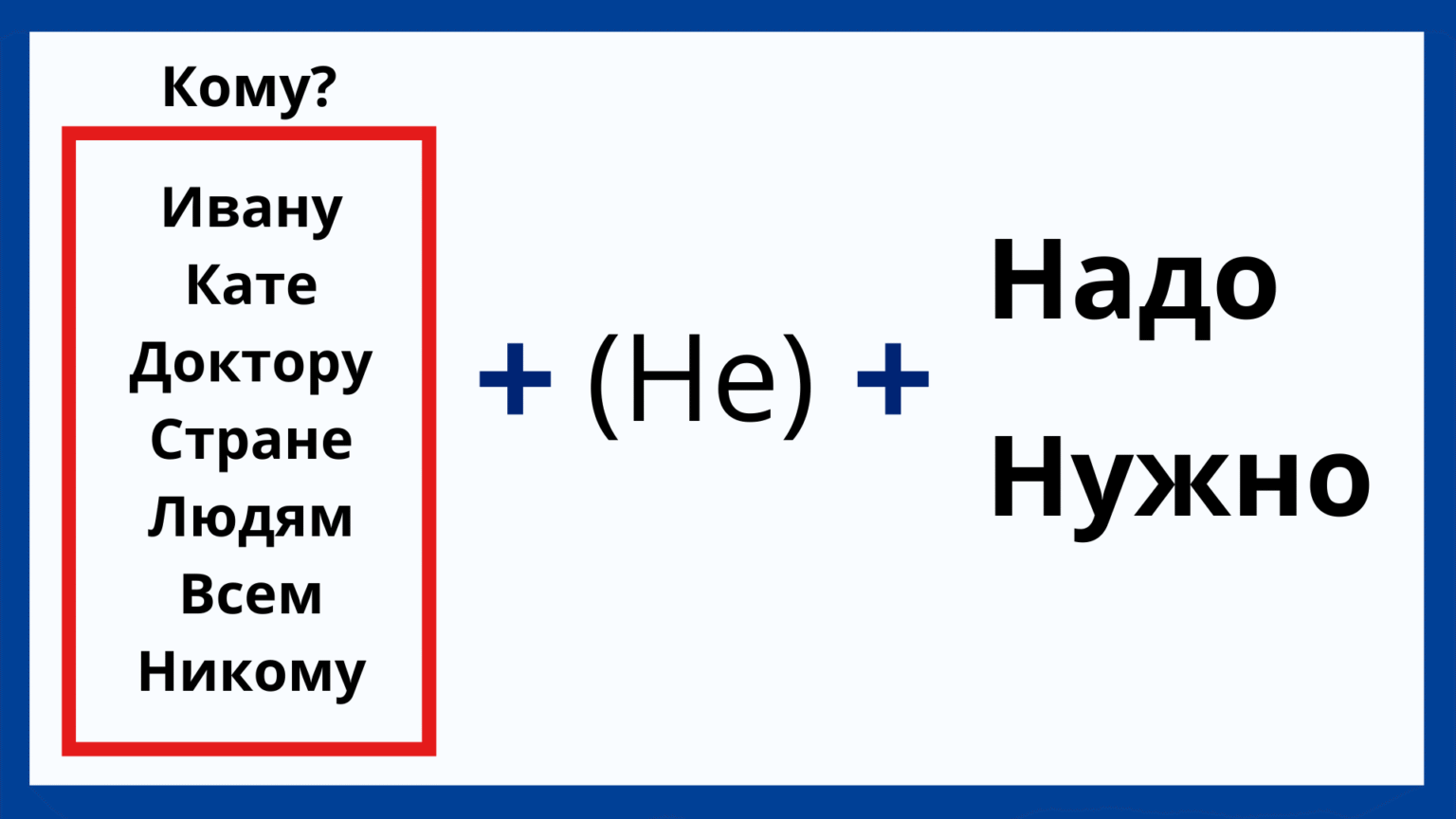
The most common mistake learners make is trying to say "I need" with "Я..." (Я на́до...). Remember, it's always the dative pronoun:
- Мне на́до... (I need...)
- Тебе́ на́до... (You need...)
- Ему́/Ей на́до... (He/She needs...)
2. Needing to DO Something (with a Verb)
When you need to perform an action (described by a verb), you use either на́до or ну́жно followed by the verb in its infinitive form (the dictionary form, usually ending in -ть, -ти, or -чь).
Structure: [Person in Dative] + на́до / ну́жно + [Infinitive Verb]
In this context, на́до and ну́жно are completely interchangeable. Think of them as synonyms.
Let's watch a video that explains this first rule and the overall construction.
Using НАДО and НУЖНО in Russian
The video 'Using НАДО and НУЖНО in Russian' from the 'Be Fluent in Russian' channel clearly explains the basic structure and the first key rule.
Watch from the beginning to 02:15. Pay attention to how the speaker introduces the dative construction ('it's needed to me') and demonstrates that 'надо' and 'нужно' can both be used with verbs like 'идти' (to go) or 'есть' (to eat).
As the video explained, you can say either:
- Мне на́до рабо́тать. (I need to work.)
- Мне ну́жно рабо́тать. (I need to work.)
Both are perfectly correct. На́до is slightly more common in colloquial speech, but the difference is minimal.
Here are some examples that might be relevant for you:
- Мне на́до сде́лать чертёж. (I need to make a drawing/draft.)
- Мне ну́жно поигра́ть в но́вую и́гру. (I need to play a new game.)
- Студе́нтам на́до учи́ться. (Students need to study.)
3. Needing SOMETHING (with a Noun)
What if you don't need to do something, but you need a thing—an object? Here's the most important rule of this lesson:
When you need a noun (an object), you can only use a form of ну́жно. You cannot use
на́до.
Furthermore, the word ну́жно must change its ending to agree with the gender and number of the noun you need. This is similar to how adjectives work.
There are four forms to learn:
- ну́жен for masculine singular nouns
- нужна́ for feminine singular nouns
- ну́жно for neuter singular nouns
- нужны́ for plural nouns (any gender)
Let's continue with the same video, which explains this distinction very well.
Using НАДО and НУЖНО in Russian
Now, let's watch the rest of the video. It focuses on how to express needing an object and explains the four different forms of 'нужно'.
Watch from 02:15 to the end (04:46). Focus on how the word for 'need' changes depending on the gender of the noun being discussed (e.g., 'телефон' vs. 'студия'). The final recap is also very helpful.
Let's summarize these rules in a table:
| If you need a... | Form to use | Example |
|---|---|---|
| Masculine Noun | ну́жен | Мне ну́жен но́вый монито́р. (I need a new monitor.) |
| Feminine Noun | нужна́ | Ему́ нужна́ но́вая клавиату́ра. (He needs a new keyboard.) |
| Neuter Noun | ну́жно | Нам ну́жно удо́бное кре́сло. (We need a comfortable armchair.) |
| Plural Noun | нужны́ | Тебе́ нужны́ хоро́шие нау́шники? (Do you need good headphones?) |
Notice the noun you need stays in the nominative (dictionary) case, just like with нравится.
4. Let's Practice
Time to put this system of rules into practice. For each sentence, choose the correct form from the options: на́до/ну́жно, ну́жен, нужна́, нужны́. Remember, if a verb follows, на́до and ну́жно are both correct.
- Мне ______ купи́ть но́вую мы́шку. (I need to buy a new mouse.)
- Худо́жнику ______ хоро́ший каранда́ш. (An artist needs a good pencil.) (каранда́ш is masculine)
- Нам ______ за́втра рабо́тать. (We need to work tomorrow.)
- Тебе́ ______ э́та програ́мма? (Do you need this program?) (програ́мма is feminine)
- Им ______ но́вые иде́и. (They need new ideas.) (иде́и is plural)
Click for answers
- на́до or ну́жно (because
купи́тьis a verb) - ну́жен (because
каранда́шis a masculine noun) - на́до or ну́жно (because
рабо́татьis a verb) - нужна́ (because
програ́ммаis a feminine noun) - нужны́ (because
иде́иis a plural noun)
Now, try applying this to your own life. This is a great way to make the grammar stick.
- What do you need to do today or this week? Write one sentence using
Мне на́до...orМне ну́жно... - What is one thing you need for your hobbies (gaming, writing, illustration)? Write one sentence using
Мне ну́жен/нужна́/ну́жно/нужны́...
This practical application is one of the best ways to internalize grammatical structures.
Conclusion
Great work today! You've learned a crucial and very common structure in Russian. By mastering the difference between needing an action and needing an object, you can express your needs and obligations much more accurately.
Key Takeaways:
- To express need, the person is always in the dative case (e.g., мне, тебе́, ему́).
- To express needing to do an action, use
на́доorну́жноfollowed by an infinitive verb. They are interchangeable. - To express needing a thing, you must use
ну́жен(m.),нужна́(f.),ну́жно(n.), orнужны́(pl.) to match the gender and number of the noun.
Preview of the next lesson:
We will continue with the dative case, but shift our focus. In the next lesson, you'll learn how to use the dative case to show the recipient of an action, as in "to call a friend" (звони́ть дру́гу) or "to help mom" (помога́ть ма́ме). This will further expand your ability to build more complex and meaningful sentences.