Здравствуйте! Welcome to our next lesson.
In the previous lesson, we explored how to use the dative case to talk about feelings and temporary states, like Мне хо́лодно (I am cold). The core idea was that the feeling is an external state happening to you. Today, we'll see that Russian uses a very similar logic to talk about likes and dislikes. This structure is one of the most common you'll encounter in daily conversation.
Our goal for this lesson is to express likes and dislikes using 'мне нравится/не нравится' + nominative. By the end, you'll be able to talk about things you like, a crucial skill for sharing your interests in games, art, and more.
1. The Grammar of Liking: Мне нравится
In English, we say "I like the book." The structure is Subject-Verb-Object. In Russian, the idea is that "The book is pleasing to me." The book is the one doing the action (pleasing), and you are the recipient.
This gives us the following structure:
[Person in Dative Case] + нравится / нравятся + [Thing liked in Nominative Case]
Notice the verb has two forms:
- Use нра́вится when the thing you like is singular.
- Use нра́вятся when the things you like are plural.
The verb changes based on the object, not the person!
Let's watch a very short video that introduces this concept clearly.
8.Dative case. Use 2. Russian language lessons
This quick video from Everika breaks down the core structure of using 'нравится' to express likes.
Watch the entire video (it's just over a minute long). Pay close attention to how the sentence changes when the object being liked is singular versus plural.
To help you recall the dative pronouns you've learned, here is a quick reference table.
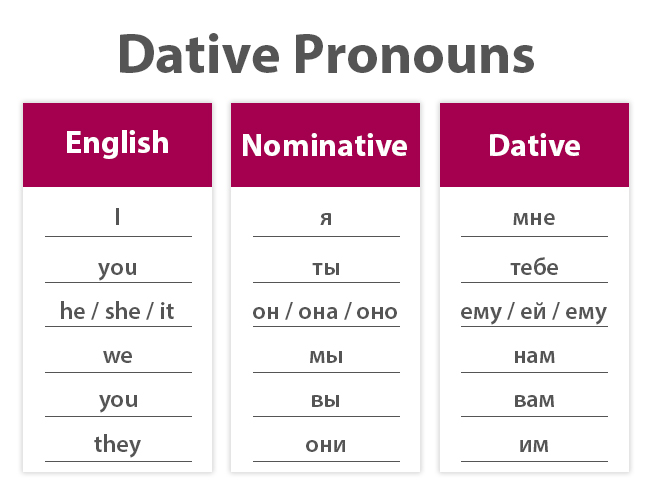
Let's break this down further with a written explanation and more examples.
Russian Dative Case - Russian Language Lesson 13
The following text from RussianLessons.net provides a concise grammatical explanation of this structure.
Please read the section titled 'To Like'. It begins just after the examples for the verb 'Звонить' (to call). Focus on the literal translation provided ('To me it is likable') and the examples showing singular ('Мне нравится Москва') and plural ('Мне нравятся дети') objects.
To express dislike, you simply add the negative particle не before the verb:
- Мне не нра́вится э́тот фильм. (I don't like this film.)
- Ей не нра́вятся видеои́гры. (She doesn't like video games.)
2. Liking vs. Loving: Нравится vs. Любить
You've now learned нравится (to like). But you may have also heard the verb любить (to love/like). What's the difference, and when do you use each one? This is a crucial distinction.
- Мне нра́вится... is used for first impressions or general preferences. The grammatical structure, as we've seen, is Dative + Verb + Nominative.
Мне нра́вится э́та карти́на.(I like this painting. It is pleasing to me.)
- Я люблю́... implies a deeper, more established feeling or a strong, habitual enjoyment. It uses a standard Subject-Verb-Object structure, and the object goes into the accusative case, which you learned in Module 5.
Я люблю́ э́ту карти́ну.(I love this painting. I am the one doing the loving.)
This resource explains the difference beautifully.
Learn Russian: Russian Made Easy Ep. 12
The 'Russian Made Easy' article does an excellent job of comparing 'Мне нравится' and 'Я люблю', highlighting the grammatical shift that occurs.
Read from the beginning of the article down to the example 'I love New York'. Pay special attention to the explanation of why 'икра' (caviar) changes to 'икру'. This directly contrasts the nominative case (with 'нравится') and the accusative case (with 'люблю').
Summary of the difference:
| Feature | Мне нравится... (to like) |
Я люблю... (to love/like) |
|---|---|---|
| Meaning | First impression, general preference | Deep affection, strong/habitual enjoyment |
| Person | Dative Case (мне, тебе, ему...) |
Nominative Case (я, ты, он...) |
| Object | Nominative Case (the "default" form) | Accusative Case (the "direct object" form) |
| Example | Мне нравится **пицца**. |
Я люблю **пиццу**. |
3. Let's Practice
Time to put this into practice. Imagine you are looking at the exercise below. Your task is to mentally sort the items on the "book" tiles into two categories: things you would use Мне нравится for (singular) and things you would use Мне нравятся for (plural).

Now, let's try translating some sentences. Remember to choose between нравится and нравятся and to use the correct dative pronoun.
Exercise: Translate the following into Russian.
- I like this game. (game = игра́)
- He likes fantasy books. (books = кни́ги)
- She doesn't like this illustration. (illustration = иллюстра́ция)
- Do you (informal) like Russian movies? (movies = фи́льмы)
- We like your drawings. (drawings = рису́нки)
Click for answers
- Мне нра́вится э́та игра́.
- Ему́ нра́вятся фэнтези́йные кни́ги.
- Ей не нра́вится э́та иллюстра́ция.
- Тебе́ нра́вятся ру́сские фи́льмы?
- Нам нра́вятся твои́ рису́нки.
Finally, to expand your vocabulary on hobbies and hear these structures in a natural context, I recommend this video.
How to talk about hobbies in Russian - Russian Comprehensible Input
The video 'How to talk about hobbies in Russian' by 'In Simple Russian' is a great piece of comprehensible input. The speaker talks about many hobbies that might interest you, from sports and reading to creative pursuits.
Watch from 07:59 to 16:37. The speaker discusses intellectual and creative hobbies like reading, learning languages, writing, and drawing. She mostly uses 'любить', but listen for the vocabulary. Can you pick out the words for 'to read', 'to write', 'to draw', 'books', 'movies'?
Conclusion
Excellent work today! You've tackled a fundamental concept for expressing personal taste in Russian. Understanding the logic behind мне нравится will significantly improve how naturally you speak and write.
Key Takeaways:
- To express "like," use the structure: [Dative person] + нравится/нравятся + [Nominative thing].
- The verb agrees with the thing being liked: нравится for singular, нравятся for plural.
Мне нравитсяis for general preferences, whileЯ люблю(+ accusative) is for stronger, more established feelings. Dislike is formed by adding не.
Preview of the next lesson:
We will continue working with the dative case. In our next lesson, you'll learn how to express needs and obligations using the words на́до and ну́жно, as in "I need to..." or "It is necessary for me to...". This will build directly on the dative structures you've mastered today.