Здравствуйте! Welcome back to your Russian course.
In our last lesson, we established a crucial foundation by learning how to identify the gender of Russian nouns. You learned that every noun is either masculine (он), feminine (она́), or neuter (оно́). This skill is about to become very useful.
Today, we will build directly on that knowledge by learning the full set of Russian personal pronouns. These are the words we use to refer to people and things without using their names or titles, like 'I', 'he', 'she', and 'they' in English. Mastering these pronouns is essential for forming even the most basic sentences.
By the end of this lesson, you will be able to correctly use all the basic personal pronouns: я, ты, он, она, оно, мы, вы, они.
1. The Russian Personal Pronouns: An Overview
Let's start with a visual summary of all the pronouns we'll be covering today. These are the words that act as the subject of a sentence—the person or thing doing the action. In Russian grammar, we say they are in the nominative case.
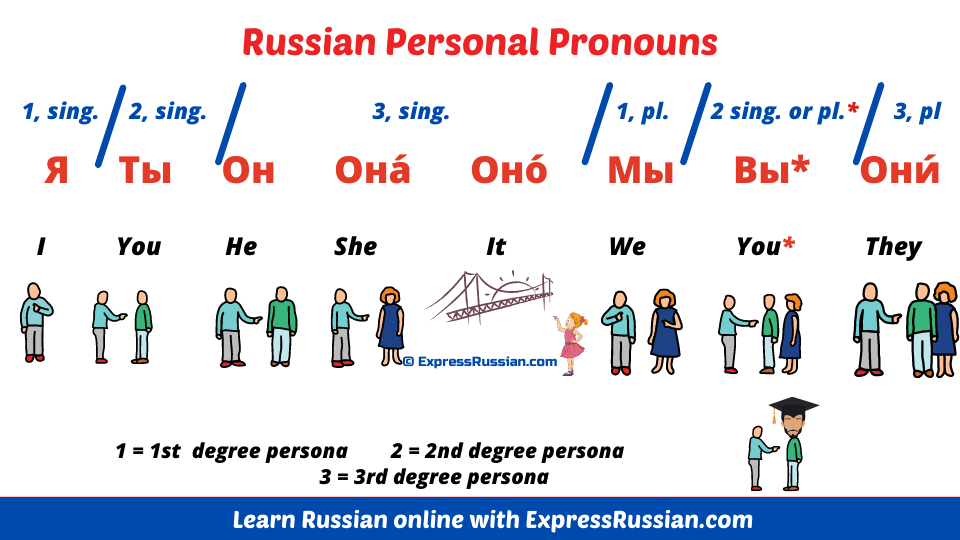
As you can see, they are:
- я - I
- ты - you (singular, informal)
- он - he / it (for masculine nouns)
- она́ - she / it (for feminine nouns)
- оно́ - it (for neuter nouns)
- мы - we
- вы - you (plural or singular, formal)
- они́ - they
Notice how он, она́, and оно́ directly correspond to the noun genders you learned in the previous lesson. For example, you would use он to replace стол (table, masculine) and она́ to replace кни́га (book, feminine).
2. Pronunciation and Basic Use
Now, let's learn how to pronounce these pronouns correctly and see them in simple sentences. A key feature of Russian you'll notice is the "zero copula"—the absence of the verb "to be" (am, is, are) in the present tense. Instead of saying "I am a student," you just say "I student" (Я студе́нт).
The following video provides an excellent walkthrough of each pronoun with clear pronunciation.
Russian personal pronouns - pronunciation and examples - Beginner Russian Lesson # 2
Watch this video from the 'Rush Into Russian' channel to hear each pronoun. The presenter, Chris, will guide you through the pronunciation and provide simple examples, also explaining the 'zero copula' concept.
Watch the video from 00:24 to 06:08 and then from 08:32 to 10:37. Pay close attention to: The pronunciation of each pronoun. The tricky ы sound in ты and мы. The vowel reduction in она́ and оно́, where the unstressed 'о' sounds like 'а' (a-NÁ, a-NÓ) — a rule you've encountered before! The absence of the verb 'to be' in the examples.
This video introduces all the pronouns you need. Let's summarize and reinforce the most important cultural point that was mentioned.
3. The 'You' Dilemma: Ты vs. Вы
One of the most critical distinctions in Russian is between ты and вы. Using the wrong one can sound rude or overly formal. Since your goal is to have natural conversations, mastering this is key.
-
Ты (ty): Informal 'you'. Use it with:
- Friends and family
- People your own age or younger
- Children
-
Вы (vy): Formal 'you' (singular) or plural 'you' (addressing a group). Use it with:
- People you don't know (strangers)
- People older than you
- People in positions of authority (professors, bosses)
- Any group of two or more people, regardless of formality.
When in doubt, always use вы. It's polite and safe. A Russian speaker will often invite you to switch to ты if the situation allows.
To solidify this concept, let's watch another short, focused explanation.
Personal Pronouns and Greeting in Russian
This video from 'Be Fluent in Russian' gives a very clear and practical explanation of when to use 'ты' versus 'вы'.
Watch the segment from 00:34 to 01:35. The speaker provides excellent real-world context for choosing the correct form of 'you'.
4. Practice
Now let's put it all together. Using the "zero copula" rule and the pronouns you've learned, try to form simple sentences.
Activity 1: Choose the Correct Pronoun
Fill in the blank with the correct pronoun based on the context. The answers are in the toggle box below.
- Это А́нна. ___ студе́нтка. (This is Anna. ___ is a student.)
- Это мой друг, Ива́н. ___ инжене́р. (This is my friend, Ivan. ___ is an engineer.)
- You are talking to your professor. "Профе́ссор, ___ здесь?" (Professor, are ___ here?)
- Меня́ зову́т Мари́я. ___ студе́нтка. (My name is Maria. ___ am a student.)
- Это мои́ друзья́. ___ игра́ют в видеои́гры. (These are my friends. ___ play video games.)
- You are talking to a friend your age. "___ идёшь в кино́?" (Are ___ going to the movies?)
- Это окно́. ___ откры́то. (This is a window. ___ is open.)
- Я и мой друг. ___ идём в парк. (Me and my friend. ___ are going to the park.)
Click to see the answers
- Она́. "А́нна" is a female name, and "студе́нтка" is a feminine noun.
- Он. "Ива́н" is a male name, and "инжене́р" is a masculine noun.
- Вы. You must use the formal/polite form when addressing a professor.
- Я. "I am a student."
- Они́. "друзья́" (friends) is plural, so you use "they".
- Ты. With a friend of the same age, you use the informal "you".
- Оно́. "окно́" (window) is a neuter noun.
- Мы. "Me and my friend" is "we".
Activity 2: Self-Assessment Quiz
To test your overall understanding, please complete the short quiz available on the following webpage. It's a great way to check if you've memorized the pronouns and their uses.
The article 'Russian personal pronouns' by Learn Russian Step By Step contains a helpful summary table and a 10-question quiz at the bottom. Use this quiz to test your knowledge.
Scroll down to the bottom of the page to the section titled 'Start the quiz' and answer all 10 questions. The questions cover translation, formal vs. informal use, and gender.
Conclusion
Excellent work! You have now learned the eight personal pronouns that form the core of Russian conversation.
Key Takeaways:
- There are eight subject pronouns: я (I), ты (you, informal), он (he/it), она́ (she/it), оно́ (it), мы (we), вы (you, formal/plural), они́ (they).
- Он, она́, оно́ correspond to the masculine, feminine, and neuter genders of the nouns they replace.
- The distinction between informal ты and formal/plural вы is crucial for politeness. When in doubt, use вы.
- In the present tense, Russian does not use a verb for "to be" (am/is/are). You simply say "I student" (Я студе́нт).
In our next lesson, we will officially learn how to form basic sentences using the word э́то (this is) and the zero copula, like in the sentences "Э́то кни́га" (This is a book) and "Я студе́нт" (I am a student). You've already had a preview of this concept today, so you're well-prepared to dive in.