Здравствуйте!
In our last lesson, we focused on choosing the correct verb aspect—imperfective (process) vs. perfective (result)—to describe actions in the past. You learned to distinguish between "I was reading" (я читал) and "I finished reading" (я прочитал).
Today, we'll apply this same core concept to the future. You'll learn how to talk about future actions that are processes, ongoing, or repeated. This is one of the two main ways to express the future in Russian.
By the end of this lesson, you will be able to form the imperfective future tense using the verb быть (to be) as a helper, allowing you to say things like "I will be drawing" or "We will be watching a movie."
1. The Compound Future: быть + Infinitive
The imperfective future tense, also known as the compound future (составное будущее), is used to talk about a future action as a process or a repeated event. Its structure is quite straightforward and analogous to the English "will be doing."
Formula: Future tense of быть + Infinitive of an imperfective verb
First, let's learn the future tense conjugation of the verb быть (to be).
How to talk about the future in Russian?
This article from Mango Languages has a very clear table showing the conjugation of быть and how it combines with an imperfective infinitive. It also explains the core uses of this tense.
Read the section 'What is the imperfective future in Russian?'. Study the conjugation table for быть carefully. Then, read the subsection 'When to use the imperfective future?' to understand its two main uses: for ongoing actions and for repeated actions.
As you saw in the article, the structure is always the same: you conjugate быть to match the person, and the main verb simply stays in its infinitive (dictionary) form.
Here's a quick summary of the быть conjugation:
| Pronoun | Future of быть |
Example: читать (to read) | Translation |
|---|---|---|---|
| я (I) | бу́ду | я бу́ду чита́ть | I will read / be reading |
| ты (you, informal) | бу́дешь | ты бу́дешь чита́ть | you will read / be reading |
| он/она́/оно́ (he/she/it) | бу́дет | он бу́дет чита́ть | he will read / be reading |
| мы (we) | бу́дем | мы бу́дем чита́ть | we will read / be reading |
| вы (you, formal/pl.) | бу́дете | вы бу́дете чита́ть | you will read / be reading |
| они́ (they) | бу́дут | они́ бу́дут чита́ть | they will read / be reading |
The key rule to remember is that this construction only works with imperfective verbs.
2. Hearing the Compound Future in Action
Now, let's listen to how this tense sounds in natural speech. The following video provides several clear examples.
The Compound Future Tense in Russian.
In this video from 'Russian with Nastya', you will hear the conjugation of быть and then see it used in full sentences. This is great for your listening comprehension and pronunciation.
Watch the video from the beginning to 06:12, and then from 08:02 to 10:22. Pay close attention to: The pronunciation of each form of быть (0:00 - 4:05). The first example: 'Завтра я буду готовить ужин' (Tomorrow I will be cooking dinner) (4:05 - 5:03). The third example: 'Он будет работать в компании' (He will be working at the company) (8:02 - 10:22). Notice how the second verb (готовить, работать) is always in the infinitive.
This tense is perfect for talking about your plans, especially in relation to your hobbies. For example:
- За́втра я бу́ду рисова́ть но́вого персона́жа. (Tomorrow I will be drawing a new character.) — Focus on the process.
- На выходны́х мы бу́дем игра́ть в видеои́гры. (On the weekend, we will be playing video games.) — Focus on the activity.
- Ле́том я бу́ду ча́сто смотре́ть ру́сские фи́льмы. (In the summer, I will often watch Russian films.) — Focus on a repeated action.
3. A Tale of Two Futures: Imperfective vs. Perfective
As we've established, Russian has two verb aspects, and this leads to two different ways of talking about the future. Today we are focused on the imperfective side. This table gives you a clear visual comparison.
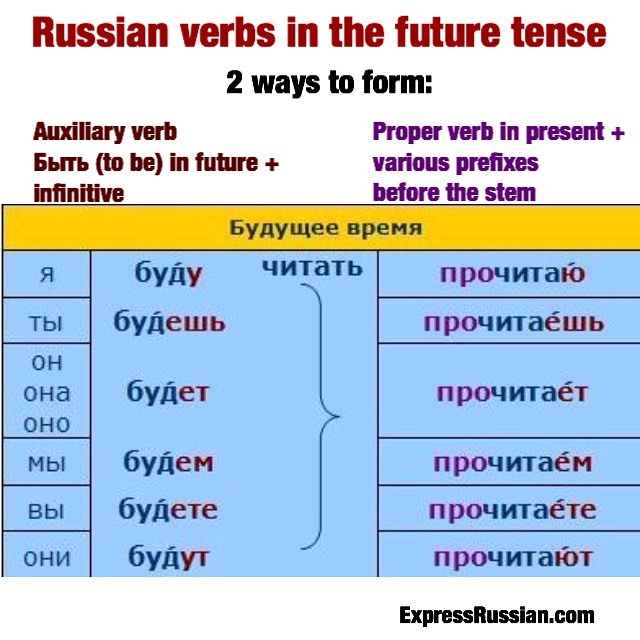
You might remember the video from our last lesson where people on the streets of St. Petersburg explained verb aspect. At one point, a philologist makes a crucial point about the future tense. When discussing the verb pair ловить / поймать (to be catching / to catch), she says:
Но нельзя́ сказа́ть "я бу́ду пойма́ть". ... Я бу́ду лови́ть.
(But you can't say "I will catch (perfective)". ... I will be catching (imperfective).)
This perfectly reinforces our rule: the compound future with быть is exclusively for imperfective verbs.
Practice
Time to put this into practice. Complete the following sentences by putting быть in the correct form.
- За́втра я __________ весь день чита́ть интере́сную кни́гу. (Tomorrow I will read an interesting book all day.)
- Что ты __________ де́лать в суббо́ту ве́чером? (What will you be doing on Saturday evening?)
- Мы __________ смотре́ть но́вый сериал, когда́ ты придёшь. (We will be watching a new series when you arrive.)
- Они́ __________ игра́ть в Dungeons & Dragons ка́ждую пя́тницу. (They will play Dungeons & Dragons every Friday.)
- Мой друг __________ рабо́тать над свои́м прое́ктом всё ле́то. (My friend will be working on his project all summer.)
Click for answers
- бу́ду (За́втра я бу́ду весь день чита́ть...)
- бу́дешь (Что ты бу́дешь де́лать...)
- бу́дем (Мы бу́дем смотре́ть...)
- бу́дут (Они́ бу́дут игра́ть...)
- бу́дет (Мой друг бу́дет рабо́тать...)
Conclusion
You've now learned the first of two ways to speak about the future in Russian. This is a huge step forward, as it allows you to describe your plans and future activities in detail.
Key Takeaways:
- The imperfective (compound) future is used for future actions viewed as a process or as repeated events.
- It is formed with the future tense of the verb
быть(бу́ду, бу́дешь, бу́дет...) plus the infinitive of an imperfective verb. - This structure is analogous to the English "I will be doing something."
Preview of the next lesson:
Now that you can talk about future processes, what about future results? In our next lesson, we will cover the simple (perfective) future. You'll learn how to say "I will finish writing," "I will draw it," or "I will watch it to the end," completing your toolkit for talking about the future.