Welcome to the first lesson of our third module, "Feedback, Control, and Stability." In the previous module, we established the philosophical foundations of cybernetics, contrasting its holistic, relational worldview with the classical reductionist approach. We concluded that cybernetics is not just a different method, but a different way of seeing the world—one that prioritizes organization, communication, and control to understand complexity.
Now, we shift from the why to the how. This module is dedicated to the engine of all cybernetic systems: the feedback loop. To begin, we must understand the most fundamental distinction in the world of control. The learning outcome for this lesson is to distinguish between open-loop and closed-loop control systems. Mastering this distinction is the first practical step toward analyzing and designing the kinds of regulatory systems that so fascinate you, including Project CyberSyn itself.
The Core Idea of Control
Before we can compare different types of control, let's clarify what a control system is. At its heart, it's a mechanism designed to make another system—often called the plant—behave in a desired way. To get a feel for this and to hear the initial definitions of open and closed loops, please watch the beginning of the following lecture.
Control Systems Lectures - Closed Loop Control
This video from Brian Douglas, "Control Systems Lectures - Closed Loop Control," provides a clear and direct introduction to the fundamental concepts of control systems, starting with the simplest form.
Watch the first three minutes, covering the definitions of a control system and an open-loop system. Pay close attention to the examples of the dishwasher and the sprinkler, and notice the key drawback illustrated by the car-on-a-hill example.
Open-Loop Control: The "Fire-and-Forget" Strategy
As the video explained, an open-loop control system is one where the control action is independent of the system's output. It operates based on a predetermined plan or a model of how the system should behave, without checking the actual results.
Think of it as a one-way street of command. You provide an input, the controller processes it, and an action is performed on the plant, resulting in an output. There is no information channel from the output back to the controller.
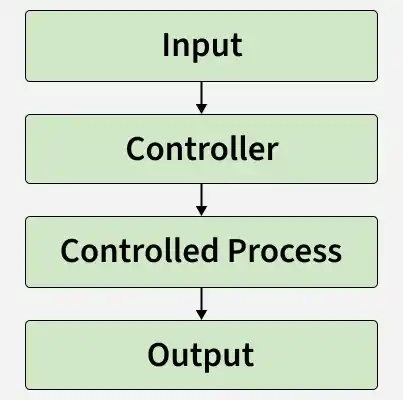
This "fire-and-forget" approach is simple and effective in stable, predictable environments where the relationship between the input and output is well-understood. A simple toaster is a perfect example: you set the timer (input), and the heating element runs for that duration, regardless of whether the bread is perfectly toasted or burnt.
To explore this concept with some more creative analogies and to understand its limitations, please read the following article.
From Open Loop to Closed Loop: Rethinking Learning
This article uses accessible examples like brewing coffee and public speaking to illustrate the nature of open-loop control.
Please read the first part of the article, up to the heading "Open-Loop vs. Closed-Loop Control." Then, read the section under that heading, focusing on the definition and examples of open-loop control.
The key weakness of open-loop control, as these examples show, is its inability to compensate for disturbances or uncertainties. If your toaster's heating element degrades over time, or if you use a different type of bread, the pre-set timer will no longer produce the desired result. The system is "blind" to the actual state of the world. For this reason, open-loop control relies heavily on having a very accurate model of the system and a highly predictable environment.
The following video from MATLAB explains this reliance on a "feed-forward" model and why it breaks down in complex, unpredictable situations.
Everything You Need to Know About Control Theory
This video, "Everything You Need to Know About Control Theory," explains open-loop control from a slightly more formal perspective, terming it "feed-forward" control.
Watch the section that defines and discusses feed-forward control. Notice the emphasis on needing an accurate model of the system and a predictable environment, and why this is unrealistic for driving a car across a city.
Closed-Loop Control: The "Sense-and-Respond" Strategy
The limitations of open-loop control lead directly to the central concept in cybernetics: closed-loop control, also known as feedback control. In this architecture, the system's output is measured and "fed back" to be compared with the desired goal. The control action is then adjusted based on the difference—or error—between the actual state and the desired state.
This creates a loop of information that allows the system to be self-regulating. It can adapt to disturbances and maintain its goal despite uncertainty. Let's return to the video from Brian Douglas to see how this works.
Control Systems Lectures - Closed Loop Control
This part of the video introduces the structure of a closed-loop system and revisits the earlier examples to show how feedback transforms them.
Please watch from the introduction of closed-loop control to the end of the cruise control example. Pay attention to the new components: the sensor, the reference signal, the comparator, and the controller.
The structure of a closed-loop system can be broken down into a simple, powerful cycle. The article "From Open Loop to Closed Loop" provides a very intuitive four-step description of this process.
From Open Loop to Closed Loop: Rethinking Learning
This article explains the core cycle of feedback control and gives several real-world examples.
Read the section that begins "The core of closed-loop control". Focus on the Perceive → Compare → Correct → Execute cycle.
Formally, cyberneticians describe this structure using four key components, as detailed in the technical article "Cybernetics and Control Mechanisms."
Cybernetics and Control Mechanisms in Technology Services
This text provides the formal, technical definitions of the components of a cybernetic control loop.
Please read the section "Core mechanics or structure," which lists and defines the four components: Sensor, Comparator, Effector, and Feedback channel.
These two descriptions, one conceptual and one formal, describe the same thing:
- Sensor/Perceive: A component that measures the current state (the output) of the system.
- Comparator/Compare: A mechanism that compares the measured state to a desired state or reference value, generating an error signal.
- Controller/Correct: A decision-making unit that determines the corrective action needed based on the error signal.
- Effector/Execute: An actuator that implements the corrective action on the system.
The feedback channel is the path that allows the result of the effector's action to be seen by the sensor, thus "closing" the loop. This structure is the essence of all regulation.
Crucially, this architecture is precisely what inspired Stafford Beer. Let's look at a diagram he sketched for Project CyberSyn.

This diagram powerfully illustrates that the principles of closed-loop control are not just for thermostats and cruise controls, but can be scaled to describe the governance of an entire nation—the very idea that motivated your interest in this course.
The Power and Peril of Feedback
Unlike open-loop control, which simply uses a system, closed-loop control fundamentally changes the system's behavior. By creating a relationship where the system's state influences its own future actions, you are introducing new dynamics.
This is incredibly powerful. It's what allows a system to be robust, adaptive, and goal-seeking. However, it also introduces complexity and potential dangers, like instability and oscillation, if the feedback loop is not designed carefully.
Everything You Need to Know About Control Theory
This final clip from the MATLAB video explains the profound difference feedback makes and why it must be handled with care.
Watch the section on feedback control. Focus on the key idea that feedback is a "self-correcting mechanism" that changes the dynamics of the system, which can be both a benefit (creating stability) and a danger (creating instability).
Conclusion: Choosing the Right Loop
In this lesson, we have drawn the fundamental distinction between open-loop and closed-loop control systems. This is not just a technical detail; it is the dividing line between simple, predetermined processes and complex, adaptive, self-regulating systems.
Here are the key takeaways:
- Open-Loop Control is a one-way, "fire-and-forget" system. It acts based on a pre-set plan and is blind to the actual output. It is simple but only works in highly predictable environments.
- Closed-Loop Control is a "sense-and-respond" system that uses feedback. It measures the output, compares it to a goal, and corrects for any deviation. This makes it adaptive and robust to disturbances.
- The components of a closed-loop system are the Sensor, Comparator, Controller, and Effector, connected by a Feedback Channel.
- Cybernetics is the study of closed-loop systems. The article "Cybernetics and Control Mechanisms" explicitly states that purely open-loop systems fall outside its scope. Feedback is not optional; it is the subject itself.
Neither system is universally superior. The choice depends on the context. As the "From Open Loop to Closed Loop" article wisely concludes, open-loop is efficient for mastered tasks in stable settings, while closed-loop is essential for precision, adaptation, and learning in complex and changing environments.
Now that we have established the structure of the feedback loop, our next step is to understand its behavior. In the next lesson, we will analyze the two fundamental types, or polarities, of feedback: negative feedback, which is the engine of stability and goal-seeking, and positive feedback, which drives growth and runaway change.