Welcome to the final lesson in our introductory module on the foundations of cybernetics. Over the past several lessons, we have assembled the conceptual toolkit of first-order cybernetics: we've explored circular causality, defined goal-directed behavior in terms of negative feedback, and examined homeostasis as a profound biological example of self-regulation.
Today, we will place this entire worldview into a broader philosophical context. The learning outcome for this lesson is to contrast cybernetic thinking with reductionist approaches to understanding complex phenomena. By drawing this contrast, you will gain a much deeper appreciation for why the emergence of cybernetics in the mid-20th century was not just the creation of a new discipline, but a radical challenge to the dominant scientific paradigm. This exploration of the philosophical underpinnings of science should resonate with your stated interest in the intersection of theory and philosophy.
The Great Divide: Two Ways of Seeing
At its core, the history of science and philosophy can be seen as a long conversation between two fundamentally different ways of understanding the world: reductionism and holism. Cybernetics and systems thinking are firmly on the side of holism.
To begin, let's establish a clear understanding of these two opposing viewpoints. The short video below from the Systems Innovation Network provides an excellent overview.
This video, "Holism & Reductionism," clearly defines and contrasts these two essential paradigms.
Please watch the first part of the video, from the beginning to the end of the examples. Pay close attention to the core definitions and the examples given for each approach, such as in medicine and economics.
As the video explains, reductionism is the belief that you can understand a complex system by breaking it down into its constituent parts and studying those parts in isolation. The assumption is that the behavior of the whole is simply the sum of the behavior of its parts. This approach has been incredibly successful, giving us everything from the atomic theory to the discovery of DNA.
Cyberneticist Heinz von Foerster offered a memorable framing of this scientific tradition, as explained by Paul Pangaro in this brief clip.
Simulation #16 Paul Pangaro - Cybernetics & Systems Thinking
In this excerpt from an interview, cyberneticist Paul Pangaro explains Heinz von Foerster's idea that traditional science is an act of "cutting" the world into smaller, more manageable pieces.
Watch the segment from "give us an example". This provides a powerful metaphor for the reductionist method.
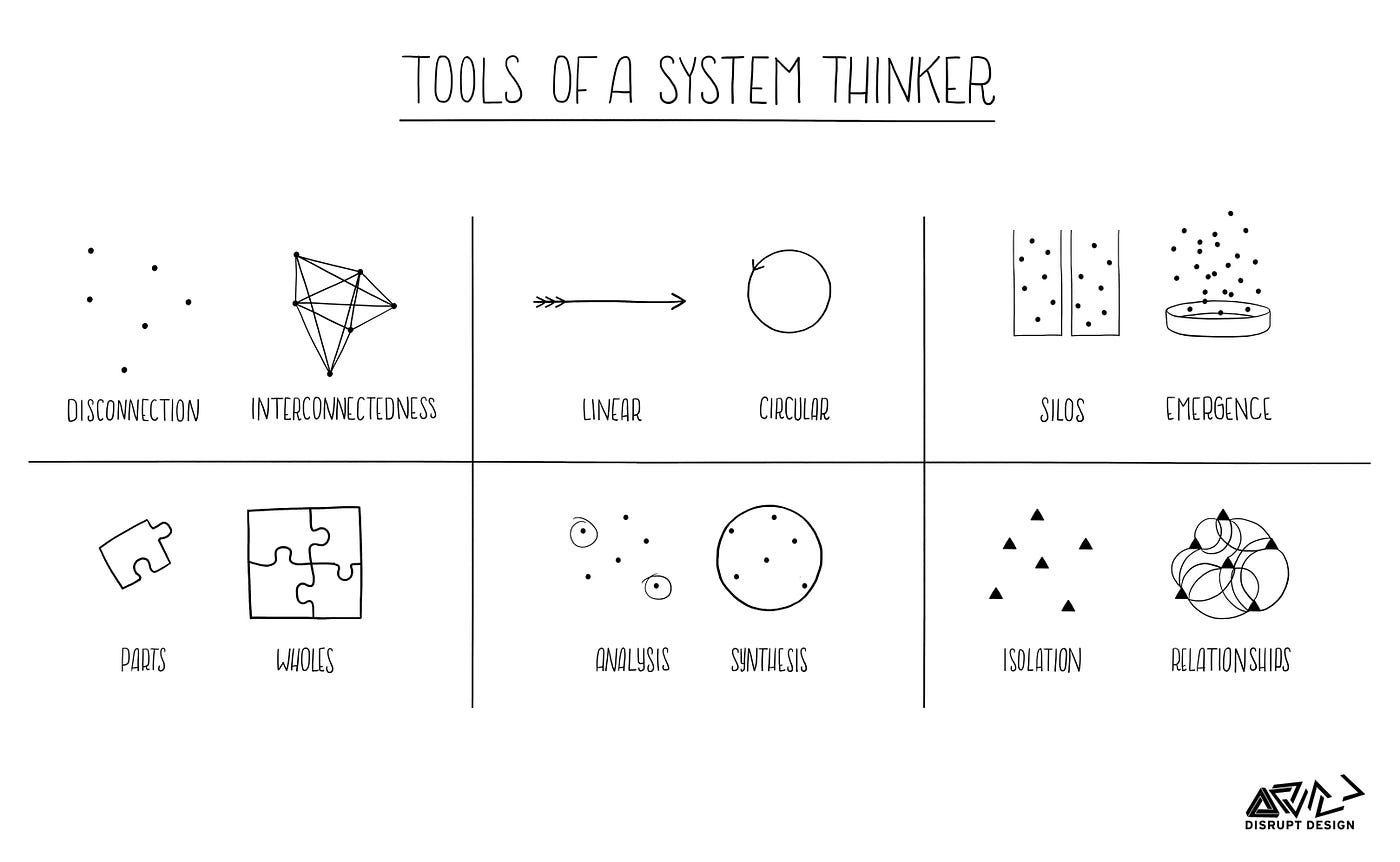
Holism, on the other hand, asserts that the whole is more than the sum of its parts. A holistic approach argues that the relationships between the parts and the emergent properties that arise from their interactions are the most crucial things to study. You cannot understand a flock of birds by studying a single bird in a cage. You cannot understand consciousness by studying a single neuron on a petri dish.
This is the worldview of cybernetics. It is not interested in the parts themselves, but in their organization, communication, and control—the very things that generate the emergent behavior of the whole.
The Philosophical Stakes: Ontology and Epistemology
This difference between reductionism and holism is not just a matter of methodology; it reflects a deep philosophical disagreement about the nature of reality (ontology) and how we can know it (epistemology).
The following reading selection will guide you through these philosophical foundations. Given your interest in philosophy, you'll find this section connects the practical methods of cybernetics to much older and deeper questions.
Chapter 3 – Philosophical Foundations of Systems Thinking
This chapter from an open educational resource on systems thinking delves into the philosophical roots of the field, contrasting it with the classical reductionist worldview.
Please read two sections from the chapter "Holism and Reductionism in Systems Thinking." First, read the section that starts with "Ontology and Systems Thinking". Focus on how systems thinking proposes a relational ontology (a reality of processes and relationships) against the classical substance ontology (a reality of fixed objects). Next, read the main section on the core topic. Pay attention to the practical examples of the divide and the explanation of why reductionism fails in complex systems.
As you've just read, the debate hinges on fundamental questions:
- Ontology (What is real?): Reductionism aligns with a view of reality made of discrete objects. Cybernetics aligns with a process philosophy, where reality is a dynamic web of relationships. For a cybernetician, the "thing" is not the object, but the pattern of organization that maintains its identity over time.
- Causality (What causes what?): Reductionism is built on linear, upward causation: the behavior of the parts determines the behavior of the whole. Cybernetics introduces circular causality (feedback) and downward causation: the whole (e.g., the goals or norms of a social system) constrains and shapes the behavior of the parts.
The Limits of Reductionism in Complex Systems
The necessity for cybernetics arose precisely because the classical, reductionist approach proved inadequate for understanding the complex, adaptive, and seemingly purposeful systems that interested its founders—brains, organisms, and societies.
Why does reductionism fail here? A more technical analysis reveals several specific fallacies that occur when reductionist methods are misapplied to complex systems. For someone with your computer science background, these points will highlight the specific ways in which simplification can lead to fundamentally incorrect models.
Theoretical Reflections on Reductionism and Systemic Research ...
This academic paper offers a rigorous critique of reductionism from a systems science perspective. It is a more advanced text, but it precisely articulates the technical failings of reductionist assumptions.
We will focus on a few key sections. Don't worry about understanding every detail; focus on the core argument of each section. First, read Section 2, "Reductionism", to get the paper's formal definitions. Note the crucial distinction it makes between an acquired property (like a traffic jam) and a possessed property (like weight). Reductionism treats the former like the latter. Next, read Section 3.2, "Reducing Emergence to Functioning". This explains the error of treating an emergent phenomenon (like flocking) as if it were a designed function (like a machine's operation). Then, read Section 3.3, "General Linearization of Non-Linear Systems". This details the danger of approximating non-linear systems as linear, which hides their most important behaviors like feedback and chaos. Finally, read Section 3.4, "The Macroscopic from the Microscopic". This critiques the assumption that you can always explain the whole by understanding the parts, ignoring the role of emergence.
As the paper argues, reductionism runs into trouble because complex systems are:
- Emergent: Their most important properties are acquired through interaction, not possessed by the components.
- Non-linear: The relationships are not proportional. Small changes can have large effects (and vice versa) due to feedback loops. Linear approximations can be dangerously misleading.
- Self-organizing: Their structure is not determined by a central controller but arises from local interactions.
Attempting to model such a system by simply summing its parts is like trying to understand a novel by analyzing the frequency of each letter of the alphabet. You get data, but you miss the entire story.

Conclusion: A Science of Wholeness
In this lesson, we have situated cybernetics in opposition to the classical scientific tradition of reductionism. This contrast is not merely academic; it represents a fundamental shift in how we approach complex problems.
Here are the key takeaways:
- Reductionism seeks to understand phenomena by breaking them down into their simplest parts, assuming linear causality where the behavior of the whole is determined by the parts (upward causation).
- Cybernetic thinking, a form of holism, focuses on the whole system, emphasizing the interconnections, feedback loops, and emergent properties that cannot be found in the parts alone. It acknowledges both upward and downward causation.
- This is not just a methodological preference but a philosophical shift in ontology (from a world of objects to a world of relationships) and epistemology (from a detached observer to an engaged participant).
- Reductionism fails for complex systems because it neglects non-linearity, emergence, and the circular nature of causality, which are the defining characteristics of the biological, social, and ecological systems cybernetics seeks to understand.
It is crucial to note that cybernetics does not reject analysis. The ability to "zoom in" and analyze components is vital. The error of pure reductionism is the failure to "zoom back out" and see how those components interact to create a coherent, dynamic whole.
With this foundational module now complete, you have a firm grasp of the historical origins, core concepts, and philosophical orientation of cybernetics. In the next module, "Feedback, Control, and Stability," we will move from this conceptual level to a more practical one. We will begin to dissect the engine of cybernetics—the feedback loop—and learn how to visualize and analyze its structure using powerful tools like Causal Loop Diagrams.