Welcome back. In our last lesson, we explored negative feedback, the fundamental mechanism that allows systems to regulate themselves, seek goals, and maintain stability. We saw how this error-opposing principle is the cybernetic key to homeostasis, whether in a thermostat, a living organism, or a well-managed organization. The core function of negative feedback is to counteract and dampen change.
Today, we turn to its polar opposite. What happens when a system's feedback loop doesn't oppose change, but amplifies it? This brings us to the focus of this lesson: to analyze positive feedback as a mechanism for growth, runaway behavior, and instability. Understanding this self-reinforcing dynamic is just as crucial as understanding stability. It is the engine of exponential growth, but also the source of catastrophic collapse. For a cybernetician, mastering the interplay between stabilizing and amplifying loops is the essence of designing robust, adaptive systems.
The Self-Reinforcing Principle
Where negative feedback works to negate an error, positive feedback works to reinforce a change. The "positive" in the term does not mean "good," just as "negative" did not mean "bad." It refers to a self-reinforcing or amplifying effect. The core logic is simple: a change in a variable leads to further change in the same direction.
This Wikipedia article provides a clear, concise definition of positive feedback and its general characteristics.
Start by reading the introductory paragraph. It defines the concept succinctly as "A produces more of B which in turn produces more of A." Then, read the section titled "Overview", which further clarifies that 'positive' refers to the loop's reinforcing nature, not a value judgment.
The classic, intuitive example of positive feedback is money earning interest in a bank account.
1.6 Types of Feedbacks and Their Effects | EME 807
This article from Penn State's curriculum on sustainable systems offers a very clear, graphical explanation of positive feedback loops.
Read the section on "Positive feedbacks," which uses the bank interest example. Notice the graph showing the account balance. It doesn't grow in a straight line (linearly); it curves upward, accelerating over time. This is the signature of a positive feedback loop: exponential growth.
As the resource illustrates, a small initial deposit generates a small amount of interest. But that interest is added to the principal, so the next interest payment is calculated on a slightly larger amount, and is therefore slightly larger itself. This continues, with the growth rate constantly increasing, creating a "snowball" effect.
This dynamic of reinforcement is what systems thinkers call a reinforcing loop.
Vicious and Virtuous Cycles
This snowball effect can be desirable or undesirable, depending on the context. This leads to the common-sense labels of "virtuous cycles" and "vicious cycles."
- Virtuous Cycle: A positive feedback loop that produces desirable outcomes. For example, the more you practice a skill, the better you get; the better you get, the more you enjoy it, which encourages you to practice even more.
- Vicious Cycle: A positive feedback loop that produces detrimental outcomes. For example, falling company profits lead to cuts in investment, which further harms the company's ability to generate profit, leading to a downward spiral.
The image below shows a simple causal loop diagram for a famous vicious cycle: a cattle stampede.
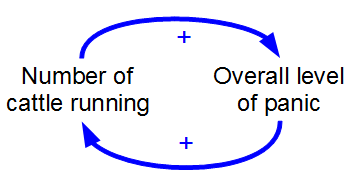
Here, the links are marked with a + sign to indicate a positive or "same direction" causal relationship. An increase in running causes an increase in panic. An increase in panic causes an increase in running. The loop feeds on itself, rapidly escalating a small disturbance into a full-blown stampede.
This runaway escalation is a hallmark of unchecked positive feedback.
The Dynamics of Instability
While essential for growth, positive feedback is inherently destabilizing. If a reinforcing loop is not constrained by some other force, it will eventually drive the system to its limits, often causing it to break, transform, or collapse.
Let's return to the Wikipedia article to look at the mathematical and systemic implications.
Read the section titled "In Terminology" (the first section after the introduction). It formally states that positive feedback tends to cause system instability, leading to exponential growth or other divergences from equilibrium.
This tendency towards instability appears in many domains:
- Technology: The loud screech of audio feedback when a microphone gets too close to its speaker is a classic runaway positive loop. Random noise is picked up, amplified, and fed back into the microphone, where it is amplified again and again until the system is saturated.
- Biology: While the onset of childbirth contractions is driven by a positive feedback loop (contractions release a hormone that causes stronger contractions), this is a temporary, goal-oriented process. If it didn't stop once the goal was achieved, it would be catastrophic.
- Economics: A "bank run" is a social-economic example. Fear that a bank might fail causes some people to withdraw their money. Seeing this, more people become fearful and withdraw their money, reinforcing the run. The belief, whether initially true or not, creates its own reality and can cause a solvent bank to collapse.
The following video provides several more examples of reinforcing loops visualized with causal loop diagrams.
Systems Thinking: Causal Loop Diagrams
This tutorial introduces reinforcing loops and gives clear, animated examples.
First, watch the segment defining reinforcing loops, which uses population growth as the primary example. Then, skip ahead and watch the example of the greenhouse gas feedback loop, which illustrates a global-scale vicious cycle.
Case Study: Runaway Climate Feedbacks
Perhaps the most urgent and large-scale example of positive feedback dynamics today is in climate science. Global warming, initiated by human activity, is beginning to trigger natural feedback loops that are amplifying the initial warming. These are not minor adjustments; they are fundamental changes to the planetary system's behavior.
Dr. Peter Carter, director of the Climate Emergency Institute, explains the concept of "runaway" climate change, which he defines as a state where positive feedbacks dominate and global warming begins to cause more global warming.
Watch the introduction where he defines runaway change and the role of amplifying feedbacks. Then, watch his explanation of the first major feedback: the Arctic ice albedo effect.
As Dr. Carter explains, the Arctic ice albedo feedback is a classic reinforcing loop:
- Increased global temperature melts white, reflective sea ice.
- This exposes the dark, absorbent ocean surface beneath.
- The dark ocean absorbs more solar energy instead of reflecting it.
- This further increases temperature, which melts more ice (returning to step 1).
This is a textbook "vicious cycle." The initial effect (warming) triggers a systemic response that amplifies the initial effect. Dr. Carter's video goes on to detail several other such loops, including the thawing of permafrost and emissions from wetlands, which all interact and reinforce one another. This illustrates a critical point for cybernetics: in complex systems, multiple feedback loops operate simultaneously, and their combined effect determines the system's overall behavior.
Taming the Fire: The Cybernetician's Role
If positive feedback is so destabilizing, how do any systems survive? The answer lies in the interplay with negative feedback. In any viable system, reinforcing loops are held in check by balancing (negative) loops.
- The exponential growth of a bacterial colony is eventually limited by a balancing loop: lack of food and accumulation of waste.
- The virtuous cycle of a startup's growth (more customers -> more revenue -> better product -> more customers) will eventually meet the balancing loops of market saturation or increased competition.
The cybernetician's task is often to design systems where this balance is effective. A system that is purely dominated by negative feedback is stable but static and cannot grow or adapt. A system dominated by positive feedback grows explosively but is unstable and will inevitably collapse. A viable, resilient system harnesses positive feedback for growth and innovation, while using negative feedback to maintain stability and control.

This is the very essence of the design challenge that Stafford Beer addressed with his Viable System Model, and that you are setting out to master. It is not about eliminating positive feedback, but about understanding, monitoring, and managing it by designing the appropriate regulatory structures (balancing loops).
Conclusion
We have now examined the second fundamental type of feedback loop. Where negative feedback is the source of stability, positive feedback is the engine of change.
Here are the key takeaways from this lesson:
- Positive feedback is a self-reinforcing mechanism. It amplifies any change in a system, causing further change in the same direction.
- It is the driving force behind exponential growth, but also exponential decline. Depending on the context, we call these virtuous or vicious cycles.
- Unchecked positive feedback leads to runaway behavior and instability, potentially destroying the system or forcing it into a new, often undesirable, state.
- In all viable systems, the amplifying effects of positive feedback must be managed and constrained by the stabilizing effects of negative feedback.
You have now analyzed both balancing and reinforcing loops separately. In the next lesson, we will synthesize this knowledge and focus on the practical skill of modeling them. You will learn to formally visualize feedback structures using Causal Loop Diagrams (CLDs), a powerful tool for mapping out the hidden structures that drive the behavior of any complex system you wish to analyze or design.