Welcome to your next lesson in our journey through systems thinking. In the previous lesson, we defined what a system is and focused on its boundary, distinguishing between open and closed systems based on their exchange of matter, energy, and information with the environment. This gave us a way to understand a system's relationship with the world outside it.
Today, we turn our attention inward. We will explore two of the most foundational and philosophically rich concepts in this field: holism and emergence. This lesson directly addresses the learning outcome of explaining these concepts and understanding why they are indispensable for studying complex systems. The ideas we'll discuss represent a fundamental departure from traditional analytical methods and form the very reason why a "systems approach" is necessary for tackling challenges like the one Stafford Beer faced with Project CyberSyn.
A World of Interconnections
Complex systems are, by their nature, interdisciplinary. They are not the exclusive domain of any single field but rather a meeting point for many. The following mind map gives a sense of this vast, interconnected landscape. Notice how "Emergence" and "Self-Organization" are placed at the very center, linking everything from nonlinear dynamics and networks to collective behavior and evolution.

This map visually represents the core idea we will unpack today: that certain phenomena can only be understood by looking at the system as an integrated whole.
Holism vs. Reductionism: Two Ways of Seeing
At the heart of systems thinking lies a long-standing philosophical debate about the best way to gain knowledge. Do we understand something by breaking it down into its smallest components, or by looking at it in its entirety? These two perspectives are known as reductionism and holism.
The video "Holism & Reductionism" from the Systems Innovation Network provides an excellent introduction to this fundamental dichotomy.
This video clearly contrasts the two competing worldviews that underpin different scientific approaches.
Watch from the beginning to the introduction of holism and reductionism. Then, focus on the section from the definition of holism. Pay close attention to the core principle that "the whole has priority over its parts" and the classic example of the "wetness of water" to illustrate a property that doesn't exist in the components (hydrogen and oxygen atoms) alone.
As the video explains:
- Reductionism is the belief that you can understand a complex system by breaking it down and studying its constituent parts in isolation. This has been the dominant paradigm of modern science for centuries, leading to incredible discoveries like the atom and the cell.
- Holism, on the other hand, posits that a system's properties and behaviors cannot be explained merely by the sum of its parts. The interactions and relationships between the parts create a new level of reality that must be understood on its own terms.
In your computer science background, you've likely encountered both approaches. Analyzing a single algorithm or function in isolation is a reductionist activity. However, debugging a system-wide failure caused by a race condition or an unexpected interaction between microservices is an inherently holistic task—the problem doesn't reside in any single component but in the relationships between them.
Emergence: The Whole Is Greater Than the Sum of Its Parts
The phenomenon at the heart of holism is emergence. Emergence is the process whereby novel and coherent structures, patterns, and properties arise from the interactions of simpler entities. These "emergent properties" are not present in the individual entities and cannot be predicted by simply studying them in isolation.
The "wetness" of water is a classic physical example. Another powerful and intuitive example is the act of walking.
The video "Emergence & Systems Thinking" offers a very clear and simple analogy to grasp this concept.
Watch the segment from the explanation of emergence. The analogy of walking versus hopping perfectly illustrates how a new capability (stable, efficient locomotion) emerges from the coordination of parts. Walking is not just "two hops"; it is a qualitatively different phenomenon that arises from the synergistic relationship between the legs.
Given your interest in the philosophical underpinnings of these topics, it's useful to distinguish between two types of emergence.
Strong Emergence Is Holism, Not Magic — Zachary Fruhling
This article by philosopher Zachary Fruhling delves into the ontological questions raised by emergence, arguing that it represents a fundamental choice in how we view reality.
First, read the introduction, which distinguishes between weak and strong emergence. Then, continue with the next two paragraphs, which reframe strong emergence as a form of holism. The key insight is that this view requires a shift in mindset where we accept that higher-level properties are real from the outset, not something mysteriously generated from nothing.
To summarize the distinction:
- Weak Emergence refers to properties that are novel at a macro level but can, in principle, be computationally derived or simulated from the micro-level interactions. The flocking behavior of birds or the formation of a traffic jam are common examples. The overall pattern is emergent, but it is a direct result of simple, local rules.
- Strong Emergence refers to properties that are genuinely irreducible to their constituent parts. The classic, though debated, example is consciousness arising from non-conscious neurons. A strongly emergent property has its own causal powers and cannot be fully explained or predicted even with complete knowledge of the parts and their interactions.
The article's crucial argument is that embracing strong emergence is not an appeal to "magic." It is an ontological commitment to holism—a decision to treat higher-level phenomena (like minds, cultures, or economies) as being just as fundamentally real as the particles that compose them.
Why Does This Matter? The Iceberg Model
Understanding holism and emergence is not just a philosophical exercise; it is profoundly practical. It changes how we approach problem-solving. Reductionist thinking tends to focus on discrete events and direct causes. Holistic thinking forces us to look for deeper structures.
The Iceberg Model is a powerful visual metaphor for this.
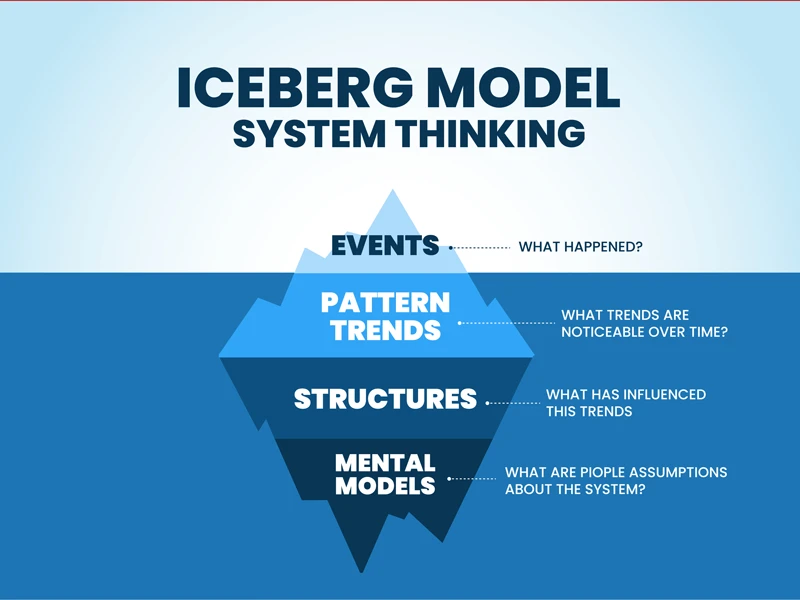
Emergent phenomena are the Events at the tip of the iceberg—the things we see and react to (e.g., a stock market crash, a project delay, a disease outbreak). A reductionist approach might try to find a single, immediate cause for the event. A systems thinker, grounded in holism, asks:
- Patterns: Has this happened before? What are the trends over time?
- Structure: What is the underlying structure of the system—the relationships, rules, and feedback loops—that is causing this pattern to recur?
- Mental Models: What are the beliefs, assumptions, and values that keep this structure in place?
The structure of a system generates its behavior. To change the events, you must change the structure. This is a core tenet of cybernetics and systems thinking.
This leads to another key concept: downward causation. Reductionism assumes only "upward causation"—the parts cause the whole. Holism recognizes that the whole also causes the parts to behave in certain ways.
Let's revisit the "Holism & Reductionism" video to explore this crucial implication.
Please watch the section on downward causation. The central idea is that the macro-level structure of the whole (e.g., a culture, an economic system, a language) constrains and shapes the behavior and even the formation of its micro-level parts (e.g., individuals, companies, words).
This is precisely why holism matters for a project like CyberSyn. Beer's goal wasn't just to optimize individual factories (the parts). It was to design a national economic structure (the whole) that would, through downward causation, guide the behavior of those factories toward the emergent goal of national economic viability. Attempting such a project with a purely reductionist mindset would be impossible; it would be like trying to understand a forest by analyzing a single tree.
Conclusion
In this lesson, we have moved from the system's boundary to its internal dynamics, exploring the fundamental concepts of holism and emergence.
Here are the key takeaways:
- Holism vs. Reductionism: Holism asserts that a system must be understood as a whole because its properties arise from the interactions between its parts. Reductionism seeks to understand the system by analyzing its parts in isolation.
- Emergence: This is the process where interactions among a system's components give rise to novel properties and behaviors that the components themselves do not possess. As the saying goes, "the whole is greater than the sum of its parts."
- Why They Matter: For complex systems, a reductionist approach is insufficient because it misses emergent properties and the powerful influence of the system's overall structure on its parts (downward causation). To understand, predict, or design the behavior of a complex system, a holistic perspective is essential.
We've established that the relationships between a system's parts are what create its most interesting behaviors. In our next lesson, we will begin to examine the most important type of relationship in cybernetics: the feedback loop. We will learn to identify the two fundamental types of loops—balancing (negative) and reinforcing (positive)—and see how they act as the engines that drive all system behavior.