In our previous lesson, we established a foundational understanding of what a system is, identifying its core components: elements, relationships, the boundary, and the environment. We saw that the act of drawing a system's boundary is a critical step that shapes our entire analysis. Today, we will focus on the nature of that boundary and what it allows to pass through.
This lesson directly addresses the learning outcome of distinguishing between open and closed systems. This distinction is not merely academic; it is one of the most fundamental concepts in systems thinking and cybernetics. Understanding whether a system is open or closed to its environment is the key to predicting its long-term behavior—whether it can adapt and survive, or whether it is destined for stagnation and decay. This concept will be essential as we later explore how complex organizations, like those studied by Stafford Beer, maintain their viability.
The Permeable Boundary: Defining System Types
The primary way to classify a system is by the permeability of its boundary. We can define three categories based on what the system exchanges with its environment.
A great starting point is the article "Open vs. Closed Systems" from Systems Theory Authority. It provides a crisp, formal set of definitions.
Open vs. Closed Systems: Key Differences ... - Systems Theory
This article clearly defines the three canonical types of systems based on their interaction with the environment.
Please read the introduction and the section "Definition and scope." Focus on the three definitions provided for open, closed, and isolated systems. Pay close attention to the distinction between the exchange of energy and matter.
To visualize these definitions, consider the following diagram. It clearly shows how mass (m) and heat (Q) are exchanged—or not—across the boundary of each system type.
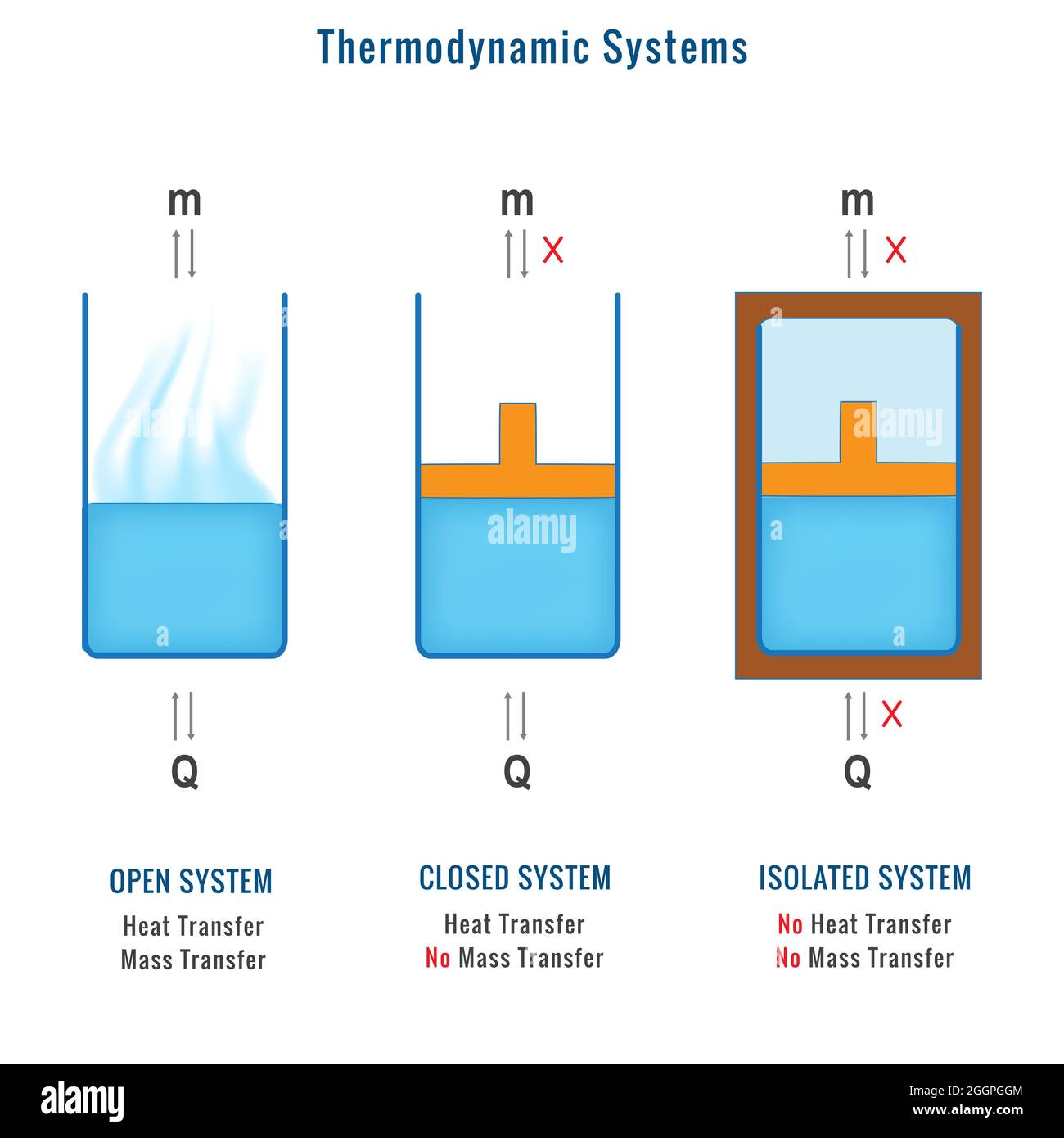
As you've seen, the three types are:
- Open System: Exchanges both matter and energy with its environment. A human being is a perfect example: we take in matter (food, water, air) and energy, and we release matter (waste, CO2) and energy (heat).
- Closed System: Exchanges energy but not matter with its environment. A sealed bottle of water placed in the sun is a simple example. It can absorb heat energy from the sun and get warmer, but no water enters or leaves the bottle.
- Isolated System: Exchanges neither matter nor energy. This is a theoretical ideal, useful for thought experiments in physics, but no such system truly exists. The universe itself might be considered an isolated system, but this is a topic of cosmological debate.
For our purposes in cybernetics, the crucial distinction is between open and closed systems.
Entropy and Equilibrium: The Fate of Systems
Why does this distinction matter so much? It comes down to the Second Law of Thermodynamics and the concept of entropy, which is a measure of disorder, randomness, or decay in a system.
A closed system, left to itself, will inevitably trend towards a state of maximum entropy. Its internal structures will break down, its energy will dissipate into a useless uniformity, and all organized activity will cease. This is known as thermodynamic equilibrium—a state of inertness and "death."
An open system, however, can defy this trend. By continuously importing low-entropy resources (like energy, information, and materials) from its environment and exporting high-entropy waste, it can maintain a highly organized internal structure far from thermodynamic equilibrium. This state is not static; it's a dynamic equilibrium, also known as a steady state or, in biology, homeostasis.
The following video provides an excellent, intuitive explanation of entropy in the context of organizational systems.
Systems Theory of Organizations
This video from the Organizational Communication Channel clearly explains entropy and why systems need inputs to avoid running down.
Watch the segment starting at the explanation of entropy. Notice the key idea: systems naturally "run down" and require a constant input of energy and resources to maintain balance (homeostasis).
This is the secret to viability. A living organism, a company, or a national economy can only survive by being an open system. The moment it becomes closed, it begins to die.
A Cybernetic Refinement: Openness to Information
The classical definitions focus on matter and energy. Cybernetics, as the study of communication and control, adds a crucial third element: information. A system can be open or closed to information independently of its relationship with matter and energy.
Klaus Krippendorff's "A Dictionary of Cybernetics" offers a more nuanced vocabulary that is extremely useful for analyzing social and technical systems.
[PDF] A Dictionary of Cybernetics
This resource provides precise cybernetic definitions that distinguish between different kinds of openness and closure.
First, read the entry for CLOSED SYSTEM. Note how it separates closure to energy, information, and organization. The idea that a system can be closed to information or organization is a key cybernetic insight. Next, read the entry for OPEN SYSTEM. Focus on the central idea that an open system is one with input that changes its behavior. Also, note the important clarification that systems are rarely fully open or closed, but rather "open to some and closed to other influences."
This gives us a more powerful analytical lens. Consider a highly bureaucratic organization. It is an open system in terms of matter and energy (it consumes office supplies and electricity, pays salaries). However, it might be functionally closed to information if it ignores customer feedback or market data. It might also be closed to organization if its structure is rigid and unchangeable. Such a system is not viable in the long run, even if it has plenty of resources.
Examples Across Domains
Let's ground these concepts with concrete examples, including some from your area of expertise.
Engineering: In your Computer Science background, a standalone computer running a program without any network connection can be thought of as a system closed to external information. The program's behavior is determined entirely by its internal logic and initial data. In contrast, a distributed cloud application with multiple microservices interacting via APIs is a quintessentially open system, constantly exchanging data with users and other services.
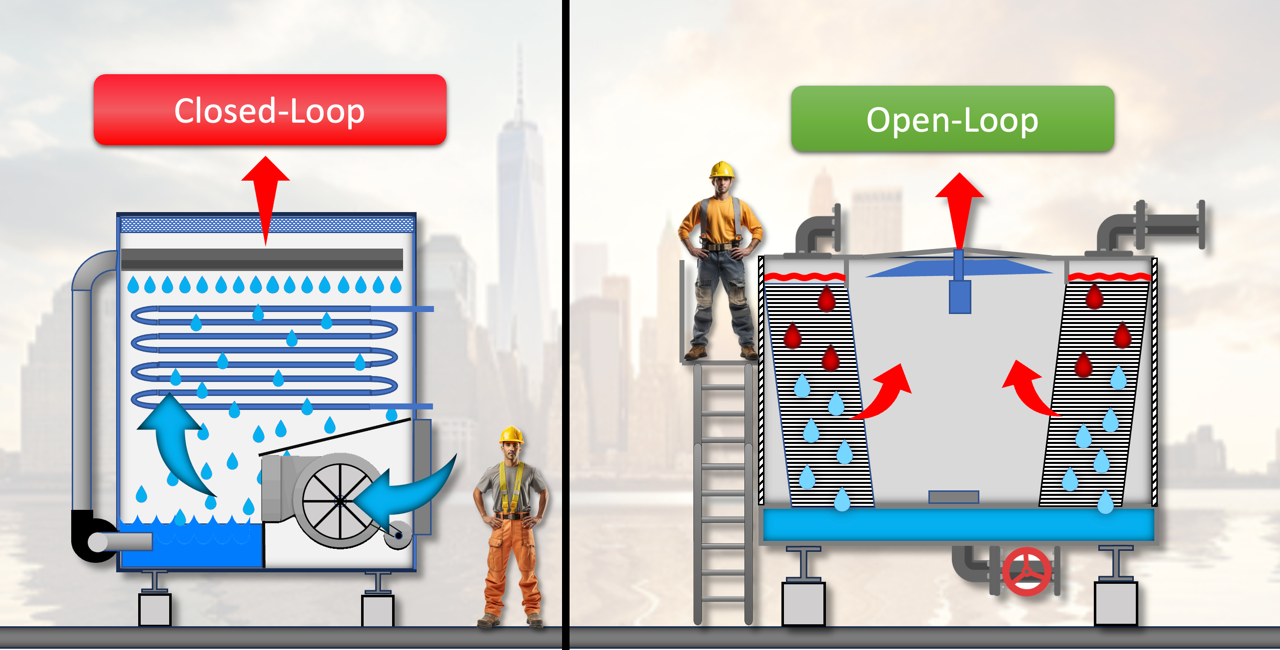
The distinction is also critical in mechanical engineering, as shown in the image below comparing open- and closed-loop cooling towers.
Organizations: As a rule, all functioning organizations are open systems. They must be. The "Systems Theory of Organizations" video uses a simple pizza place to illustrate the constant flow of inputs, throughputs, and outputs that keep it running.
Systems Theory of Organizations
This video provides a clear model of an organization as an open system.
Watch from the three main parts of an organizational system—inputs, processes, and outputs—using a pizza shop as an example. Then, continue watching to hear the emphasis on how systems are open to their environment through permeable boundaries.
Some may point to a nation-state like North Korea as an example of a "closed system." While it is highly restrictive, it is not truly closed. It still engages in limited trade (matter exchange), is subject to global political pressures (information exchange), and consumes energy. This highlights Krippendorff's point: systems are rarely absolutely open or closed, but rather exist on a spectrum. The question is how open or closed they are, and to what kinds of influence.
Conclusion
In this lesson, we have explored the critical distinction between open and closed systems, a concept defined by the permeability of a system's boundary.
Key takeaways include:
- Open systems exchange matter, energy, and information with their environment. They can maintain a state of dynamic equilibrium (homeostasis) and are capable of survival and adaptation.
- Closed systems exchange energy but not matter. They are subject to entropy and tend towards disorganization and decay.
- Isolated systems are a theoretical ideal that exchanges nothing with the environment.
- From a cybernetic perspective, openness to information and organization is just as critical as openness to matter and energy.
- All viable systems—from living cells to corporations to national economies—must be open systems.
This understanding is the bedrock for analyzing system viability. In our next lesson, we will delve deeper into the system's internal workings. We will explore the concepts of emergence and holism, investigating how the relationships between a system's elements give rise to properties and behaviors that are impossible to predict by studying the parts in isolation.