Hello! Welcome to the first lesson of our new module, "Rate of Return Analysis."
In the previous modules, we used Present Worth (PW) and Annual Worth (AW) to evaluate projects. These methods give us an answer in absolute dollar terms, telling us how much value a project is expected to create. Now, we're going to shift our perspective. We'll learn a method that provides a relative measure of a project's profitability—a percentage. This is like asking, "What rate of return is this project generating?" rather than "What is this project worth in today's dollars?"
Our goal for this lesson is to define the Internal Rate of Return (IRR) and its economic interpretation. We will explore what the IRR represents, how it's used to make investment decisions, and the conceptual foundation that makes it such a widely used metric in business and engineering.
What is the Internal Rate of Return (IRR)?
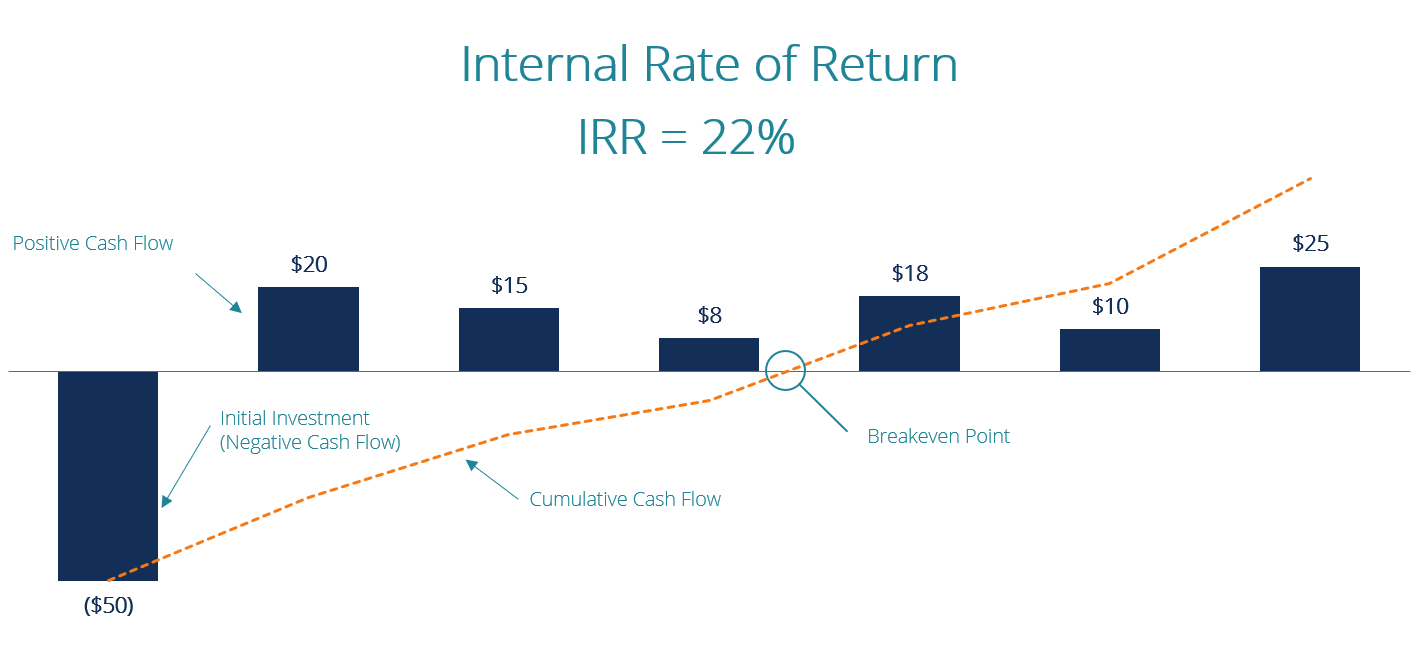
At its core, the IRR is a measure of a project's intrinsic profitability. Think of it as the effective interest rate that an investment is expected to earn over its lifetime.
Imagine you're evaluating a new software product. You have an initial development cost (an outflow) followed by several years of subscription revenue (inflows). The IRR is the single interest rate that would make the present value of all those future revenues exactly equal to your initial development cost.
Formally, the IRR is defined as the interest rate, i*, at which the Net Present Value (NPV) or Net Present Worth (NPW) of a project's cash flows equals zero.
The formula looks like this:
Where:
- is the net cash flow in period .
- is the life of the project.
- is the Internal Rate of Return we are trying to find.
The following resource from MIT provides a formal definition and explains the core decision rule.
Lecture 9 (S'04) Methods for Evaluating Individual Projects
This section from an MIT lecture note, 'Methods for Evaluating Individual Projects', gives a precise definition of IRR and the primary decision criterion associated with it.
Please read the section titled '2. Internal Rate of Return (IRR) Method' (page 3). Focus on the definition of IRR and the 'Decision criterion'. We will discuss the part about 'Descartes' Rule of Signs' and multiple solutions later.
The Economic Interpretation and the Decision Rule
As the reading highlights, the IRR represents the breakeven point for your cost of capital.
- If your company's cost of capital (your MARR) is exactly equal to the project's IRR, the project breaks even—it generates just enough return to cover its financing costs. Its NPW would be $0.
- If your MARR is less than the IRR, the project is earning more than its cost of capital, creating value for the company. Its NPW would be positive.
This leads to a simple and powerful decision rule for a single project:
If IRR ≥ MARR, accept the project.
If IRR < MARR, reject the project.
This rule provides a clear "go/no-go" signal for an investment based on its inherent rate of return.
A Deeper Interpretation: Pure vs. Mixed Investments
While the "NPW=0" definition is mathematically correct, it's helpful to understand what IRR means for the capital invested in a project over time. This brings us to the concept of Project Balance.
The Project Balance (PB) at any point in time is the amount of money tied up in, or committed to, a project. It's the net amount of capital that has not yet been recovered.
-
Pure Investment: In a simple project (initial outflow, subsequent inflows), the project balance is negative throughout the project's life until the final period. This means the project is always "owing" money back to the investor. In this case, the IRR has a clear meaning: it is the rate of return being earned on the unrecovered balance of the investment. Most of your software development projects will likely fall into this category.
-
Mixed Investment: For some complex projects, the cash flows might cause the project balance to become positive during the project's life. This means the project has generated surplus cash, which the company has effectively "borrowed" from the project. In this scenario, the overall return depends on what the company can earn on that surplus (an external rate), so a single "internal" rate of return becomes less meaningful.
For our purposes, it's important to know that IRR is most clear and useful when applied to pure investment projects.
The same MIT lecture note you just read explains this concept well.
Lecture 9 (S'04) Methods for Evaluating Individual Projects
Let's return to the same lecture note to understand this deeper interpretation of IRR.
Now, please read the section that begins 'To understand what lies behind these results...' on page 4 and continues to the bottom of page 6. Focus on the definitions of Project Balance (PB), 'PURE INVESTMENT', and 'MIXED INVESTMENT'.
Test your understanding!
You are evaluating two independent project proposals for your company, where the MARR is 12%.
- Project Hydra: Develop a new API for a partner. It has a calculated IRR of 19%.
- Project Phoenix: Refactor a legacy system to reduce technical debt. It has a calculated IRR of 10%.
Based only on the IRR rule, what can you definitively say about the acceptability of each project? What can't you conclude from this information?
Show answer
-
What you can say:
- Project Hydra is acceptable. Its IRR of 19% is greater than the MARR of 12%.
- Project Phoenix is not acceptable. Its IRR of 10% is less than the MARR of 12%.
-
What you can't say: You can't say anything about which project would add more value in absolute dollars. The IRR is a percentage, not a magnitude. It's also not a tool for comparing mutually exclusive projects, as a project with a lower IRR could potentially have a higher Net Present Worth. We will cover this comparison issue in a future lesson.
Important Considerations and Limitations
IRR is one of the most popular metrics in finance and engineering economics, but it's not without its quirks. It's important to be aware of its underlying assumptions and potential pitfalls.
Engineering Economics: Session 3
These slides from another MIT course provide a concise summary of the key issues to be aware of when using IRR.
Please review slide 75 ('Determining Equivalence: Internal Rate of Return (IRR)') for a quick recap, and then focus on slide 77 ('Issues with the IRR method').
As the slides point out, there are two main issues to keep in mind:
- The Reinvestment Assumption: The IRR calculation implicitly assumes that any positive cash flows generated during the project's life can be reinvested at the IRR itself. If your project has a very high IRR (e.g., 70%), this assumption can be unrealistic, as finding other investments with such a high return is unlikely. The MARR is often a more realistic rate for reinvestment.
- Multiple IRRs: For projects with non-conventional cash flows (where the sign of the net cash flow changes more than once, e.g.,
- + + -), it is mathematically possible to have more than one IRR. This can happen in projects that require a large decommissioning or cleanup cost at the end. When this occurs, the IRR method becomes ambiguous and other methods like NPW are preferred.
Conclusion
In this lesson, we have introduced the Internal Rate of Return as a powerful tool for project evaluation. It offers a different but complementary perspective to the worth-based methods we've already learned.
- Key Takeaways:
- The IRR is the discount rate that makes a project's Net Present Worth (NPW) equal to zero.
- Economically, it represents the project's intrinsic, compound rate of return.
- The fundamental decision rule for a single project is to accept it if its IRR is greater than or equal to your Minimum Acceptable Rate of Return (MARR).
- IRR is most reliably interpreted for "pure investments," where the investor is always a net lender to the project.
- It's crucial to be aware of the IRR's limitations, such as the reinvestment assumption and the potential for multiple solutions in non-conventional projects.
Preview of the Next Lesson
Now that you understand what the IRR is and what it represents, the natural next question is: "How do I find it?" In our next lesson, we will tackle exactly that. We will learn how to calculate the IRR for simple investment projects with conventional cash flows, using techniques like trial and error and linear interpolation.