Hello! Welcome back.
In our last two lessons, we established how to use Present Worth (PW) analysis to evaluate projects and compare alternatives, even when they have unequal lifespans. A key concept we introduced was "salvage value"—the residual worth of an asset at the end of a study period. Today, we're going to formalize and expand on that idea.
Your learning outcome for this session is to incorporate salvage values and disposal costs in present worth calculations. This means accounting for the cash flows that occur at the very end of a project's life, whether they are positive (you sell the asset) or negative (you pay to get rid of it). Given your experience managing projects and infrastructure, you know that retiring old systems or hardware is rarely a zero-cost exercise. This lesson will give you the tools to model these end-of-life events accurately.
Understanding End-of-Life Cash Flows
When a project concludes or an asset reaches the end of its useful life, two primary financial events can occur:
- Salvage Value (S): This is a cash inflow. It's the money you get back from selling the asset, trading it in, or scrapping it for materials. For a server, this might be its resale value on the second-hand market.
- Disposal Cost (DC): This is a cash outflow. It represents the expenses required to retire the asset. This is especially relevant in technology for tasks like secure data destruction, software decommissioning, or environmentally safe disposal of electronic components.
In essence, a disposal cost can be thought of as a negative salvage value.
The Total Cost of Ownership Perspective
In the IT world, these end-of-life costs are a critical part of the Total Cost of Ownership (TCO). TCO looks beyond the initial purchase price to include all costs over an asset's entire lifecycle: acquisition, operation, and retirement.
To give you a practical perspective on what these retirement costs entail in a software and IT context, please read the short section from the following article.
How to Calculate Total Cost of Ownership for Software
This article from Maven Solutions, a software consulting firm, provides a great overview of Total Cost of Ownership. Focus on the section discussing retirement costs to see real-world examples relevant to your field.
Please read only the section titled 'Retirement Costs'. Notice the examples provided, such as decommissioning, data security, and transition costs. These are precisely the kinds of expenses we model as disposal costs.
As you can see, ignoring these costs can give you a misleadingly optimistic view of a project's financial viability.
How to Calculate Present Worth with Salvage and Disposal Costs
The calculation itself is a straightforward application of what you already know. Both salvage value and disposal costs are treated as a single future sum () that occurs in the final year () of the analysis period. We simply find its present worth and add it to our total PW calculation.
- For a salvage value (S), the cash flow is positive:
PW_of_Salvage = +S(P/F, i, n) - For a disposal cost (DC), the cash flow is negative:
PW_of_Disposal = -DC(P/F, i, n)
Let's see this in action with a comprehensive example.
The resource below, Applied Engineering Economy, provides a clear, worked example of comparing three machines, each with a different first cost, annual cost, and salvage value.
The following guide demonstrates exactly how to incorporate salvage value into a Present Worth comparison. We will focus on Example 23.
Please review 'Example 23' in the section on 'Present Worth Analysis of Equal-Life Alternatives'. Pay close attention to how the salvage value is handled in the PW equations for each machine.
Let's break down the calculation for the first machine, Machine E, from that example:
- First Cost (P): $4,500
- Annual Cost (A): $900 for 8 years
- Salvage Value (S): $200 at year 8
- MARR (i): 10%
The PW equation is set up as follows:
Notice the signs:
- The initial cost and annual costs are outflows (negative).
- The salvage value is an inflow (positive).
As the text states: "The salvage values are considered a “negative” cost, so a + sign precedes them. (If it costs money to dispose of an asset, the estimated disposal cost has a - sign.)" This single sentence perfectly summarizes the rule.
If Machine E had a disposal cost of $200 instead of a salvage value, the equation would change to:
A Visual Example
The following image provides another illustration of this principle, this time in the context of a defined study period (which we covered in our last lesson).
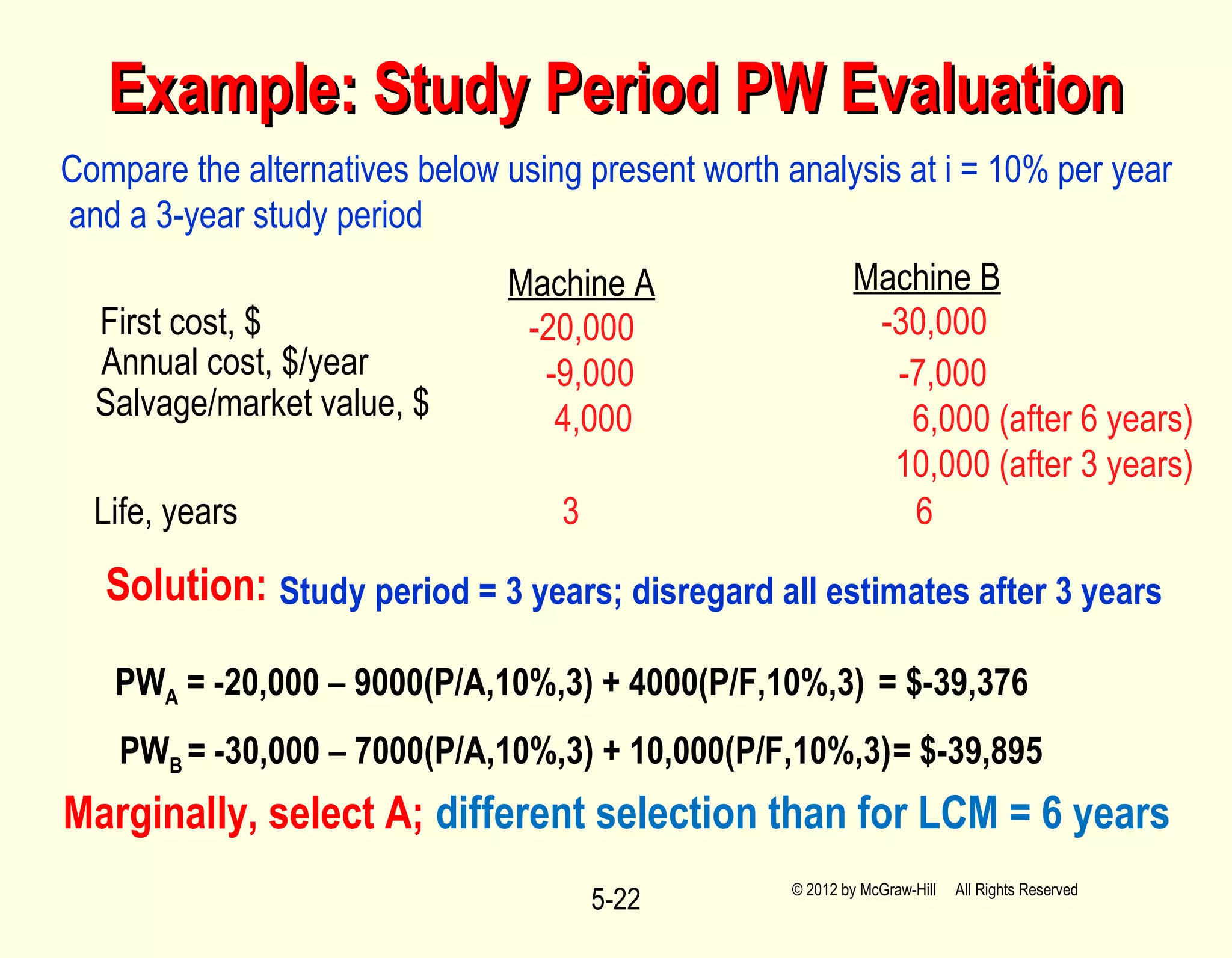
This example reinforces how the salvage value is consistently treated as a positive cash flow at the end of the analysis period, regardless of whether that period is determined by the asset's life or a specific study period.
Test your understanding!
Your company is considering a new server for its internal operations. You need to calculate its Present Worth of costs over its entire useful life. The MARR is 12%.
- Initial Cost: $25,000
- Useful Life: 5 years
- Annual Maintenance Cost: $3,000
- End-of-life Secure Decommissioning Cost: $2,000
What is the Present Worth of this server investment? You will need the following factors: (P/A, 12%, 5) = 3.6048 and (P/F, 12%, 5) = 0.5674.
Show answer
We set up the PW equation, treating the initial cost, annual costs, and the final decommissioning cost as outflows (negative).
The total present worth of the cost of owning and operating this server for 5 years is $36,949.20.
Conclusion
You have now mastered a crucial detail in conducting accurate economic analyses. By correctly accounting for end-of-life cash flows, your evaluations will be more realistic and comprehensive.
- Key Takeaways:
- Salvage Value (S) is a positive cash inflow at the end of an asset's life, and its PW is added to the total PW.
- Disposal Cost (DC) is a negative cash outflow, and its PW is subtracted from the total PW.
- Both are treated as a single future sum () and are discounted to the present using the
(P/F, i, n)factor. - Considering these costs is a key part of understanding the Total Cost of Ownership (TCO) of any technology asset.
Preview of the Next Lesson
With a solid foundation in PW analysis, we can now start applying it to common strategic decisions in software engineering. In our next lesson, we will apply the present worth method to build-vs-lease decisions for technology infrastructure. This will involve comparing the costs of leasing cloud resources versus purchasing your own hardware—a classic dilemma you have likely faced in your career.