Hello! Welcome back to our study of engineering economics.
In our last lesson, we established the Minimum Acceptable Rate of Return (MARR) as the critical benchmark, or "hurdle rate," that any investment must clear to be considered worthwhile. We learned that the MARR is frequently used as the discount rate in project evaluations.
Today, we will put that discount rate to work. Our goal is to calculate the present value of a single future cash flow. This is the first and most fundamental calculation in the Present Worth method of analysis. It answers the crucial question: "What is a promised amount of money in the future worth to me, right here, right now?"
For you, this skill is the key to objectively comparing a future revenue gain from a new SaaS feature against the immediate cost of developing it.
Why is Future Money Worth Less Today? The Concept of Discounting
Imagine someone offers you a choice: $10,000 today or $10,000 five years from now. The choice is obvious—you'd take it today. Why? Because you could invest that $10,000 today and have more than $10,000 in five years. This is the time value of money in action.
The process of determining the "today value" of a future amount is called discounting. It's the inverse of compounding. While compounding tells us how a present sum grows into a future value, discounting tells us how much a future sum shrinks when translated back to its present value.
The rate at which we discount is our old friend, the MARR. It represents the opportunity cost—the return we are giving up by not having the money today.
The formula for this process is straightforward.
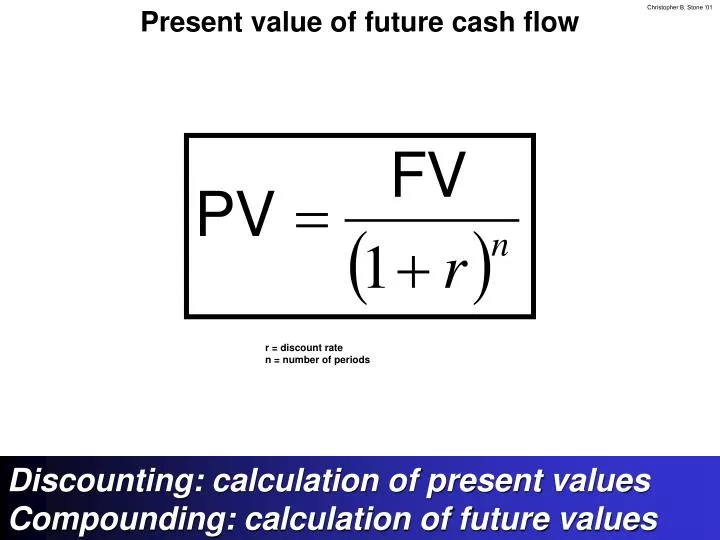
The Present Value Formula and Notation
To perform these calculations consistently, we use a standard set of notation, which you'll see throughout engineering economics.
These slides from an MIT lecture introduce the standard notation and the formal equation for calculating the present amount (P) from a future amount (F).
First, review the 'Notation' slide (page 5 of the PDF, labeled 'Slide 11') to familiarize yourself with the variables P, F, i, and N. Then, read the 'Formulae for N Periods – Single Payments' slide that defines the Present Amount (page 7 of the PDF, labeled 'Slide 16').
As you saw in the reading, the core variables are:
- P = Present sum of money, or Present Value (PV)
- F = Future sum of money, or Future Value (FV)
- i = Effective interest rate per period (our discount rate, e.g., the MARR)
- N = Number of compounding periods (e.g., years)
The formula to find the present value is:
Or, written differently:
The term in the brackets, , is known as the Present Worth Factor. You'll often see this represented in a standard shorthand notation: (P/F, i%, N). This reads as: "To find P, given F, at an interest rate of i% for N periods."
Using this notation, the formula becomes:
For a software engineer, you can think of (P/F, i%, N) as a function call calculate_present_worth_factor(interest, periods) that returns the correct multiplier.
A Worked Example
Let's apply this with a simple example from the MIT materials.
This slide provides a straightforward problem to practice the present value calculation.
Read the 'Single Payment Example' on page 9 of the PDF (labeled 'Slide 19'). We will solve this together.
Problem: An investor can purchase land that will be worth $10,000 in 6 years. If the investor's MARR (their discount rate) is 8%, what is the maximum they should pay for the land today?
Solution:
-
Identify the variables:
- Future Value, F = $10,000
- Number of periods, N = 6 years
- Discount rate, i = 8% or 0.08
-
Set up the formula:
-
Calculate the result:
This means the future $10,000 is only worth about $6,302 in today's money to this investor. Paying any more than this would result in a rate of return lower than their required 8%.
Test your understanding!
Your company is upgrading a key piece of its cloud infrastructure. The new system costs $120,000 today. You project that this upgrade will prevent a major failure, saving the company from an estimated $200,000 loss four years from now.
If your company's MARR for infrastructure projects is 10%, what is the present value of that future $200,000 saving? Based on this calculation alone, does the saving's present value justify the immediate cost?
Show answer
-
Variables:
- F = $200,000
- N = 4 years
- i = 10% or 0.10
-
Calculation:
-
Conclusion: The present value of the future saving is $136,602.70. Since this is greater than the upfront cost of $120,000, the investment appears to be economically justified. The project is expected to deliver value above and beyond the MARR.
Application: The Building Block of Net Present Value (NPV)
This simple calculation is the fundamental building block for Net Present Value (NPV) analysis, one of the most robust methods for evaluating complex projects. An entire project's financial life is just a series of cash flows (positive and negative) over many years. NPV is simply the sum of the present values of all these individual cash flows.
A CFO's Guide to Calculating the ROI of Custom Software ...
To see how this single calculation powers a complete project evaluation, let's look at a practical guide written for CFOs evaluating custom software development.
First, read the subsection titled 'Net Present Value (NPV): Accounting for the Time Value of Money'. Note how the NPV formula is just a sum of the PV formula we are using today, applied to each year's cash flow. Then, quickly look at 'Table 4: Sample ROI Calculation Walkthrough - AP Automation Software'. Focus on the 'Present Value of NCF' row. This shows our calculation in action, applied year after year to determine the total value of the project in today's dollars.
As that guide shows, a real project evaluation involves applying the PV formula to every future cash flow, then summing the results. For example, in Table 4, the Net Cash Flow of $76,000 in Year 3 is discounted to a present value of $57,076 (because ). By mastering today's single-payment calculation, you've already mastered the core component of full-scale NPV analysis.
Conclusion
Today we've translated the abstract concept of the time value of money into a practical calculation. You now have the tool to determine the value of any single future sum in today's dollars.
- Key Takeaways:
- Discounting is the process of finding the present value (P) of a future sum (F).
- The formula is ** **, where 'i' is the discount rate (often the MARR).
- This calculation is the fundamental building block for the Net Present Value (NPV) method, which is used to evaluate the total worth of complex projects.
Preview of the Next Lesson
We've learned how to bring future money back to the present. In the next lesson, we will do the reverse: we will calculate the future value of a single present cash flow. This will complete our toolkit for handling single payments across time.