Hello! Welcome to the next lesson in our exploration of engineering economics.
In our last session, we focused on discounting—the process of calculating the present value of a future sum of money. We answered the question, "What is a future amount worth today?" using the formula .
Today, we'll look at the other side of that coin. Our goal is to calculate the future value of a single present cash flow. This involves compounding, the process that makes investments grow over time. This skill is fundamental for projecting the future worth of an investment you make today, whether it's investing capital in a new server or committing funds to a development project.
The Power of Compounding
In the previous lesson, we established that money today is more valuable than the same amount of money in the future. The primary reason is that money you have today can be invested to earn a return. The process of that money growing by earning interest on both the original principal and the accumulated interest is called compound interest.
Let's look at how this works year by year.
Vol. II, Essay 2: Equivalence of Cash Flows
To understand how a present sum grows into a future value, we first need to grasp the power of compound interest. This essay from MIT explains the concept and walks through a clear, year-by-year example.
Read the section titled 'Time Value of Money'. Focus on the paragraph that begins 'For example, suppose you deposit $1,000 in a bank...' and study Table 1, which shows the growth of the deposit over five years.
As you saw in the reading, a sum of money doesn't grow linearly. Each year, the interest earned is added to the principal, and the next year's interest is calculated on this new, larger amount. This "interest on interest" effect is what leads to exponential growth over time.
While we can calculate the future value year by year as shown in Table 1, it's far more efficient to use a single formula, especially for longer time periods.
The Future Value Formula
The process of compounding can be expressed with a concise formula that directly calculates the future value of a present sum.
These slides from an MIT lecture formally define the formula and standard notation for calculating the future value of a single payment.
First, quickly review the 'Notation' slide (page 5 of the PDF, labeled 'Slide 11') to refresh your memory on the variables P, F, i, and N. Then, study the 'Formulae for N Periods – Single Payments' slide that defines the Future Amount (page 7 of the PDF, labeled 'Slide 15'). Pay attention to both the formula and the (F/P, i%, N) notation.
To summarize the key points from the reading:
- P = Present sum of money (Present Value)
- F = Future sum of money (Future Value)
- i = Effective interest rate per period
- N = Number of compounding periods
The formula to find the future value is:
The term is known as the Compound Amount Factor or Future Worth Factor. In standard engineering economic notation, this factor is represented as (F/P, i%, N). This shorthand reads: "To find F, given P, at an interest rate of i% for N periods."
Using this notation, the formula is written as:
This is the mathematical inverse of the Present Worth Factor we used in the last lesson. Notice that .
A Visual Summary
The following image provides a clear visual summary of the formula, its components, a cash flow diagram, and a worked example.
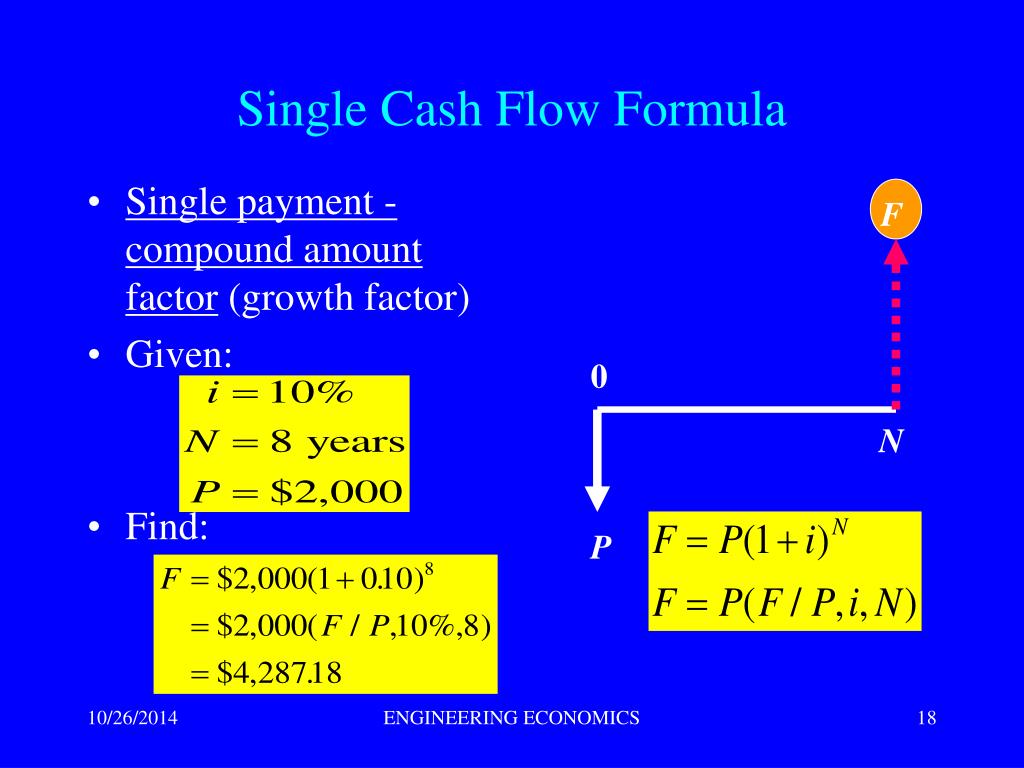
Let's walk through the example in the image:
- Problem: What is the future value of $2,000 invested for 8 years at an interest rate of 10% per year?
- Variables:
- P = $2,000
- i = 10% or 0.10
- N = 8 years
- Calculation:
The initial $2,000 investment will more than double to $4,287.18 in 8 years at a 10% compound annual growth rate.
Test your understanding!
You are the lead on a new project and have an initial budget of 500,000 ETB. You are considering an alternative: instead of starting the project now, you could invest this capital in a government bond that yields a guaranteed 7% annually.
What would be the future value of this 500,000 ETB investment after 5 years? Calculating this helps you quantify the future opportunity cost of starting your project today.
Show answer
-
Variables:
- P = 500,000 ETB
- i = 7% or 0.07
- N = 5 years
-
Calculation:
-
Conclusion: The future value of the alternative investment would be 701,276 ETB. This is the amount of money the company forgoes in 5 years by choosing to spend the 500,000 ETB on your project now instead of investing it.
Conclusion
Today, we've completed our look at single cash flows by learning how to project a present value into the future. You are now equipped to move money both forward and backward in time, a core competency in economic analysis.
- Key Takeaways:
- Compounding is the process by which an investment grows, earning returns on both the principal and prior interest.
- The formula to calculate future value is ** **.
- The Compound Amount Factor, , is the multiplier that grows the present sum to its future value, often denoted as (F/P, i, N).
Preview of the Next Lesson
The Future Value formula is powerful for precise calculations. However, in business meetings or early-stage project discussions, you often need a quick, back-of-the-envelope estimate. In our next lesson, we will learn a very useful mental shortcut: the Rule of 72, which allows you to quickly estimate the time it takes for an investment to double in value.