Hello! Welcome back to your study of Engineering Economics.
Introduction
In our last lesson, we mastered how to handle inflation by ensuring our project evaluations are consistent, either by using actual dollars with a market interest rate or real dollars with a real interest rate. This was a crucial step in making our financial models more realistic. However, those models still operated under one major assumption: that the future is a fixed path we commit to from day one.
As an experienced manager and entrepreneur, you know that this is rarely the case. You don't just launch a project and hope for the best; you adapt. You pivot, scale up successes, and cut losses on failures. This managerial flexibility has immense value, but it's completely ignored by standard Net Present Worth (NPW) analysis.
Today, we introduce a concept that formally recognizes and values this flexibility: Real Options. This lesson will address the learning outcome: Define a real option and identify common types in technology projects (e.g., to defer, expand, abandon). We will explore how treating investment opportunities as options, rather than as static commitments, provides a more powerful and realistic framework for decision-making, especially in the uncertain world of technology.
1. From Static Decisions to Dynamic Flexibility
Traditional Discounted Cash Flow (DCF) analysis, like the NPW method, forces a "now or never" decision. It calculates a project's value based on a single, predetermined operating strategy. If the NPW is positive, you accept; if negative, you reject.
But what if a negative-NPW project has the potential for a huge upside if the market develops favorably? What if you could wait a year to see how a new technology matures before committing? This is the domain of real options.
A real option is the right, but not the obligation, to take a certain business action in the future. The "option" is "real" because it pertains to tangible assets like factories, products, or software platforms, as opposed to financial assets like stocks.
To get a formal definition from an MIT perspective, let's turn to a paper on the topic.
Valuing Innovative Technology R&D as a Real Option
This section of an MIT thesis provides a concise and formal definition of real options. It explains how they represent opportunities to modify projects, allowing you to capture potential gains and limit downside losses.
Please read the first paragraph of Chapter 4, under the heading 'Real Options as a Way of Thinking'. Focus on the definition of a real option and how it contrasts with financial options.
The key insight is that uncertainty, which is typically viewed as a negative (risk), can actually increase the value of a project if you have the flexibility to respond to it. A real option is the mechanism for that flexibility. Just as you wouldn't exercise a financial stock option if it were unprofitable, you wouldn't exercise a real business option (like expanding a failing product line) if it were a bad decision. This ability to selectively act on good outcomes and avoid bad ones is where the value comes from.
2. Identifying Real Options in Technology Projects
Your background in software development and business scaling is a natural fit for real options thinking. Technology projects are defined by uncertainty:
- Market Uncertainty: Will customers adopt our new SaaS platform?
- Technological Uncertainty: Will this new programming framework deliver the promised performance?
- Competitive Uncertainty: What will our competitors do in response to our launch?
Instead of being paralyzed by these uncertainties, you can structure your projects to exploit them. This involves intentionally building in decision points.
The following resource provides excellent examples of how this is applied in the IT industry.
Managing Information Technology Investment Risk
This paper focuses specifically on IT investment risk. It will help you see how the abstract concept of real options translates into concrete strategies for managing software and technology projects.
Read the 'Introduction' and the 'Sample Investment Situation' sections. Notice the examples of real-world IT projects (like Merrill's Cash Management Account) and the hypothetical 'Internet Sales Channel' project. Pay attention to how flexibility (deferral, piloting, scaling) is proposed to manage project uncertainties.
As the paper illustrates, thinking in terms of options is a mindset shift. An initial investment is not just a one-time cost; it can be the price you pay to acquire an option for future growth. A pilot project isn't just a small-scale version of the final product; it's an investment that gives you the option to either expand, pivot, or abandon based on real market feedback.
3. A Taxonomy of Common Real Options
To apply this thinking, you need to be able to recognize the different types of options that might be present or that you could create. Here are some of the most common ones found in technology projects.
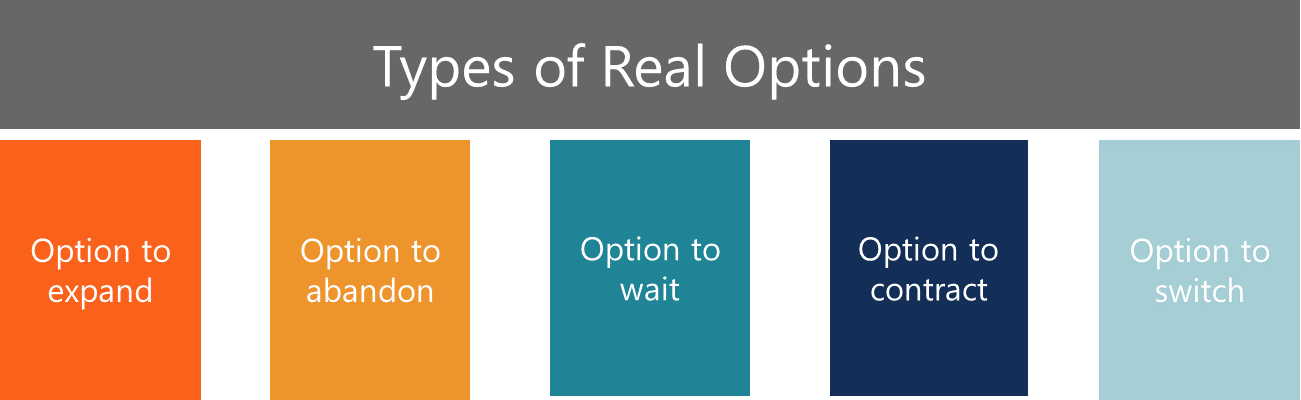
Let's explore these and a few others in more detail. The following resource provides a fantastic table that defines these options in an IT context.
Managing Information Technology Investment Risk
This table clearly defines the most common types of real options you will encounter or can build into technology projects. It provides a practical vocabulary for discussing and identifying strategic flexibility.
Focus on 'Table 2: types of real options that could be embedded in IT investments'. Read through the definition of each option and think about how it might apply to projects you've managed.
Based on that table, here is a summary of the most critical option types for your work:
-
Option to Defer (or Wait): The right to delay an investment until you have more information. This is valuable when markets are uncertain or a technology is still maturing.
- Your Context: Delaying a full-scale investment in a new platform until you see whether a new data privacy law passes.
-
Option to Abandon: The right to shut down a project and liquidate its assets if it proves unprofitable. This caps your potential losses.
- Your Context: Launching a new mobile application but having a pre-defined point at which, if user engagement is too low, you cease development and sell the codebase or user data.
-
Option to Expand (or Scale): The right to make additional investments to increase the scale of a project if it turns out to be a success.
- Your Context: Building the initial version of a SaaS platform to handle 1,000 users, but designing the architecture so that you can easily (and cheaply) exercise an option to scale it to 1,000,000 users if demand is high.
-
Option to Contract: The right to reduce the scale of operations if a project is less successful than hoped. This is the opposite of the expansion option.
- Your Context: Launching a service with 24/7 customer support, but retaining the option to scale back to business hours if call volume is low, thereby saving on operational costs.
-
Staged Investment Option (or Explore/Pilot): Investing in phases, where each phase gives you the option to proceed to the next. This is the foundation of Agile development and the MVP (Minimum Viable Product) concept.
- Your Context: Instead of funding a 2-year project upfront, you fund a 3-month MVP build. The success of the MVP gives you the option to fund the next 6-month phase.
-
Option to Switch: The right to change inputs, processes, or outputs in the middle of a project.
- Your Context: Designing a web application to be deployable on either AWS or Azure. This gives you the option to switch providers if one becomes significantly cheaper or offers better features.
Test your understanding!
You are evaluating a proposal to build a new B2B SaaS platform for your agricultural clients. The full development is projected to cost 1,000,000 ETB. The market is new and uncertain.
Instead of committing the full amount, your team suggests a revised plan:
- Phase 1 (Cost: 150,000 ETB): Build an MVP and pilot it with three key clients over six months.
- Phase 2 (Cost: 850,000 ETB): If the pilot is successful (i.e., clients are willing to pay a certain price), proceed with the full build-out. If the pilot fails, the project is terminated.
What key real options are embedded in this revised proposal?
Show answer
This proposal is rich with options:
- Staged Investment Option: The entire project is broken into two phases, with a decision gate in between.
- Option to Abandon: If the MVP pilot fails, you have the right to abandon the project, limiting your total loss to the 150,000 ETB spent on Phase 1.
- Option to Expand: The decision to proceed with Phase 2 is an option to expand the project from a small-scale MVP to a full-scale product.
- Option to Defer: Implicitly, by not committing the full 1,000,000 ETB today, you are deferring the 850,000 ETB investment decision for six months, during which you will gather more market information.
Conclusion
Today you've added a powerful strategic layer to your project evaluation toolkit. You've moved beyond the rigid world of static DCF and into the dynamic reality of managerial flexibility.
- Key Takeaways:
- A real option is the right, but not the obligation, to make a future business decision regarding a real asset.
- Real options have value because they allow you to capitalize on positive uncertainty (upside potential) while limiting the impact of negative uncertainty (downside risk).
- Traditional NPW analysis ignores this value and can therefore lead to rejecting valuable, flexible projects.
- Common types of real options in technology include the options to defer, abandon, expand, contract, switch, and stage an investment. Recognizing these is the first step to making better strategic decisions.
Preview of the Next Lesson
Identifying options is the first step. The next logical question is: "How much is this flexibility actually worth?" In our next lesson, we will begin to answer that. We will learn how to use decision tree analysis to model and evaluate a project that includes a real option, allowing us to put a quantitative value on the strategic choices you have as a manager.