Hello! Welcome to the ninth module of our course.
In the previous module, we reached a major milestone: performing a complete after-tax analysis to determine a project's Net Present Worth (NPW). This gave us a powerful, data-driven method for making a "go/no-go" decision based on our best estimates for costs, revenues, and tax implications.
However, experienced managers like yourself know that the real world rarely conforms perfectly to our estimates. What happens if our projections are wrong? What if customer acquisition is slower, or development costs are higher than planned? This module is all about confronting this reality.
Today's lesson is the conceptual starting point for this new topic. We will distinguish between risk and uncertainty in the context of engineering economics. Understanding this fundamental difference is critical because it dictates which tools and strategies we should use to make robust decisions when the future is not guaranteed.
1. From Certainty to Uncertainty
So far in our analyses, we've mostly worked with deterministic estimates. We assumed a specific initial cost, a definite series of revenues, and a known salvage value. This was necessary to learn the mechanics of evaluation methods like NPW.
Now, we acknowledge that these numbers are forecasts, not facts. The future is unpredictable. In engineering economics, we categorize this unpredictability into two distinct concepts: risk and uncertainty.
Let's start with some foundational definitions.
1.011 Project Evaluation Dealing with Risks & Uncertainty
These lecture notes from an MIT Project Evaluation course provide clear, concise definitions for risk and uncertainty and list several categories of risk that are common in large projects.
Please read the section titled '1. Definitions'. Pay close attention to the distinction made between 'Uncertainty' and 'Risks'. Also, note the different examples of risks provided (Construction, Competitive, Financial, Political), as these provide a useful framework for thinking about your own projects.
As the notes explain:
- Uncertainty is a broader concept. It stems from the fact that we cannot predict the future perfectly. There may be variations, trend changes, or entirely new situations we haven't encountered before.
- Risk refers more specifically to the possibility that something will go wrong, leading to a negative outcome (like a financial loss). We can often categorize and analyze these potential negative events.
This distinction might seem subtle, but it has profound implications for how we analyze and manage projects. The following image provides a great side-by-side comparison to solidify the key differences.
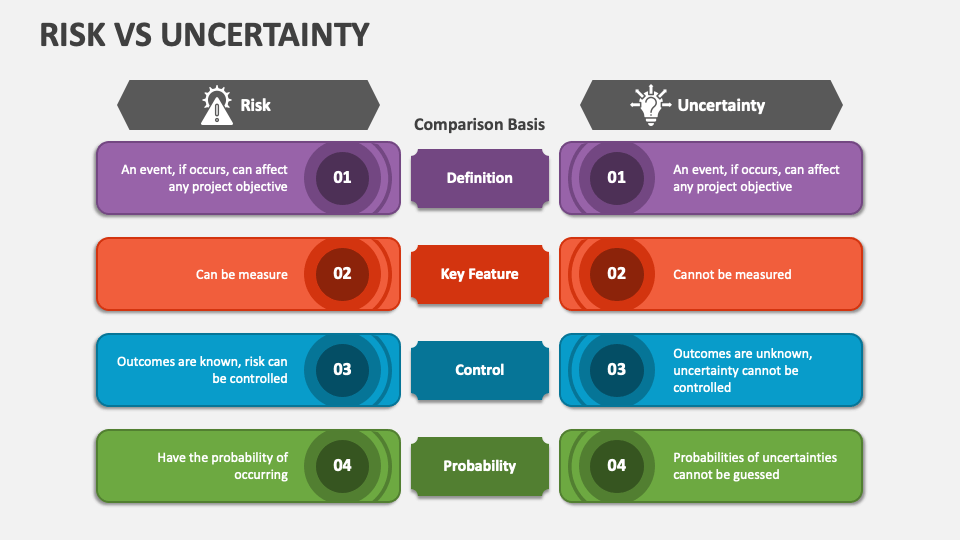
2. The Formal Distinction: Knightian Uncertainty
The distinction we're discussing was formally established by the economist Frank Knight in his 1921 book, Risk, Uncertainty, and Profit. His framework is essential for clear thinking in economic analysis.
To dig deeper into this formal distinction, the following article from MIT News provides a very clear explanation.
Explained: Knightian uncertainty
This article, titled 'Explained: Knightian uncertainty', elaborates on Frank Knight's crucial distinction between situations where odds can be measured versus those where they cannot.
Please read the article, focusing on the paragraphs that define Knight's view of risk and uncertainty. Pay special attention to the examples used, such as the airline accident vs. the 30-year economic outlook. Also, consider the discussion of how this concept applies to the behavior of financial firms.
To summarize and apply Knight's ideas to our context:
Risk exists when we don't know the exact outcome, but we can define all possible outcomes and assign a probability to each one. This is possible when we have a large amount of historical data or a well-understood physical model.
- Key attribute: Measurable or quantifiable probability.
- Tech Example: Estimating the number of defective units in a production run of a hardware device. Based on past manufacturing data, you might determine there is a 0.1% probability of a defect. This is a risk. You can model this financially using expected values.
Uncertainty exists when we cannot define all possible outcomes, or more commonly, we cannot assign meaningful probabilities to the outcomes we can imagine. This happens in novel situations without historical precedent.
- Key attribute: Not susceptible to measurement; probability is incalculable.
- Tech Example: You are launching a disruptive SaaS product creating a whole new market category. What will the customer adoption rate be in the first three years? There is no historical data. Competitor reactions, shifts in technology, and changing customer tastes are all unknown variables. This is true uncertainty.
Your experience in software development provides a great analogy.
- The probability of a server experiencing downtime can be treated as a risk. You can use historical data and metrics like Mean Time Between Failure (MTBF) to estimate the odds and mitigate it with redundant systems.
- The future market success of a completely novel app you're building from scratch is an uncertainty. You can't calculate the probability of it going viral. You manage this by using agile development, gathering user feedback, and being prepared to pivot your strategy.
3. Why This Distinction Governs Our Strategy
Distinguishing between risk and uncertainty isn't just an academic exercise. It directly influences the tools we choose for project evaluation.
-
When dealing with Risk (measurable probabilities): We can use quantitative methods like probabilistic analysis and expected value calculations. We can buy insurance or build in explicit redundancies to mitigate known risks. We will cover these methods in Module 10.
-
When dealing with Uncertainty (unmeasurable probabilities): We must rely on different strategies. We can't calculate a single "expected" NPW. Instead, we aim to understand the project's vulnerabilities and build in flexibility. The techniques in this module are designed for this:
- Breakeven Analysis: Identifies the point at which we stop losing money.
- Sensitivity Analysis: Shows us which uncertain variable has the biggest impact on our project's profitability.
- Scenario Analysis: Explores outcomes under pessimistic, optimistic, and most-likely futures.
Test your understanding!
For each of the following scenarios in a software company, classify the situation as primarily involving risk or uncertainty, and briefly state why.
- Forecasting the monthly cloud hosting bill for a mature, stable application with a predictable user base.
- Estimating the potential market size for a new platform that uses generative AI to write marketing copy, a technology that is still rapidly evolving.
- The possibility that your lead database administrator, a key employee, might accept a job at another company within the next year.
- The potential for a major new data privacy law, similar to GDPR, to be enacted in your primary market within the next five years.
Show answer
- Risk: The user base is stable and pricing tiers are known. While usage might fluctuate slightly, you can analyze past data to create a probability distribution of costs and calculate an expected value. The outcomes and probabilities are reasonably measurable.
- Uncertainty: This is a classic case of uncertainty. The technology is new, the market doesn't exist yet, competitor actions are unknown, and customer acceptance is a complete unknown. There is no reliable historical data to assign probabilities to potential market sizes.
- Risk: This can be treated as a risk. While you don't know if this specific person will leave, you can use historical employee turnover data for your company and the industry to estimate the probability. You can mitigate this risk with succession planning and knowledge-sharing protocols.
- Uncertainty: The passage of such a law, its specific contents, and its ultimate impact on your business model are all highly unpredictable. You can't calculate a meaningful probability of a specific outcome. You would manage this through scenario planning (what if it passes vs. what if it doesn't?) and building a flexible business model.
Conclusion
Today we've established a crucial conceptual foundation for the rest of this module. You now understand the formal economic distinction between risk and uncertainty, a distinction that is vital for sophisticated project analysis.
- Key Takeaways:
- Risk applies to situations where outcomes are unknown but their probabilities are measurable.
- Uncertainty applies to situations where probabilities are themselves unknown or incalculable.
- This distinction is critical because it determines the analytical tools and management strategies we should use.
Preview of the Next Lesson
Now that we appreciate the nature of uncertainty, how do we begin to analyze a project in its presence? Our first tool will be breakeven analysis. In the next lesson, you will learn how to perform this analysis to identify the exact value of a critical project parameter (like units sold or subscription price) at which a project becomes financially viable.