Hello! Welcome to our next lesson.
In our last session, we learned the mechanics of the rollback procedure, which is the algorithm for "solving" a decision tree. You now know how to calculate the expected value at chance nodes and how to select the optimal path at decision nodes.
Today, we'll put that knowledge into practice. The goal of this lesson is to apply decision tree analysis to a technology investment problem with uncertain outcomes. We'll work through a complete case study that mirrors the strategic choices you'd face as a software engineer or manager, moving from a problem description to a final, justified recommendation.
1. Framing a Technology Investment Problem
Let's start with a common scenario in the tech world. Imagine you are managing the infrastructure for a growing e-commerce platform. You anticipate a massive traffic surge for an upcoming sales event, and you must decide how to prepare your servers. You have two choices:
- Invest heavily in a brand-new, powerful server.
- Opt for a cheaper upgrade of your existing hardware.
Each choice has an initial cost. The outcome, however, depends on an uncertain future event: whether the traffic surge is "heavy" or "low." Your final profit will depend on the path you choose and the outcome that occurs.
This is a classic problem for decision tree analysis. Your background in software development and management involves constantly weighing such trade-offs between initial investment, performance, and risk. The decision tree gives us a formal structure for this analysis.
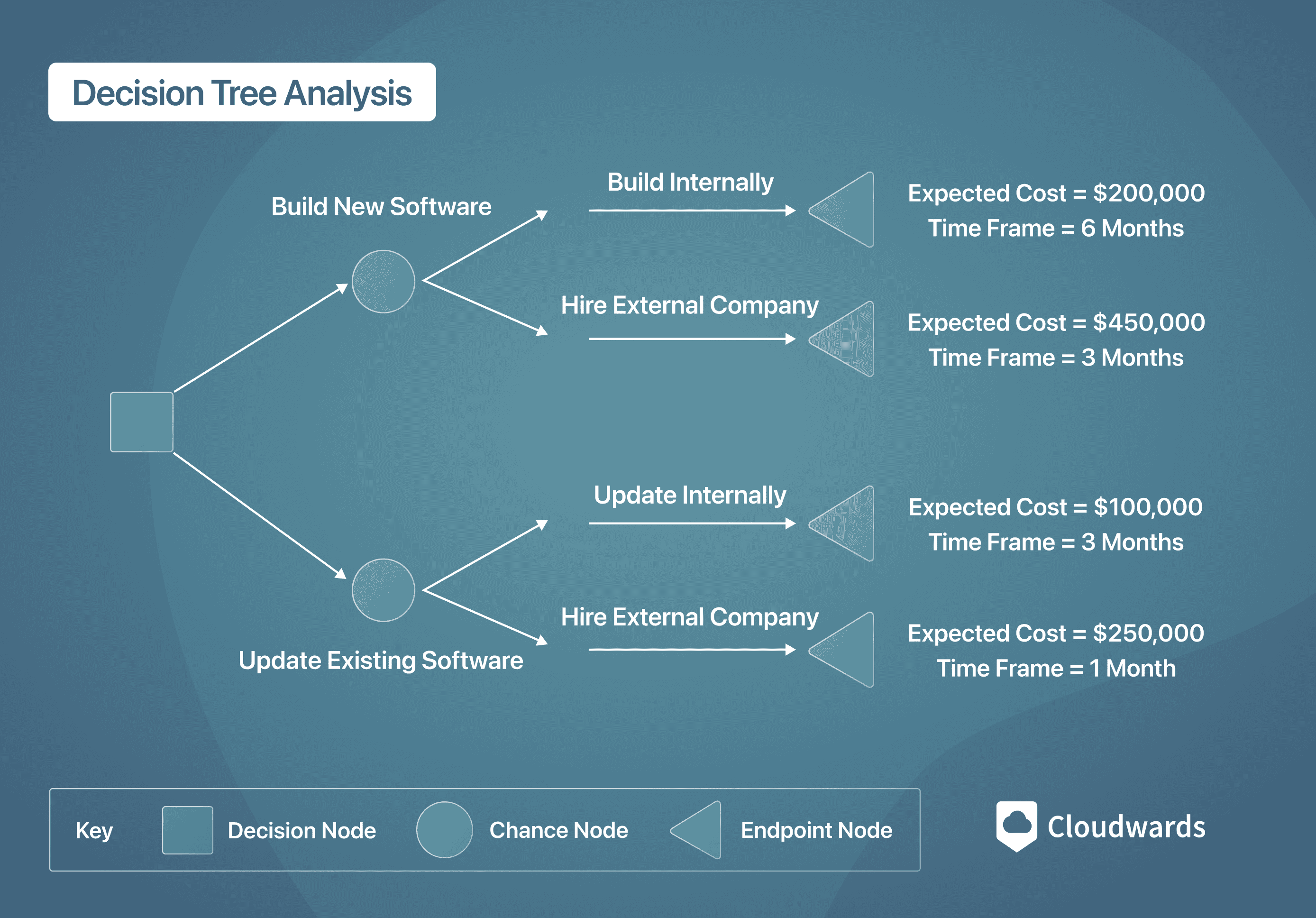
The image below shows a generic example of how a software development decision can be structured as a decision tree, with initial choices leading to further options and final outcomes.
2. Case Study: E-Commerce Server Upgrade
Now, let's work through the server upgrade problem step-by-step. The following video provides an excellent, concise walkthrough of this exact scenario. It will guide you through structuring the tree, assigning financial values, and using the rollback method to find the optimal decision.
Decision Tree Analysis for calculating Expected Monetary Value (EMV) | Decision Tree Example
The video 'Decision Tree Analysis for calculating Expected Monetary Value (EMV)' from the PMC Lounge channel will serve as our primary case study. It's a perfect application of what we've learned to a practical IT problem.
Please watch the video from 00:54 to 00:13:14. Pay close attention to how the presenter: Sets up the decision: 'Buy new IT server' vs. 'Cheaper upgrade'. Assigns values: This includes initial costs, potential sales for each outcome, and the probabilities of heavy vs. low traffic. Calculates EMV: Follow the calculation for each possible path. Makes the final decision: See how the total EMV for each initial choice is used to determine the best strategy.
As the video demonstrates, by calculating the total Expected Monetary Value (EMV) for each path, we can make a clear choice. The 'Buy New IT Server' path has a positive EMV of $1,000, while the 'Cheaper Upgrade' path has a negative EMV of -$400. Therefore, the optimal decision is to buy the new server.
3. Integrating the Time Value of Money
The example above used simple payoffs. However, as we've established throughout this course, engineering economic analysis requires accounting for the time value of money. In a more rigorous analysis, the "payoffs" at the end of the branches would be the Present Worth (PW) or Net Present Value (NPV) of the cash flows associated with that path.
The decision tree then helps us calculate the Expected Present Worth (E[PW]).
Let's examine a textbook example that correctly incorporates this concept. This scenario involves a company, Mitselfik Inc., deciding whether to purchase new scheduling software.
The following slides from the 'Engineering Economy' textbook chapter demonstrate how to properly integrate Present Worth calculations into a decision tree.
Please read the section titled 'Adding probabilities to decision trees', which begins with the Mitselfik, Inc. software example. You'll find it on slide 7 of the PDF. Focus on how the analysis first calculates the Present Worth (PW) of each potential sales increase over 5 years (at a MARR of 12%). These PW values become the payoffs at the end of the chance node branches. The expected value is then calculated from these PW figures.
This example solidifies the link between decision trees and the core principles of engineering economics. The process is:
- For each possible outcome, model the cash flows over time.
- Calculate the Present Worth (PW) of each outcome's cash flow stream.
- Use these PW values as the terminal payoffs in your decision tree.
- Apply the rollback procedure to find the decision path with the highest Expected Present Worth (E[PW]).
Test your understanding!
Let's try another quick example. A company must decide whether to develop Product A or Product B. The development costs, potential revenues, and probabilities of success are different for each.
Watch this short video and, before the presenter reveals the answers, pause and try to calculate the EMV for each product yourself.
Decision Tree Analysis - Intro and Example with Expected Monetary Value
The video 'Decision Tree Analysis - Intro and Example with Expected Monetary Value' provides a clear, simple problem perfect for practice.
Watch the video from the beginning to 06:47. Pause after the problem is set up (around 03:44) and calculate the EMV for both Product A and Product B using the rollback method. Then, continue watching to check your answer.
Which product should the company invest in and why?
Show answer
- EMV for Product A:
- EMV for Product B:
The company should invest in Product A. Although Product B has a higher potential payoff ($900 vs. $700), the combination of costs and probabilities makes Product A the more valuable choice in terms of expected return.
Conclusion
You have now successfully bridged the gap from theory to application. By working through these technology-focused case studies, you've seen how decision trees provide a powerful and logical framework for making investment choices in the face of uncertainty.
- Key Takeaways:
- Decision tree analysis follows a clear process: Frame the problem, Structure the tree, Quantify the branches (with costs, probabilities, and payoffs), and Solve using the rollback procedure.
- In a formal engineering economic analysis, the payoffs at the end of the tree should represent the Present Worth (PW) of the cash flows for that outcome.
- The final goal is to choose the path with the highest Expected Present Worth (E[PW]) or lowest expected cost.
Preview of the Next Lesson
We've now completed our module on decision trees under risk. The next module, "Advanced Topics," will build directly on these ideas. We will start by exploring inflation and how to work with cash flows in actual vs. real dollars. Then, we will introduce Real Options Analysis. You saw a brief mention of this in one of our readings. While decision trees help us find the best strategy today, real options analysis gives us a way to value the flexibility to make decisions in the future as uncertainties resolve.