Introduction
Welcome back. In our last lesson, we completed a detailed anatomical breakdown of the triceps brachii. The most crucial discovery was that the long head is bi-articular, crossing both the shoulder and elbow joints, while the lateral and medial heads are uni-articular, crossing only the elbow. This distinction mirrors the anatomy of the biceps, where its long head is also bi-articular.
This lesson bridges that anatomical knowledge to a core principle of hypertrophy. Our goal is to explain why the bi-articular nature of the long heads of the biceps and triceps is critical for achieving a full stretch.
Understanding this principle is fundamental. It moves you from simply performing exercises to strategically manipulating joint positions to create a specific physiological response—a powerful hypertrophic stimulus known as stretch-mediated hypertrophy.
1. The Bi-Articular Advantage: A Mechanical Reality
A bi-articular muscle is one that crosses two joints. This unique structure means that its total length is determined by the position of both of those joints simultaneously.
Think of it like a rope running over two separate pulleys. To make the rope as taut as possible, you can't just move one pulley; you must move both to maximize the distance between the rope's anchor points.
- Triceps (Long Head): Crosses the shoulder and elbow.
- Biceps (Long Head): Crosses the shoulder and elbow.
Let's break down how this works for each muscle.
Stretching the Triceps Long Head
As we learned, the long head originates on the scapula (shoulder blade) and inserts on the ulna (forearm). To fully stretch it, we need to move its origin and insertion as far apart as possible.
- Shoulder Flexion: Raising your arm overhead (shoulder flexion) pulls the scapula and the long head's origin up and away from the elbow.
- Elbow Flexion: Bending your arm (elbow flexion) moves the insertion on your forearm down and away from the shoulder.

Therefore, the position of maximum stretch for the triceps long head is when the arm is overhead and fully bent. This is the position at the bottom of an overhead triceps extension.
Stretching the Biceps Long Head
The biceps long head originates just above the shoulder socket on the scapula, travels over the front of the shoulder joint, and inserts on the radius in the forearm.
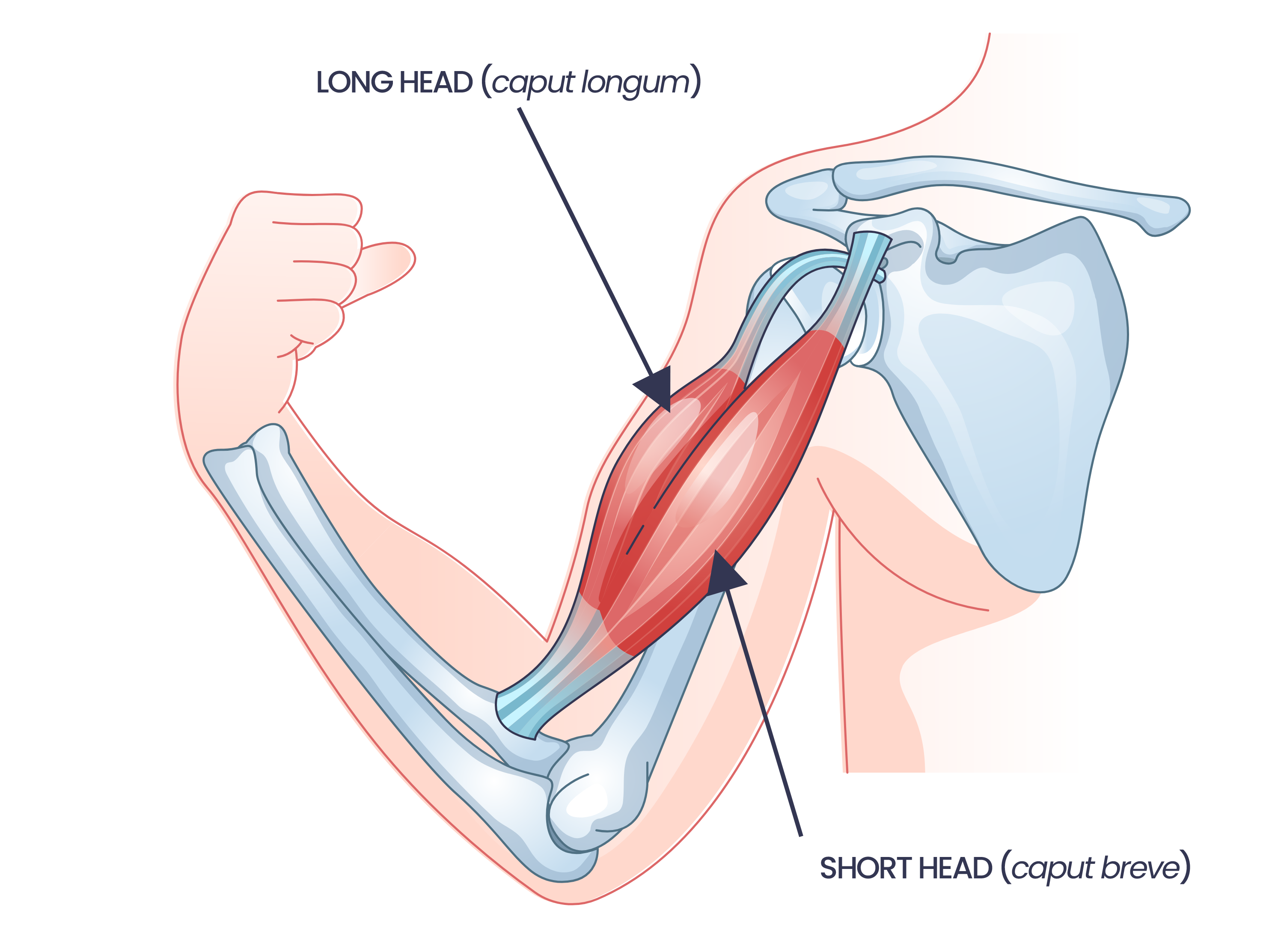
To achieve a maximal stretch, we must again move the origin and insertion apart.
- Shoulder Extension: Moving your arm behind your torso (shoulder extension) pulls the origin on the scapula further away from the elbow.
- Elbow Extension: Straightening the arm (elbow extension) moves the insertion on the forearm further away from the shoulder.
The position of maximum stretch for the biceps long head is when the arm is behind the torso and straight. This is the starting position of an incline dumbbell curl.
2. Why a Full Stretch Is Critical: Stretch-Mediated Hypertrophy
Now we know how to stretch these muscles. The next question is, why is this so important for growth? The answer lies in a powerful driver of hypertrophy that is becoming increasingly well-supported by research.
To understand this, let's watch a segment from the House of Hypertrophy channel. This video breaks down the types of tension a muscle experiences and why training under stretch is so effective.
The ULTIMATE Guide to Biceps Growth (73 Studies)
This segment from 'The ULTIMATE Guide to Biceps Growth' explains the concept of active and passive tension and how their combination during a stretched exercise creates a powerful signal for muscle growth.
Watch from 21:51 to 23:44. Focus on the distinction between active tension (from contraction) and passive tension (from stretch), and the key idea that combining both is highly effective for hypertrophy.
As the video explained, training a muscle in its lengthened position combines two potent stimuli:
- Active Tension: The force you generate by trying to contract the muscle.
- Passive Tension: The elastic force generated by the muscle being stretched, much like a rubber band.
This combination of high active and passive tension is a primary mechanism behind stretch-mediated hypertrophy.
3. Evidence for Stretch-Mediated Hypertrophy in Bi-articular Muscles
The theory is sound, but your scientific approach demands evidence. Fortunately, recent studies provide compelling support for this principle, especially for the bi-articular heads of the arms.
To see this in action for both the triceps and biceps, let's review two key video segments.
The BEST Triceps Hypertrophy Exercise
First, let's look at the triceps. The video 'The BEST Triceps Hypertrophy Exercise' discusses a landmark study comparing overhead extensions (stretched position) to pushdowns (shortened position).
Watch from 02:42 to 03:42. The video first identifies the triceps long head as a two-joint muscle and then directly links the overhead position to a greater stretch and superior hypertrophy, citing a key study (Maeo et al., 2022).
The ULTIMATE Guide to Biceps Growth (73 Studies)
Now, let's see how this concept applies to the biceps. The following segment from the biceps guide summarizes the scientific literature supporting the power of stretch.
Please watch from 12:17 to 17:44. This section is dense but provides the scientific justification you're looking for. It covers: The historical context of stretch for hypertrophy. Evidence from isometric and range-of-motion studies. The direct parallel to the triceps long head, referencing the same Maeo et al. study, which found overhead extensions produced 1.5 times more growth than pushdowns.
The evidence strongly suggests that for bi-articular muscles, training at long muscle lengths is a superior strategy for maximizing growth. The Maeo et al. (2022) study is a cornerstone piece of evidence, demonstrating that when all other variables are equal, the only difference being shoulder position (and thus, long head stretch), the group training in the stretched position saw significantly greater hypertrophy.
For further reading and reinforcement, the following article provides a concise summary of this principle.
Master Arm Weight Training - Vitruve
The article 'Master Arm Weight Training' from Vitruve provides a practical summary of these concepts, explicitly connecting the bi-articular nature of the triceps long head to stretch-induced hypertrophy.
Read the sections titled 'Brief Anatomy of the Triceps Brachii' and 'Exercises above the head are essential if you want to stimulate the triceps to the fullest'. These sections succinctly tie together the anatomy and the application.
Coach's Note: The Logic Chain
As a future coach, it's crucial to internalize this causal link so you can explain it to clients. The logic flows like this:
- Anatomy: The long heads of the biceps and triceps are bi-articular (cross two joints).
- Biomechanics: This structure allows them to be placed under a uniquely deep stretch by moving the shoulder joint (flexion for triceps, extension for biceps).
- Physiology: Training in this lengthened position generates high passive tension, which, when combined with active tension, triggers a powerful growth signal (stretch-mediated hypertrophy).
- Application: Therefore, exercises that load the muscle in this stretched position (e.g., overhead extensions, incline curls) are critical for maximally developing these specific muscle heads.
Conclusion
In this lesson, we connected the anatomical detail of bi-articularity to the potent physiological mechanism of stretch-mediated hypertrophy. You can now explain precisely why manipulating shoulder position is not just a variation, but a fundamental strategy for targeting the long heads of the biceps and triceps.
Key Takeaways:
- A bi-articular muscle crosses two joints, and its length is determined by the position of both.
- To fully stretch the triceps long head, you must flex the shoulder (arm overhead) and flex the elbow.
- To fully stretch the biceps long head, you must extend the shoulder (arm behind the body) and extend the elbow.
- Training in these lengthened positions creates high passive tension, which, combined with the active tension of contraction, drives stretch-mediated hypertrophy, a powerful stimulus for muscle growth.
Preview for the Next Lesson
We have established the why behind training at long muscle lengths. In our next lessons, we will explore the practical application of this knowledge. We will analyze how different exercises for the biceps (e.g., incline curl, preacher curl) and triceps (e.g., overhead extension, pushdown) can be used to preferentially target not only different muscle heads but also challenge them in their fully lengthened vs. fully shortened positions.