Introduction
Welcome to Module 7. In our previous module on the shoulder complex, we progressed from identifying anatomical structures to diagnosing movement faults and, finally, to formulating precise coaching cues to correct those faults. You learned to act as a "director" of movement, using anatomical intent to guide clients toward safer and more effective execution.
We will now apply that same systematic approach to the upper arm. This module will dissect the anatomy and biomechanics of the biceps, triceps, and brachialis, equipping you to design and coach arm training with surgical precision.
Today's lesson serves as the foundation for this entire module. Our objective is to describe the origin, insertion, and fiber direction of the biceps brachii (long and short head) and brachialis. Understanding these attachment points is not just academic; it is the key to unlocking why certain exercises are more effective than others and how subtle changes in grip or body position can dramatically shift the focus of an exercise.
1. The Anterior Upper Arm: Your Primary Elbow Flexors
The muscles on the front of your upper arm are located in what's known as the anterior compartment. While there are three muscles here, for the purpose of hypertrophy, we are primarily concerned with two:
- Biceps Brachii: The most visible muscle, famous for its "peak." It has two distinct heads.
- Brachialis: A powerful, often-overlooked muscle that lies deep to the biceps.
We'll dissect each of these, starting with the biceps brachii.
2. Anatomy of the Biceps Brachii
The name biceps brachii literally means "two-headed muscle of the arm." As the name implies, it has two distinct sections, the long head and the short head, which have different origin points on the scapula (shoulder blade).
To get a clear, memorable overview of these attachments, let's watch a short video that uses helpful mnemonics.
Biceps, Brachialis, and Coracobrachialis EASY Mnemonics
The video 'Biceps, Brachialis, and Coracobrachialis EASY Mnemonics' by Memorize Medical provides a fantastic and concise explanation of the origins and insertions of the anterior arm muscles. It uses clever hand gestures to make the attachments easy to remember.
Please watch from 00:20 to 02:43. Focus on the following: The 'by-skips' mnemonic (00:20 - 00:42): This explains why the biceps is bi-articular (crosses two joints), a critical concept we'll return to. The origins of the two heads (00:42 - 02:15): Pay close attention to the hand-gesture mnemonic used to remember the origin points of the short head (coracoid process) and long head (supraglenoid tubercle). The insertion points (02:15 - 02:43): Note the two distal attachments: the radial tuberosity and the bicipital aponeurosis.
Let's break that down and solidify the details.

Origin (Where it starts):
- Short Head: Originates from the coracoid process of the scapula. This is a small, hook-like structure on the front of your shoulder blade. Visually, this head runs up the inside (medial) part of the upper arm.
- Long Head: Originates from the supraglenoid tubercle of the scapula. This is a small bump located just above the shoulder socket (glenoid fossa). Its tendon takes a unique path, traveling through the shoulder joint itself and down a groove in the humerus (the bicipital groove). This head forms the outer part of the biceps and contributes to its "peak."
Insertion (Where it ends):
The two heads merge into a single muscle belly that crosses the elbow and inserts at two points:
- Radial Tuberosity: A bump on the radius bone of the forearm. This is the primary attachment for producing forceful movement.
- Bicipital Aponeurosis: A sheet of fibrous tissue that fans out and blends with the fascia of the forearm, providing stability.
Fiber Direction:
The fibers of both heads run vertically down the anterior humerus, from their respective origins on the scapula to their common insertion near the elbow. This parallel arrangement is optimized for generating force during elbow flexion (curling).
Coach's Note: Anatomical Variation is Real
While textbooks provide a standard model, human anatomy has significant variability. Your computer science background will appreciate this: think of the textbook anatomy as a base class, but individuals can be instances with overridden properties.
The ULTIMATE Guide to Biceps Growth (73 Studies)
The video 'The ULTIMATE Guide to Biceps Growth' from House of Hypertrophy touches on this variability. It's a fascinating look at how different people can have different biceps structures.
Watch the segment from 01:20 to 03:00. You don't need to memorize the percentages, but absorb the key idea: a significant portion of the population has more than the standard two heads of the biceps. This reinforces that anatomy is a map, not a rigid blueprint.
This anatomical variation is one reason why different people may respond better to different exercises and why a "one size fits all" approach is suboptimal.
3. Anatomy of the Brachialis: The Hidden Workhorse
Lying beneath the biceps is the brachialis. It is less visible but is a more powerful elbow flexor than the biceps. Its development can significantly increase upper arm thickness by pushing the biceps up from underneath.
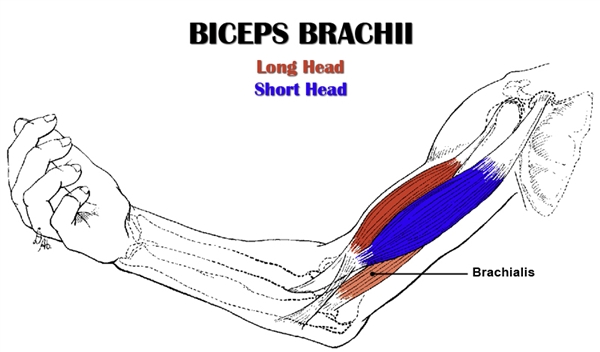
Let's get its precise attachments.
The Biceps & Brachialis – An MSR Approach
To get a clear, text-based definition of the brachialis's attachments, we'll consult the 'The Biceps & Brachialis – An MSR Approach' article. This provides the core anatomical facts in a very direct format.
In the article, find the section 'Biceps & Brachialis Anatomy & Biomechanics' and read only the bullet point for the Brachialis under the subheading 'Origin and Insertion'.
Let's summarize the key difference between the brachialis and the biceps:
- Origin: The brachialis originates on the distal (lower) half of the anterior surface of the humerus (the upper arm bone itself). It does not cross the shoulder joint.
- Insertion: It inserts on the coronoid process and tuberosity of the ulna (the other forearm bone, parallel to the radius).
- Fiber Direction: Like the biceps, its fibers run vertically down the arm, parallel to the humerus.
This anatomical difference is fundamentally important. Because the brachialis only crosses the elbow joint, its ability to produce force is unaffected by shoulder position. The biceps, being bi-articular, is heavily influenced by shoulder position, a concept we will explore in detail when we discuss creating lengthened-position exercises.
4. Synthesis and Key Distinctions
Let's consolidate this information into a clear table. This structure should resonate with the way you might organize data for analysis.
| Muscle | Origin | Insertion | Key Characteristic |
|---|---|---|---|
| Biceps Brachii (Short Head) | Coracoid process (scapula) | Radial tuberosity & Bicipital aponeurosis | Crosses shoulder and elbow joints |
| Biceps Brachii (Long Head) | Supraglenoid tubercle (scapula) | Radial tuberosity & Bicipital aponeurosis | Crosses shoulder and elbow joints |
| Brachialis | Anterior surface of humerus | Coronoid process & Tuberosity of ulna | Crosses only the elbow joint |
Reflection Question: Based on this table, why might an "incline dumbbell curl" (where you are leaning back) create a greater stretch on the biceps brachii but have no additional stretch-related effect on the brachialis?
Think about which joints each muscle crosses. The incline position changes the angle at the shoulder, but not at the elbow's starting position.
Conclusion
In this lesson, you established the foundational anatomy of the primary elbow flexors. You can now precisely describe the attachments and fiber orientation of these key muscles.
Key Takeaways:
- Biceps Brachii: A two-headed muscle (long and short head) that originates on the scapula and inserts on the radius. Its fibers run vertically down the arm. Critically, it is bi-articular, crossing both the shoulder and elbow joints.
- Brachialis: A powerful muscle located deep to the biceps. It originates on the humerus itself and inserts on the ulna. It is uni-articular, crossing only the elbow joint.
- Structure Dictates Function: This difference in attachments is the fundamental reason why shoulder position matters for training the biceps but not the brachialis.
Preview for the Next Lesson
Now that we have mapped the muscles on the front of the upper arm, we will turn our attention to their antagonist group on the back. In our next lesson, we will describe the origin, insertion, and fiber direction of the triceps brachii (long, lateral, and medial heads). Understanding the anatomy of both the elbow flexors and extensors is crucial for building a complete and balanced program for arm hypertrophy.