Introduction
Welcome to your next lesson in biomechanics. In our last session, we established a critical principle: your individual anatomical proportions—like femur or arm length—act as a biomechanical filter, dictating which muscles bear the most load during major compound lifts. A long-femured lifter, for instance, will inherently have a hip-dominant squat, while a short-femured lifter will have a quad-dominant one.
Today, we dive one level deeper. We move from analyzing bias between muscles to understanding bias within a single muscle. The central question is no longer just "Do squats work the quads or glutes more?" but "How can we preferentially grow the lower part of the quadriceps versus the upper part?"
This brings us to our learning outcome: Define regional hypertrophy and explain how fiber orientation can cause different portions of a muscle to be preferentially activated.
This concept, known as regional hypertrophy, is where coaching transitions from a broad approach to a highly precise one. For someone with your background in systems and optimization, you can think of it this way: a muscle isn't a monolithic block of code. It's a complex program with distinct subroutines (functional compartments) that can be called upon independently depending on the specific demands of the task. Our goal is to learn how to write the "training code" that calls the specific subroutines we want to develop.
1. What is Regional Hypertrophy?
At its core, regional hypertrophy is the phenomenon of non-uniform growth across different parts of the same muscle in response to training. We used to think of a muscle as a single unit that grew evenly, like inflating a balloon. We now know it's more like a landscape with hills and valleys, where training can preferentially build up certain peaks.
To start, let's get a conceptual overview that challenges the old, simplistic model of muscle function.
REGIONAL HYPERTROPHY - What is Regional Hypertrophy?
This video from The Muscle PhD provides an excellent introduction to the concept of regional hypertrophy and why the simple 'origin-to-insertion' model is insufficient.
Watch the first three minutes of the video (from 00:12 to 03:21). Pay attention to how the presenter argues that a muscle is more complex than a simple band pulling from origin to insertion, introducing the idea of functional compartments.
This idea is powerfully supported by research. A well-known 2014 study by Fonseca et al. demonstrated this principle clearly. They compared two groups of trainees:
- Group 1: Performed only Smith machine squats for their leg training.
- Group 2: Performed a variety of exercises (Smith squats, deadlifts, lunges, leg press).
The result? The squat-only group saw growth in some, but not all, of the quadriceps heads. The variety group saw more complete, homogeneous growth across the entire quadriceps. This is a perfect practical example of regional hypertrophy in action: different exercises stimulate different regions of the muscle group.
2. The Mechanisms of Preferential Activation
Why does this happen? The answer lies in several layers of neuromechanical organization. A muscle's fiber orientation is a key piece of the puzzle, but it's part of a larger system involving neural control and architecture.
Mechanism A: Functional Compartmentalization
Many large muscles are not single, homogenous structures. They are divided into distinct anatomical or functional compartments, which can have different fiber orientations, leverage on a joint, and even separate nerve supplies.
What is regional hypertrophy, and how does it happen?
This article by Chris Beardsley provides a clear written explanation of the mechanisms behind regional hypertrophy. We'll start with the section on functional compartmentalization.
Read the section titled 'Why might different exercises lead to different muscle growth?' The article uses the gluteus medius as a prime example of a muscle with multiple, separately innervated compartments.
Let's visualize the gluteus medius example from the article.
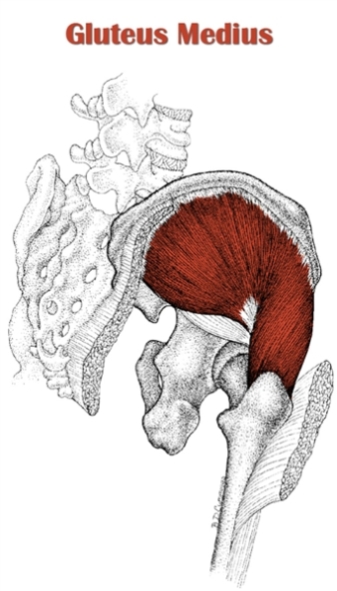
Because of this fan-shaped fiber orientation, different parts of the gluteus medius have different functions:
- Anterior (front) fibers: Excel at hip abduction combined with internal rotation and flexion.
- Posterior (rear) fibers: Excel at hip abduction combined with external rotation and extension.
Therefore, an exercise like a side-lying hip raise with slight internal rotation will preferentially target the anterior fibers, while an exercise using a cable to abduct the leg from a slightly flexed position will better target the posterior fibers. The central nervous system (CNS) selectively activates the specific compartment best suited for the direction of force required.
Mechanism B: The Special Case of Bi-Articular Muscles
The most powerful and practical examples of regional activation come from bi-articular muscles—those that cross two joints. In the previous lesson, we touched on this when we saw how compound movements create competing demands. Now, let's explore the "why" in detail.
Ep. 157- Exercise Selection for Hypertrophy: An In-Depth Examination
In this next clip from the Iron Culture podcast, Dr. Eric Helms gives one of the clearest explanations available on why common compound exercises fail to train certain parts of bi-articular muscles. This is essential knowledge for any coach.
Watch from 31:00 to 37:37. Dr. Helms will explain: Why squatting patterns are poor at stimulating the hamstrings and the rectus femoris (one of the four quad muscles). Why pressing movements (like bench press) are poor at stimulating the long head of the triceps. Listen closely for the concept of a muscle's action 'opposing' the primary goal of the movement.
Let's break down the logic from the video:
-
Rectus Femoris in a Squat:
- Function: Knee extension and hip flexion.
- Squat Demand: Knee extension and hip extension.
- The Conflict: For you to stand up from a squat, your glutes must produce powerful hip extension. If the rectus femoris were to contract strongly, its hip flexion action would directly oppose the glutes. To allow for efficient movement, the CNS essentially "down-regulates" the rectus femoris during a squat. The vasti muscles, which only extend the knee, do the heavy lifting.
- Result: Squats are great for the three vasti muscles but poor for the rectus femoris.
-
Hamstrings in a Squat:
- Function: Hip extension and knee flexion.
- Squat Demand: Hip extension and knee extension.
- The Conflict: The quadriceps must produce powerful knee extension. If the hamstrings contracted strongly, their knee flexion action would oppose the quads.
- Result: The hamstrings are relatively quiescent during a squat, contributing mainly to stability. They are not effectively trained.
-
Long Head of the Triceps in a Bench Press:
- Function: Elbow extension and shoulder extension.
- Bench Press Demand: Elbow extension and shoulder flexion/horizontal adduction.
- The Conflict: The anterior deltoids and pecs produce shoulder flexion. If the long head of the triceps contracted strongly, its shoulder extension action would oppose them.
- Result: Pressing movements are great for the medial and lateral heads of the triceps (which only perform elbow extension) but are suboptimal for the long head.
This neuromechanical "gating" is a primary driver of regional activation and a cornerstone of intelligent exercise selection. To train the rectus femoris, you need an exercise that isolates knee extension, like a leg extension. To fully train the triceps, you need an exercise that involves elbow extension while the shoulder is flexed (like an overhead extension) to stretch the long head.
Mechanism C: Architectural and Mechanical Differences
Finally, even within a single, uniformly innervated muscle compartment, regional hypertrophy can occur due to differences in internal architecture.
What is regional hypertrophy, and how does it happen?
Let's return to the Chris Beardsley article to explore another mechanism.
Read the sections 'How do muscles grow?' and 'What determines whether muscle fibers increase more in length or diameter?' This introduces a fascinating concept: growth can happen via increasing fiber length (adding sarcomeres in series) or diameter (adding myofibrils in parallel), and different training styles promote one over the other.
The key insight is that different training stimuli can lead to different types of growth, which manifest in different regions:
- Distal Hypertrophy (Growth in Length): Training with a focus on the lengthened position and eccentric contractions (e.g., the bottom of a deep squat, a full-stretch flye) tends to add sarcomeres in series. This often results in more growth toward the distal end of the muscle (closer to the far tendon).
- Medial Hypertrophy (Growth in Diameter): Training with a focus on the shortened position and high metabolic stress (e.g., squeezing at the top of a leg extension or pec-deck) tends to increase the diameter of the fibers. This often results in more growth in the thickest, middle part of the muscle belly.
These effects are due to non-uniform strain. Because of variations in things like fascicle length and pennation angle along a muscle, different regions experience different amounts of mechanical strain, even during the same exercise. Regions that are stretched more experience a different hypertrophic signal than regions that are primarily just contracting.
3. Practical Application: A Case Study in the Hamstrings
So, how do we use this information? The main takeaway is that exercise variety is not optional for optimal development; it is a requirement.
To fully develop a muscle, you must select a variety of exercises that challenge its different functions, compartments, and fiber orientations through their full contractile range.
Let's look at a visual example for the hamstrings.

Let's analyze this using the principles we've learned:
- Flywheel Leg Curl & Nordic Hamstring: These are knee-flexion dominant exercises. Notice the high activation (
++) in the semitendinosus and biceps femoris short head—the primary knee flexors. The Nordic curl, with its intense eccentric component, creates massive stimulus in the distal regions, consistent with the principle of lengthened-position training causing distal growth. - Hip-Extension Conic-Pulley: This is a hip-extension dominant exercise. Unsurprisingly, activation shifts to the biceps femoris long head and semimembranosus, which are powerful hip extensors. The stimulus is also more pronounced in the proximal (upper) regions of the muscle.
A program that only included RDLs (a hip hinge) would undertrain the knee flexion function of the hamstrings and neglect the distal fibers. Conversely, a program with only leg curls would undertrain the hip extension function and proximal fibers. A complete program needs both.
Conclusion
Today we've moved our understanding of hypertrophy from the macro level (between muscles) to the micro level (within a single muscle). We've seen that muscles are not simple ropes but complex, compartmentalized structures that require a multi-faceted approach to fully develop.
Key Takeaways:
- Regional hypertrophy is the non-uniform growth of a muscle, where different exercises or training styles stimulate certain regions more than others.
- This occurs due to several mechanisms:
- Functional Compartmentalization: Muscles are often divided into regions with different fiber orientations and separate nerve supplies, allowing for task-specific activation.
- Bi-Articular Mechanics: Muscles crossing two joints, like the rectus femoris and hamstrings, often have parts that are neurologically "down-regulated" during compound movements to prevent opposing forces.
- Architectural Differences: Variations in fiber architecture lead to non-uniform mechanical strain, with different training styles (e.g., lengthened vs. shortened) promoting growth in different regions (e.g., distal vs. medial).
- The Practical Imperative is Variety: To achieve complete, symmetrical development, you must use a variety of exercises that challenge a muscle's different functions (e.g., hip extension and knee flexion for hamstrings) and stress it at different lengths.
Coach's Corner: The Pursuit of Precision
This knowledge separates the "rep counter" from the true hypertrophy coach. Your thinking should evolve from "What exercise works the back?" to "I have a vertical pull for the lats emphasizing shoulder adduction and a horizontal row for the traps and rhomboids emphasizing scapular retraction. Now, what exercise can I add to challenge the lats in the lengthened position to stimulate the distal fibers?"
This level of precision is what allows you to identify and fix weak points in a physique, solve movement problems, and build truly well-rounded, aesthetic, and resilient athletes.
Preview for the Next Lesson
We've repeatedly mentioned the importance of training a muscle at long lengths. There's a growing body of evidence that this is a uniquely potent stimulus for hypertrophy. In our next lesson, we will focus on this concept. The learning outcome will be: Apply the concept of resistance-profile matching to select exercises that maximally challenge a muscle in its lengthened position. We will learn how to analyze an exercise not just by what muscle it works, but where in the range of motion it provides the most challenge.