Introduction
Welcome to your third lesson in our Biomechanics module. In our last session, we explored the fascinating concept of regional hypertrophy, establishing that muscles are not monolithic units but complex structures with different functional compartments. You learned that exercise variety is essential to stimulate all regions of a muscle, and we specifically highlighted that training at long muscle lengths is a powerful tool for promoting growth, particularly in the distal (far end) portions of muscle fibers.
Today, we will build directly on that foundation. It's one thing to know that training in a stretched position is beneficial; it's another to know how to select exercises that truly challenge a muscle in that state. This brings us to today's learning outcome: Apply the concept of resistance-profile matching to select exercises that maximally challenge a muscle in its lengthened position.
We will dissect the interaction between an exercise's resistance and a muscle's strength. For someone with your background in computer engineering, you can think of this as an optimization problem: we have a muscle's force output function (its strength curve) and an exercise's load input function (its resistance profile). Our goal is to align these functions to maximize the hypertrophic signal, especially in the all-important lengthened range.
1. Defining the Core Concepts: Resistance vs. Strength Profiles
To begin, we need to clearly define two interacting concepts:
- Strength Profile (or Strength Curve): This is an internal property. It describes how your capacity to produce muscular force changes throughout a joint's range of motion. Due to leverage and the muscle's own length-tension relationship, you are naturally stronger at some points in a lift and weaker at others.
- Resistance Profile: This is an external property. It describes how the challenge, or resistance, provided by an exercise changes throughout the range of motion. This is determined entirely by physics—gravity, leverage, and the equipment you use (free weights, cables, bands, machines).
The art of intelligent exercise selection lies in matching the external resistance profile to the internal strength profile to achieve a specific goal. Since our goal is to amplify the stimulus in the lengthened position, we want to choose exercises where the resistance profile is heaviest precisely when the target muscle is most stretched.
2. Deconstructing the Resistance Profile
Let's dive deep into what creates a resistance profile. The primary determinant for free-weight and many machine-based exercises is the moment arm: the perpendicular distance from the joint's axis of rotation to the line of force (e.g., gravity acting on the weight). A longer moment arm means the exercise feels heavier.
This video provides an excellent, clear breakdown of resistance profiles.
The Ultimate Guide to Resistance Profiles
Watch these selected clips from 'The Ultimate Guide to Resistance Profiles' by Basement Bodybuilding. It will define the resistance profile and use clear visual analogies to explain how equipment and setup dictate where a movement is hardest.
Please watch the following segments: What is a Resistance Profile? (00:59 - 01:36): Focus on the definition of resistance profile and moment arm. Pendulum Analogy (01:36 - 03:12): This is the most crucial part. Understand how the changing horizontal distance from the axis creates a curve, leading to 'lengthened-biased' or 'short-biased' movements. Equipment Differences (03:27 - 05:58): Note how free weights, machines, and selectorized stacks create fundamentally different resistance profiles. Positioning vs. Biasing (Critical Concept) (07:38 - 09:24): This segment explains the most common misconception in all of hypertrophy training using the incline curl vs. preacher curl example. Pay very close attention to this distinction.
Let's summarize the critical points from the video:
- Free Weights & Gravity: With free weights, the resistance is always pulling straight down. The challenge is greatest when the lever (your limb) is perpendicular to the force of gravity (i.e., horizontal).
- Pendulum-Style Machines: Many machines (like a T-bar row or a Hammer Strength press) pivot around a fixed axis. The resistance is greatest when the weight is horizontally furthest from that axis.
- Cables: Cables are unique because the line of force is determined by the cable's direction, not gravity. This allows us to create constant tension or manipulate the moment arm in ways free weights cannot.
- Accommodating Resistance (Bands/Chains): These tools always create a short-biased profile, where the exercise gets progressively harder as you approach the fully contracted position. This is the opposite of what we're looking for to emphasize the lengthened position.
The Most Important Distinction: Positioning vs. Biasing
As the video explained with the incline vs. preacher curl, it's vital not to confuse the position of the muscle with the bias of the resistance profile.
- An incline dumbbell curl positions the bicep in a stretched state (shoulder is extended). However, due to gravity, the peak resistance (longest moment arm) occurs when your forearm is horizontal, which is midway through the curl. The very bottom of the lift is relatively easy.
- A preacher curl positions the bicep in a shorter state (shoulder is flexed). However, because your upper arm is angled forward, the moment arm is longest at the bottom of the curl, when your arm is nearly straight. This makes it a lengthened-biased exercise—it challenges the muscle most when it's stretched within that specific movement pattern.
3. The "Why": Maximizing Tension for Stretch-Mediated Hypertrophy
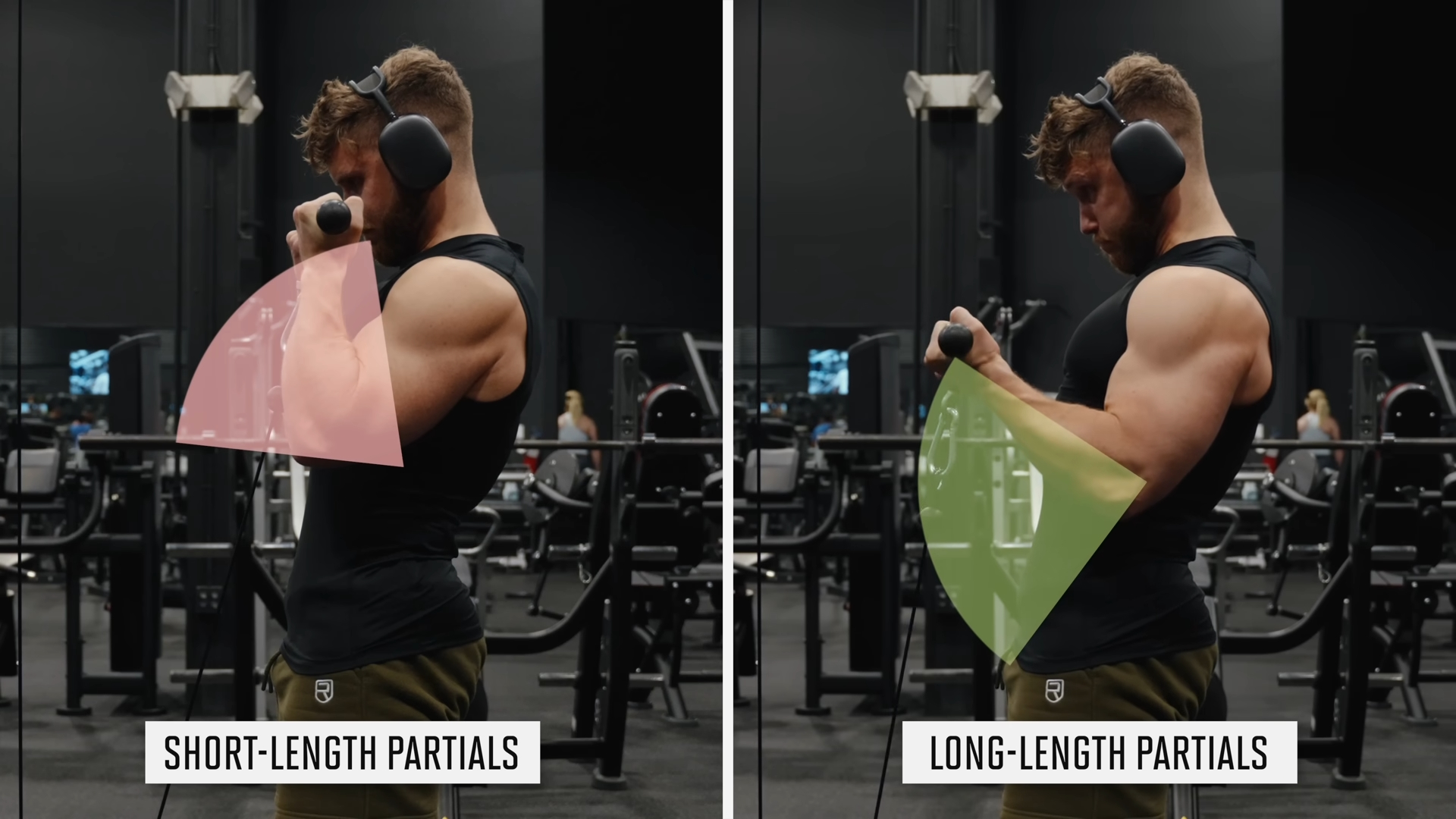
We've mentioned that training at long muscle lengths is highly effective. Let's quickly review the mechanism. When a muscle is stretched, it generates not only active tension from contraction but also passive tension from its elastic components (fascia, titin). The sum of these two, the total tension, is generally highest when the muscle is in a stretched position.
This increased total tension is a powerful signal for muscle growth.
Long-Muscle-Length Training (Aka Stretch-Mediated Hypertrophy)
The article 'Long-Muscle-Length Training' from Outlift provides a concise explanation of the mechanisms and gives practical examples.
Read the sections titled 'Why Does Depth Affect Muscle Growth?' and 'Examples'. Focus on Greg Nuckols's explanation of how passive tension contributes to total tension, which drives hypertrophic signaling. The dumbbell fly example is a perfect illustration of matching the sticking point to the position of maximal stretch.
As the article highlights, exercises like the dumbbell fly are incredibly effective for the chest because the point of maximal muscle stretch (bottom of the fly) coincides perfectly with the point of maximal resistance (longest moment arm). This is the ideal scenario for stretch-mediated hypertrophy.
4. Practical Application: Matching Profiles for Optimal Stimulus
Now let's apply this logic to exercise selection. Our goal is to choose an exercise and equipment combination that creates a resistance profile that overloads the muscle in its lengthened state.
Case Study 1: The Reverse-Banded Hack Squat
This is an advanced application, but given your background, the data-driven approach will be insightful. A standard hack squat is heaviest at the very bottom, but the resistance drops off very quickly as you ascend. Your strength, however, does not drop off that fast. This mismatch means you're only getting a maximal stimulus for a tiny fraction of the rep.
The reverse band "corrects" the resistance profile. It provides the most help at the bottom and the least at the top. While this sounds like it's making the hardest part easier, it actually allows the resistance curve to better match your strength curve through the first half of the rep, leading to a more effective stimulus over a larger range of motion.
Reverses Banded Hack Squat Vs Regular Hack for Hypertrophy. Strength vs Resistance Profile/curve
This video from N1 Education is a masterclass in profile matching. The presenter actually measures his own strength curve and then analyzes how a reverse band alters the resistance profile of a hack squat to make it a more efficient hypertrophy tool.
Watch these two key segments: Strength vs. Resistance Profile (03:16 - 05:54): Observe how the presenter overlays his measured strength curve with the resistance curve of the exercise. Notice how the reverse band makes the two curves nearly parallel in the bottom portion of the lift. Analysis and Conclusion (09:02 - 12:28): Listen to the analysis of how the reverse band creates a more significant stimulus in the bottom half of the rep compared to no band, making it a more efficient movement for hypertrophy.
The takeaway is that by intelligently modifying the resistance profile, we can create a better stimulus for the target muscle (quads) in the lengthened position (the bottom half of the squat).
Case Study 2: An Exercise Selection Guide
Let's create a quick-reference guide for choosing exercises that challenge key muscles in their lengthened position.
| Muscle Group | Less Effective (Short-Biased) | More Effective (Lengthened-Biased) | Anatomical/Biomechanical Rationale |
|---|---|---|---|
| Pectoralis Major | Cable Crossover, Resistance Band Push-up | Dumbbell Fly, Deficit Push-up, Dip | Free-weight flys and deep presses create the largest moment arm when the humerus is parallel to the floor, where the pecs are stretched. |
| Latissimus Dorsi | Barbell Row (hardest at top) | Dumbbell/Cable Pullover | Pullovers challenge the lats when the shoulder is fully flexed (arms overhead), stretching the muscle to its maximum length. |
| Triceps (Long Head) | Triceps Pushdown | Overhead Cable/Dumbbell Extension | The long head is bi-articular. Raising the arm overhead stretches it. An overhead extension challenges it in this stretched state. A cable is superior here as it provides constant tension at the very bottom, unlike a dumbbell. (See Resource LINK) |
| Biceps Brachii | Spider Curl (hardest at top) | Preacher Curl, Incline Cable Curl | The free-weight preacher curl is hardest at the bottom. An incline curl done with a cable positioned low and behind you also effectively loads the stretched position. |
| Hamstrings | Standing Leg Curl (hip is extended) | Seated Leg Curl, Romanian Deadlift (RDL) | The seated leg curl stretches the hamstrings at the hip (hip flexion). The RDL stretches the hamstrings at the hip via a deep hinge. Both challenge the lengthened position. |
| Quadriceps | Banded Leg Extension | Deep Squat, Hack Squat, Sissy Squat | Any deep knee flexion movement will challenge the quads in a lengthened position, particularly the vasti muscles. Sissy squats place an extreme stretch on the rectus femoris as well. |
Conclusion
Today, we've added a crucial layer of sophistication to your coaching toolkit. By understanding the interplay between strength and resistance profiles, you can now analyze and select exercises with a much higher degree of precision.
Key Takeaways:
- To maximize hypertrophy via the stretch-mediated pathway, you must select exercises that are heaviest when the target muscle is in a lengthened position.
- This is achieved by matching the exercise's resistance profile to the muscle's strength profile, ensuring the peak external challenge aligns with the position of maximal internal stretch and tension.
- Equipment choice is paramount. Free weights, cables, and machines all offer different resistance profiles. Cables, in particular, are excellent for creating tension in positions where gravity offers none.
- Critically, do not confuse muscle positioning (e.g., incline curl) with resistance biasing (e.g., preacher curl). You must analyze the moment arms to know where the challenge truly lies.
Coach's Corner: The Intentionality of Selection
An average trainer tells a client to do a "triceps exercise." A good coach prescribes a "cable pushdown to target the lateral and medial heads." An expert coach, armed with the knowledge from today, might prescribe a "seated overhead cable extension" with the specific intent of creating maximal tension on the long head of the triceps in its maximally lengthened position to drive stretch-mediated hypertrophy. This is the level of intent and precision that produces superior results.
Preview for the Next Lesson
We have now completed our foundational modules on anatomy, physiology, and biomechanics. It's time to apply this integrated knowledge. We will begin our deep dive into specific muscle groups, starting with the chest. In our next lesson, we will cover the first learning outcome of Module 4: Describe the origin, insertion, and fiber direction of the clavicular (upper), sternal (mid), and costal (lower) divisions of the pectoralis major. You will see how the different fiber orientations of the chest demand different movement patterns, a problem we can now solve using our understanding of resistance profiles.