Introduction
Welcome to our final lesson on the pectoralis major. In our previous session, we diagnosed the common mistakes that lead to suboptimal chest growth, such as anterior deltoid dominance and "cheating" reps that reduce tension. We established that these errors are not random but predictable consequences of specific biomechanical and anatomical faults.
Today, we transition from diagnosis to prescription. The goal of this lesson is to learn how to apply coaching cues based on anatomical intent to improve pectoralis major activation during pressing and fly movements. Knowing why a movement is incorrect is the foundation; knowing how to fix it with precise language is what separates a knowledgeable trainee from an effective coach.
Anatomical intent means using cues that focus on the function of the target muscle, rather than just the external task. For example, instead of "lift the weight," a cue with anatomical intent would be "drive your upper arm across your chest." This internal focus can dramatically improve the mind-muscle connection and ensure the desired muscle is doing the work.
1. Foundational Cues for All Pressing Movements
These initial cues address the most common faults discussed in our last lesson—namely, poor scapular positioning and an incorrect arm path. Mastering this setup is the single most important step for maximizing pec activation in any press.
The "Chest Up and Out" Setup
The most critical cue for any pressing movement happens before the weight even moves. The goal is to create a stable base and pre-stretch the pectoral fibers.
The cue is to retract and depress your scapulae, but a more intuitive way to think about it is to reach up and out with your chest. Imagine you are trying to show off a logo on your shirt to someone standing on the ceiling in front of you. This naturally pulls your shoulder blades together and down, puffs up your chest, and creates a slight arch in your upper back.
Anatomically, this action achieves two things:
- Stability: It locks your shoulder girdle into a solid platform, preventing the shoulder from rounding forward and giving the pecs a stable origin to pull from.
- Leverage: It positions the glenohumeral (shoulder) joint optimally, improving the mechanical advantage of the pectoral fibers and reducing the leverage of the anterior deltoids.
Maximally Stimulate Your Chest With This Amazing Press Cue!
Dr. Mike Israetel from Renaissance Periodization provides an excellent demonstration and explanation of this foundational cue.
Watch from 00:17 to 03:50. Pay close attention to his 'reach up and out with your chest' cue and the 'funky pigeon' analogy. Notice how he explains that this setup pre-stretches the pecs and puts them in the driver's seat for the movement.
This "chest up" posture should be maintained throughout the entire set. On the eccentric (lowering) phase, a great reinforcing cue is to think about "meeting the bar with your chest." This ensures you maintain thoracic extension and achieve a deep, controlled stretch at the bottom, which is critical for stretch-mediated hypertrophy.
2. Cues for the Concentric (Pressing) Phase
Once you have a solid setup, the next step is to initiate the press with the pecs, not the delts or triceps. This requires specific cues that encourage the primary function of the sternal pectoralis: horizontal adduction.
For Barbell Pressing: "Bend the Bar"
When using a barbell, your hands are in a fixed position. You can't physically bring them closer together. However, you can create an isometric adduction force.
The Cue: As you press the bar up, actively try to "bend the bar" in half or "try to squeeze your hands together." You won't actually bend the bar, but this intention will fire the pectoral fibers as they attempt to pull your arms toward the midline of your body.
For Dumbbell Pressing: "Bring Your Biceps to Your Chest"
Dumbbells offer a free range of motion, which is a double-edged sword. It's easy to press them straight up, which can become a very shoulder-and-tricep-dominant movement.
The Cue: Instead of thinking about pushing the dumbbells up, think about "squeezing your biceps toward the sides of your pecs" or "driving your elbows together." This shifts the focus from elbow extension (a triceps function) to shoulder adduction (a pec function). The dumbbells moving up becomes the result of your pecs pulling your upper arms (humerus) across your body.
Improve Your Chest Development!
The article 'Improve Your Chest Development!' from Muscular Strength provides excellent written cues that reinforce this concept of initiating adduction.
Read the sections titled 'Dumbbell Bench Press' and 'Barbell Bench Press'. Note the specific cues: 'squeezing your pectorals to bring your elbows together' for dumbbells, and 'creating horizontal adduction torsion on the bar by trying to force your hands together' for barbells.
3. Cues for Fly and Crossover Movements
Flys are isolation movements designed to target horizontal adduction directly. However, form is easily compromised, often by the shoulders rolling forward.

The Foundational Fly Cue: "Hug a Giant Tree"
This external cue helps lifters understand the arcing path of a fly. Instead of letting the arms go straight out and back, you should maintain a slight bend in the elbow and imagine you are wrapping your arms around a massive tree trunk.
Advanced Cues for Cable Flys
Cables are superior to dumbbells for flys because they provide continuous tension. Here are two cues to maximize their effectiveness.
- "Imagine a string pulling your sternum up." This is a powerful cue to prevent the shoulders from rounding forward and the chest from caving in, especially as you fatigue. It helps you maintain the "chest up" posture we established earlier.
- "Keep your forearms in line with the cable." This is a crucial biomechanical cue. For the resistance to be optimally placed on the pecs, the line of pull from the cable should be perpendicular to your upper arm throughout the movement. If your hands drift ahead of or behind the line of the cable, you lose tension and efficiency.
The ONLY 2 Exercises You Need For A Massive Chest
Jeremy Ethier's video 'The ONLY 2 Exercises You Need For A Massive Chest' brilliantly details these setup and execution cues for a seated cable fly.
Watch from 05:58 to 07:45. Pay close attention to his use of a foam roller for thoracic extension, the cue to keep the forearm aligned with the cable, and the 'string pulling the sternum' analogy to prevent shoulder takeover.
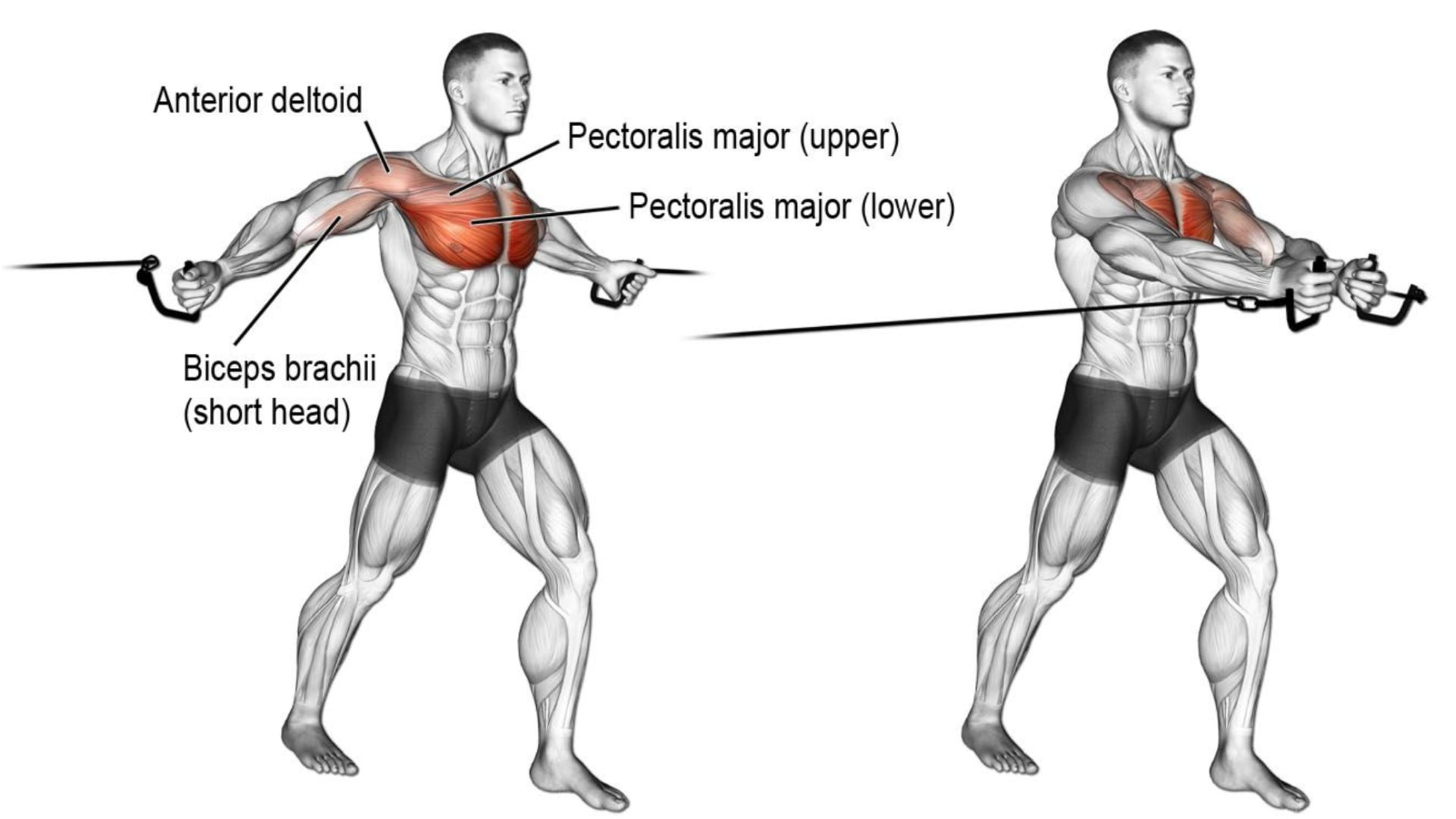
4. Cues for Targeting Specific Pectoral Divisions
By slightly modifying the movement path and applying specific cues, we can bias different regions of the chest.
Clavicular (Upper) Pecs
The upper pec fibers run from the clavicle down to the humerus, primarily acting to flex the shoulder (bring the arm forward and up).
- Exercise: Incline Press
- Cue: "Drive up and inwards." On the concentric phase, don't just think about pressing up. As you approach the top, think about bringing the dumbbells or your hands (on a barbell) slightly toward the midline. This incorporates the adduction function along with flexion.
- Advanced Tip: As discussed in the Jeremy Ethier video, individual sternum angle matters. Someone with a steep sternum might need a higher incline (e.g., 30-45°) to align the press with their upper pec fibers, while someone with a flat sternum might find a very low incline (15°) is sufficient.
Costal (Lower) Pecs
The lower pec fibers run diagonally from the lower ribs up to the humerus. Their main functions are shoulder adduction (bringing the arm down to the side) and shoulder extension from an overhead position.
- Exercises: Dips, High-to-Low Cable Flys
- Cue: "Punch the floor." This is a powerful external cue. When performing a dip or a high-to-low fly, the goal is to drive your arms down and slightly in front of you, following the line of the costal fibers. Thinking "punch the floor" perfectly mimics this arm path.
The Best Lower-Chest Workouts for the Gym & Home
The article 'The Best Lower-Chest Workouts' by Onnit explains the anatomical reasoning behind this cue.
Read the sections '1. High-To-Low Cable (or Band) Fly' and '2. Costal Dip'. Note how strength coach Paul Carter uses the 'punch the floor' cue and explains that the arm path must be congruent with the fiber orientation of the lower pecs.
Conclusion
Effective coaching cues are the link between anatomical knowledge and real-world results. By moving beyond generic instructions and using cues grounded in anatomical intent, you can systematically correct faults and maximize the stimulus on the target muscle.
Key Takeaways:
- Setup is Everything: The "chest up and out" cue establishes a stable and leveraged position for all presses.
- Focus on Function, Not the Weight: Use cues like "bring biceps to chest" or "bend the bar" to focus on the pec's function of adduction, not just moving a weight from A to B.
- Align Force with Fibers: For flys, maintain thoracic extension ("string on sternum") and align your arm path with the cable. For specific divisions, tailor the arm path and cues ("drive up and in" for upper pecs, "punch the floor" for lower pecs) to match their fiber orientation.
- Intent Drives Adaptation: The conscious effort to perform a movement with the target muscle (the mind-muscle connection) is a skill that can be trained and improved with precise cueing.
Preview for the Next Lesson
We've now completed our deep dive into the pectoralis major. In our next lesson, we will move to another critical area for upper body aesthetics and function: the shoulder complex. We will dissect the anatomy of the anterior, lateral, and posterior deltoid heads, as well as the all-important rotator cuff, and learn how their distinct functions dictate optimal exercise selection.