Introduction
Welcome back. In our last lesson, we performed a "diagnostic" on common quadriceps training mistakes. We moved beyond simply labeling form as "good" or "bad" and instead analyzed issues like insufficient depth, the "Good Morning" squat, and pelvic control faults by tracing them back to their anatomical and biomechanical roots. You now understand why these errors occur, from mobility limitations and anthropometry to relative muscle weakness.
Today, we shift from analysis to action. This lesson is about becoming the coach. Our goal is to formulate anatomical coaching cues to correct common quadriceps training mistakes and optimize quad activation. We will learn to translate our analytical understanding into precise, effective instructions that produce better movement and, consequently, better hypertrophy outcomes. Think of it as moving from debugging code to writing the patch.
The Principle of Anatomical Intent
As a coach, your most powerful tool is language. The cues you choose can be the difference between a client feeling a movement correctly for the first time or reinforcing a poor pattern. We will focus on cueing with anatomical intent.
-
Generic Cue: "Squat deeper."
- Problem: This tells the client the desired outcome but provides no instruction on how to achieve it. If they could squat deeper, they likely would already be doing so.
-
Anatomical Cue: "Drive your knees forward over your toes as you descend, keeping your heels on the ground."
- Benefit: This gives the brain a specific motor task directly linked to the mechanics of a quad-dominant squat. It's a precise instruction for the body's "operating system."
Effective cues don't just state a goal; they provide a clear pathway to it, grounded in the anatomical principles we've covered.
1. Cueing to Correct Insufficient Depth and Promote Quad Dominance
The Mistake: Not achieving deep knee flexion, which leaves hypertrophic potential on the table by failing to train the vasti muscles in their lengthened position.
The Goal: To encourage maximal, safe knee flexion and forward knee travel, which ensures the quads are the prime movers.
The key is to re-pattern the squat away from a simple "sit down" motion and towards a "forward and down" motion of the knees.
How To Squat For Pure Quad Growth
Dr. Mike Israetel from Renaissance Periodization provides an excellent, hypertrophy-specific squatting checklist. Notice how his cues are often the opposite of those used for powerlifting, as the goal is different.
Watch from 02:50 to 07:59. Pay close attention to these key points: Point 4 (05:01): The cue to drive the knees as far forward as possible over the toes, so long as the heels stay down. This is crucial for maximizing the knee-flexion moment arm. Point 7 (06:57): The instruction to stay as upright as possible at the bottom. This prevents the hips from taking over. Point 8 (07:23): The suggestion to pause at the bottom to own the stretched position and enhance stretch-mediated hypertrophy.
Based on this, here is a toolbox of cues to correct insufficient depth:
Cues for Deeper, Quad-Focused Squats
- "Drive your knees forward and out." This simple cue encourages both knee flexion and hip abduction, creating space for the torso to descend vertically.
- "Imagine your kneecaps are painting stripes on the wall in front of you." This is an external cue that promotes forward knee travel without the lifter overthinking their own anatomy.
- "Try to sink your hips straight down between your heels." This fights the tendency to push the hips back, which turns the squat into a hinge.
- "Stay tall and keep your chest facing the wall in front of you." This helps maintain an upright torso, keeping tension on the quads instead of shifting it to the lower back and glutes.
- For lifters with limited ankle mobility: "Use a heel lift. Feel how it allows your knees to travel further forward." This isn't "cheating"; it's an intelligent modification to overcome a specific anatomical limitation, and it's backed by research. Studies, such as the one by Bozkurt et al. that we have in our resources, show that a heel-elevated position significantly increases quadriceps activation by allowing for greater knee flexion and a more upright posture.
2. Cueing to Correct the "Good Morning" Squat
The Mistake: During the ascent, the hips rise much faster than the shoulders, causing the torso to become more horizontal and shifting the load from the quads to the posterior chain (glutes and lower back).
The Goal: To maintain a consistent back angle and ensure the hips and shoulders rise in unison, driven by quad extension.
Cues to Keep the Quads in Control
- "Lead with your chest out of the bottom." or "Drive your traps up into the bar." This forces the lifter to initiate the ascent by driving vertically with the upper body and quads, rather than by extending the hips.
- "Keep your hips under the bar." This internal cue prevents the hips from shooting backward and up as the ascent begins.
- "Think 'leg press.' Push the world away from you with your feet." This powerful external cue refocuses the lifter's intent on using their legs to move the load, just as they would in a leg press machine.
3. Optimizing Cues for Machines
Machines like the leg press and hack squat are excellent tools because they provide external stability, allowing the lifter to focus purely on quad activation without worrying about balance. The cues here are less about correcting errors and more about optimizing the setup for maximum stimulus.
How To Leg Press For Best Quad Growth | Targeting The Muscle Series
Let's return to Renaissance Periodization for a masterclass in leg press setup and execution for quad growth. These cues are directly applicable to coaching a client on this machine.
Watch the video, focusing on these actionable coaching points: Seat Position (01:05 - 02:11): Understand how to adjust the seat to allow for maximum knee flexion. Foot Placement (02:11 - 04:12): Note the cue to place feet as low as possible on the platform without the heels lifting at the bottom. Stance (07:17 - 09:29): Listen to the rationale for a slightly wider stance with toes out to create room for the torso and achieve a deeper stretch. Tempo and Pausing (09:29 - 11:32): The cues for a slow eccentric and a pause in the stretched position are key for mind-muscle connection and hypertrophy.
Cues for Machine-Based Training
Leg Press:
- Setup: "Place your feet shoulder-width apart and low on the platform. Find the lowest spot where your heels stay glued down at the bottom of the rep."
- Execution: "Control the descent for 3 seconds. Think about letting your knees come all the way to your chest."
- At the Bottom: "Pause for a second in the deep stretch. Feel your quads load up before you drive."
- To Prevent Lumbar Rounding: "Keep your entire back, from your shoulders to your tailbone, pressed firmly into the pad." If a client struggles with this, you can use the technique from the video: "Place this foam pad behind your lower back to help you maintain contact as you go deep."
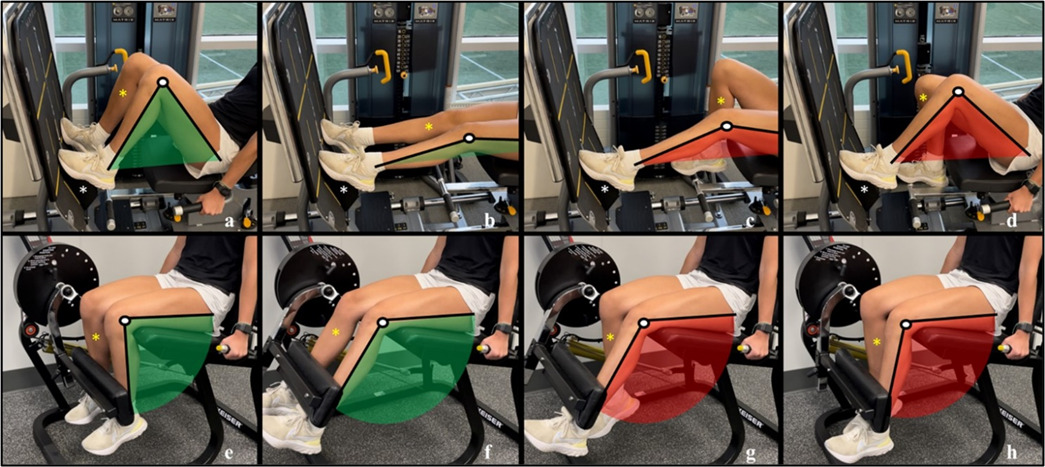
Hack Squat:
- Setup: "Position your feet directly under your hips. A lower placement on the platform will bias your quads more."
- Execution: "Let your knees drive forward over your toes as you descend. Keep your entire back and hips connected to the pad."
4. Cueing for Isolation Exercises
The Goal: To maximally challenge the rectus femoris (in addition to the vasti) through a full range of motion, with a focus on the stretch.
How To Grow Your Quads - E3 Rehab
The E3 Rehab article we've referenced before has an excellent section on isolation exercises with practical, coachable tips.
Review the section 'Isolation Exercises For The Quads.' Focus on the actionable advice for the Seated Leg Extension and the Reverse Nordic/Sissy Squat. Notice the suggestions for modification, like using pads or bands, which are part of a coach's toolkit.
Cues for Isolation Movements
Leg Extension:
- "Lean back and hold onto the handles to put the rectus femoris on stretch before you even start."
- "Control the lowering portion of the rep; don't let the weight stack crash. Imagine you're resisting it all the way down."
- "At the top, squeeze your quads hard for a moment, but stop just short of snapping your knee straight."
Reverse Nordic / Sissy Squat:
- "Brace your core and squeeze your glutes. Keep a perfectly straight line from your knees, through your hips, to your shoulders."
- "The movement is a lean back, not a sit down. Hinge only at your knees."
- "Only go as deep as you can control. Use a bench behind you as a target to ensure consistent depth."
Coach's Note: The Art of the Feedback Loop
Your job isn't just to shout cues, but to enter into a feedback loop with your client. This process is algorithmic and iterative, which should feel familiar given your background.
- Observe: Watch the client's movement without saying anything. Identify the primary fault (e.g., hips rising too fast).
- Cue: Select one, simple anatomical cue designed to fix that single fault (e.g., "Lead with your chest out of the hole.").
- Observe Again: Did the cue work? Did the movement improve? Did it create a new problem?
- Refine or Reinforce: If it worked, reinforce it ("Perfect, see how your hips and shoulders moved together?"). If it didn't, try a different cue (e.g., an external one: "Push the floor away.").
A good coach has a deep toolbox of internal, external, and anatomical cues and knows that different cues work for different people. Your role is to find the right instruction that "clicks" for the individual in front of you.
Conclusion
You have now bridged the gap from anatomical knowledge to practical application. You can not only identify what's wrong with a movement but also provide precise, effective instructions to fix it.
Key Takeaways:
- Effective coaching cues are grounded in anatomical intent, telling the lifter how to move, not just what the outcome should be.
- To fix insufficient depth, cue for forward knee travel and an upright torso.
- To fix a "Good Morning" squat, cue for a vertical drive led by the chest and shoulders.
- In machine training, cues should focus on optimizing setup (foot position, seat angle) and execution (tempo, range of motion) to maximize tension on the target muscle.
- Cueing is an iterative feedback loop: Observe, Cue, Observe, and Refine.
Preview of the Next Lesson
This concludes our exhaustive look at the quadriceps. We will now move to the posterior thigh and hip to begin Module 9: Glutes and Hamstrings Anatomy. In the first lesson of this new module, we will apply our anatomical framework to the muscles of the gluteal group. You will learn to describe the origin, insertion, and fiber direction of the gluteus maximus, medius, and minimus. This foundational knowledge is essential for understanding their distinct roles in hip extension, abduction, and pelvic stabilization.