Introduction
Welcome to the twelfth lesson in our module on coaching application. In the last lesson, we focused on diagnostics—how to observe a movement fault like a knee valgus or a "butt wink" and trace it back to a specific muscular imbalance or mobility restriction. You learned to act like a detective, using a series of tests to form a strong hypothesis about the root cause of a client's movement issue.
Today, we move from diagnosis to problem-solving. This lesson is dedicated to mastering the learning outcome: Modify exercises for clients with different limb lengths and mobility restrictions using anatomical and biomechanical reasoning.
We'll differentiate between two key reasons for modification:
- Structural Variations: These are permanent anatomical features, like limb lengths. A client with long femurs isn't "broken"; their anatomy simply requires a different approach to an exercise like the squat.
- Functional Limitations: These are typically temporary issues like poor mobility or stability that you can work to improve over time.
Think of it this way: your client's body is the hardware, and the exercise is the software. Your job as a coach is to customize the software to run optimally on their unique hardware. This ability to individualize is what separates a good coach from a great one.
1. The Physics of Individual Differences: Moment Arms Revisited
Before we modify exercises, we must understand why modifications are necessary. The core concept is the moment arm, which we've touched on before. It is the perpendicular distance from a joint's axis of rotation to the line of force being applied. A longer moment arm increases the rotational force (torque) that a muscle must produce to move a load.
How to Bench Press: The Definitive Guide - Stronger by Science
To solidify this crucial concept, let's review a formal definition from the 'How to Bench Press' guide by Stronger by Science. Understanding this is non-negotiable for biomechanically sound coaching.
Read the subsections under 'Super Basic Physics', starting from 'Force' and ending at the 'Summary' bullet points just before the 'Anatomy' section. Pay close attention to how 'external moments' (from the weight) and 'internal moments' (from your muscles) are calculated and the direct statement on why longer limbs make lifting harder.
In short: Torque = Force × Moment Arm.
When a client's limb lengths change, the moment arms at their joints change, which fundamentally alters the muscular demands of an exercise.
Case Study 1: The Squat and Anthropometry
The squat is perhaps the most obvious example of how limb proportions dictate form. The primary constraint is that the lifter's combined center of mass (barbell + body) must remain over their mid-foot to maintain balance.
Watch this video to see how different body segments affect a lifter's ability to "fold" into a squat.
Squats Part 1: Fold-Ability and Proportions
This video from PersonalTrainingdotcom provides an exceptional visual breakdown of how segment lengths influence squat mechanics. It's one of the clearest demonstrations available.
Watch the following two segments carefully: 02:40 - 03:57: Observe how changing the tibia length alters the degree of forward lean required. 03:57 - 05:34: Pay close attention to the demonstration with the disproportionately long femur. This clearly shows why some people physically cannot squat deep with an upright torso and often complain of low back or hip strain.
Let's analyze the two common archetypes:
-
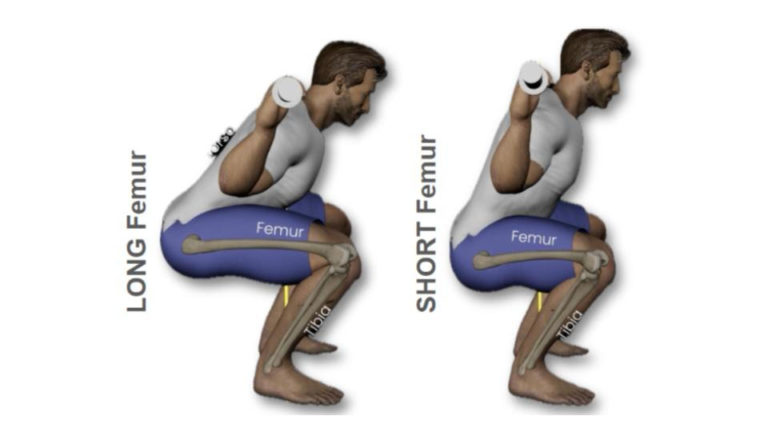
Long Femurs / Short Torso: To keep the bar over the mid-foot, this individual must adopt a significant forward lean. This increases the moment arm at the hip and decreases the moment arm at the knee. The result is a highly hip-dominant squat with greater demands on the glutes, hamstrings, and spinal erectors.
-
Short Femurs / Long Torso: This individual can maintain a much more upright torso. This decreases the moment arm at the hip and increases the moment arm at the knee. The result is a quad-dominant squat.
These images provide a clear, static comparison of these mechanical differences.

Case Study 2: The Bench Press and Arm Length
Arm length, or more accurately, the wingspan-to-height ratio, has a similar effect on pressing movements.
- Long Arms: This creates a longer range of motion. At the bottom of a bench press, the bar is further from the shoulder and elbow joints, creating longer moment arms. This places a greater stretch and demand on the pectorals but makes the lockout more difficult due to the increased work required from the triceps and deltoids over a longer distance.
- Short Arms: This creates a shorter, more compact range of motion with more favorable leverages, generally allowing for heavier loads to be lifted.
The following video is a masterclass in analyzing and programming for a long-armed lifter.
Long-Armed Bench Pressers Have It Rough, but We Can Help!
From the elitefts channel, this video is a practical case study on modifying the bench press for a lifter with long arms. It explains the biomechanical implications and provides concrete solutions.
Focus on these segments: 00:29 - 03:09: Understand why long-armed lifters are naturally pec-dominant, weaker in pressing, and at a higher risk for pec tears. 07:29 - 10:05: See how using a closer grip changes the moment arms to increase triceps and front delt involvement. 12:11 - 13:04: Listen to the justification for using an incline press to build the front delts, a common weak point for this body type.
2. Practical Modifications for Structural Variations
Now, let's turn theory into action. How do we program for these individuals?
Modifying for the Long-Femured Squatter:
The goal is to enable them to achieve depth safely and effectively stimulate the target musculature (usually the quads and glutes) without excessive strain on the lower back.
- Heel Elevation: Using weightlifting shoes or placing small plates under the heels artificially increases the functional length of the tibia. This allows the knees to track further forward, enabling a more upright torso and shifting stress from the hips and low back toward the quadriceps.
- Low-Bar Position: Moving the barbell down the back (onto the rear delts instead of the traps) shortens the moment arm between the bar and the hips. This makes the inherent forward lean more biomechanically efficient and better leverages their strong posterior chain.
- Alternative Exercises: For hypertrophy, forcing a long-femured client to do high-bar back squats may be counterproductive. Better options that control the torso angle and allow for deep knee flexion include:
- Hack Squats
- Leg Presses (especially with a lower foot position)
- Pendulum Squats
- Safety Bar Squats
Modifying for the Long-Armed Bencher:
The goal is to build the weaker synergists (triceps, delts) and manage the high stress on the pectoral muscle and shoulder joint at the bottom of the lift.
- Grip Width Adjustment: While a wide grip shortens the range of motion, it maximizes the moment arm for the pecs. For a long-armed lifter, a slightly narrower grip (e.g., shoulder-width) can be beneficial for hypertrophy training. It increases the range of motion at the elbow, forcing greater triceps involvement, and also increases the demand on the anterior deltoids.
- Incline & Dumbbell Presses: As the video mentioned, a low incline press (15-30 degrees) is an excellent way to target the anterior delts and upper pecs with heavier loads than a standard overhead press. Dumbbell presses allow the hands and elbows to follow a more natural arc, which can reduce shoulder stress.
- Range of Motion Overload: To strengthen the lockout, incorporate exercises that overload the top half of the press, where the triceps are the primary movers.
- Board Press / Pin Press: Set the board or pins to stop the bar 2-4 inches off the chest. This allows the lifter to use heavier weight to specifically train their sticking point.
- Close-Grip Bench Press: This is a primary mass-builder for the triceps.
3. Modifying for Functional Limitations
Unlike limb lengths, mobility restrictions are often changeable. Your modification strategy has two parts:
- Workaround: Modify the exercise now to get a good training effect without pain or compensation.
- Fix: Assign mobility and stability drills to correct the underlying issue over time.
Example 1: Limited Ankle Dorsiflexion in the Squat
- Diagnosis (from last lesson): Butt wink, early heel lift, or excessive forward lean. Knee-to-wall test confirms restriction.
- Workaround: Heel elevation. Just as with the long-femured squatter, this allows the knee to translate forward over the toe, cleaning up the entire squat pattern.
- Fix: Program calf and soleus foam rolling, weighted ankle stretches, and banded joint mobilizations.
Example 2: Limited Thoracic Spine Extension in Overhead Press
- Diagnosis: Excessive arch in the low back (lumbar hyperextension) and flaring of the rib cage as arms go overhead.
- Workaround: Switch to single-arm or alternating variations that allow for some torso rotation.
- Half-Kneeling Single-Arm Dumbbell Press: The kneeling stance locks the pelvis, preventing lumbar compensation, while the unilateral load is less demanding on thoracic mobility.
- Landmine Press: The angled path of the bar is much more forgiving for those with limited shoulder flexion and thoracic extension.
- Fix: Program thoracic mobility drills like cat-cow, thoracic rotations on all fours, and foam roller extensions.
Example 3: Limited Shoulder Internal Rotation in the Bench Press
- Diagnosis: Pain in the front of the shoulder or elbow when using a straight bar.
- Workaround: Use implements that allow a neutral grip (palms facing each other).
- Dumbbell Bench Press
- Swiss Bar / Multi-Grip Bar Bench Press
This neutral grip position requires less shoulder internal rotation, reducing stress on the joint capsule and biceps tendon.
- Fix: Program drills to improve shoulder internal rotation, such as the "sleeper stretch" or banded internal rotation mobilizations. The
Stronger by Sciencearticle (LINK, section 6) also suggests exercises like side-lying external rotation to strengthen the rotator cuff, which is crucial for stabilizing a joint that lacks mobility.
Conclusion
Individualization is the hallmark of an expert coach. Today, you've learned the biomechanical reasoning to move beyond one-size-fits-all exercise prescriptions. By analyzing a client's unique structure and current functional abilities, you can tailor any movement to maximize muscle stimulus while ensuring safety and longevity.
Key Takeaways:
- Structure Dictates Function: Limb lengths are not "faults" but permanent anatomical realities that determine leverage and muscle bias. Modify the exercise to fit the person.
- Moment Arms are Key: Longer limbs often create longer moment arms, increasing torque at the joints. Your modifications should aim to manage these forces effectively.
- Workaround vs. Fix: Use exercise modifications as a "workaround" for mobility limitations while simultaneously programming corrective drills to "fix" the root cause.
- The Goal of Modification: Always aim to achieve the intended stimulus on the target muscle group while minimizing stress on joints and connective tissues.
Reflection Question
Consider a conventional deadlift. How would having long arms and a short torso vs. short arms and a long torso affect the starting position and the relative difficulty of the lift? Which muscle groups would be more challenged in each case?
Preview of the Next Lesson
You can now diagnose movement faults and modify exercises for a wide range of individuals. In our next lesson, you will put it all together. The learning outcome will be to create a hypothetical client profile and select a justified suite of exercises covering all major muscle groups across their full contractile range. This will be your first step in transitioning from analyzing single movements to designing a complete, anatomically-informed training program.