Introduction
Welcome back. In our previous lesson, we established a clear distinction between the two primary ways to train the hamstrings: hip hinge movements (like RDLs) and knee flexion movements (like leg curls). You now understand that a complete program must incorporate both to target all hamstring heads and stimulate growth across their entire length.
Today, we shift from what to do, to how to do it correctly. This lesson focuses on analyzing common posterior chain training mistakes by examining movement patterns, with a primary focus on the hip hinge. The goal isn't just to spot bad form, but to understand the underlying biomechanical reasons why these errors occur and why they compromise both safety and results. This skill is the hallmark of an advanced coach who can move beyond simple "do this" instructions to "here's why this is happening and how we fix it."
The most common and dangerous of these mistakes is lumbar compensation, where the lower back takes over the work that should be done by the powerful glutes and hamstrings.
The Fundamental Error: Confusing Spinal Flexion with a Hip Hinge
Before we analyze specific exercises, we must solidify the difference between bending your back and hinging at your hips. These are two fundamentally different movement patterns with vastly different consequences under load.
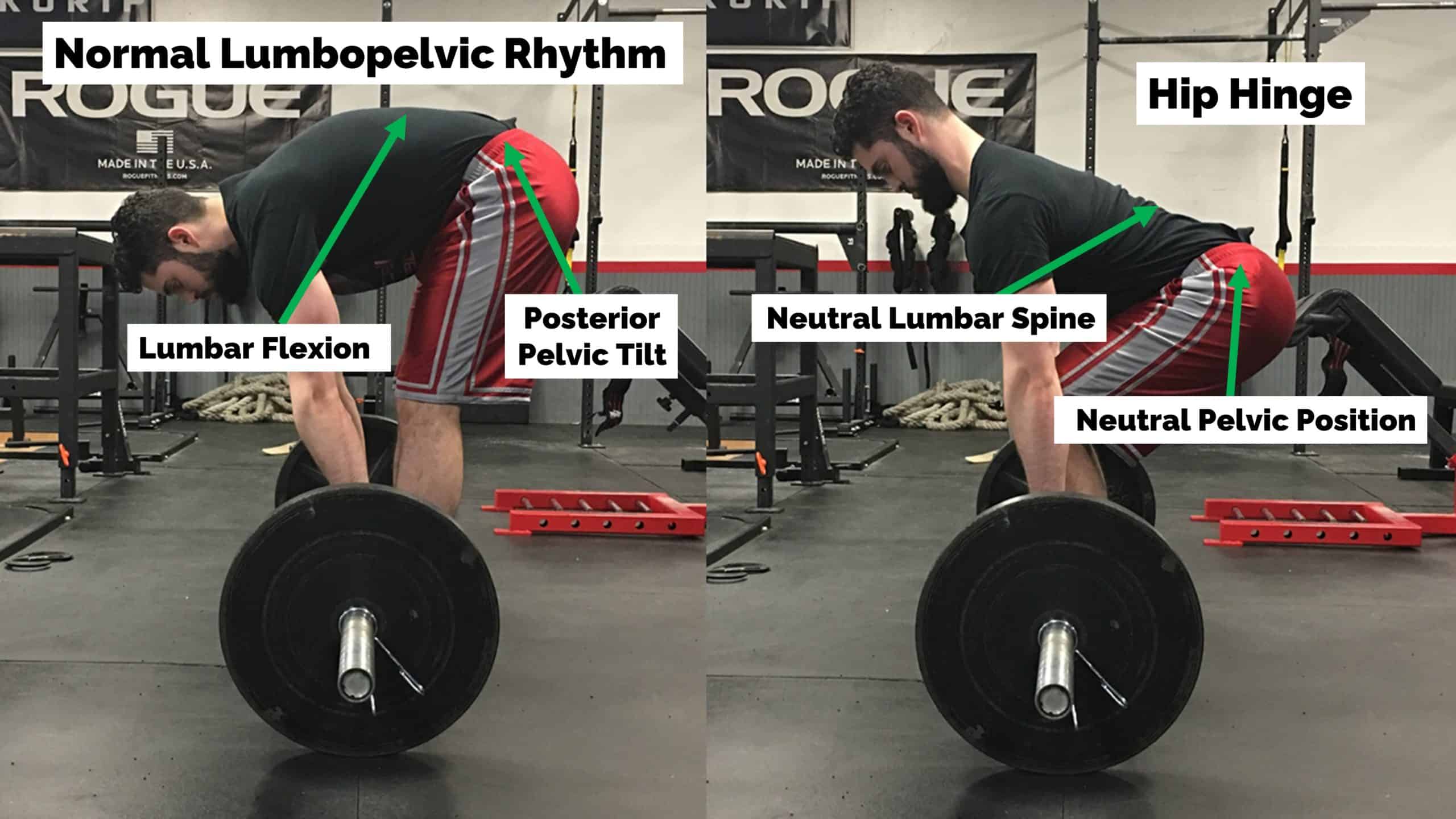
When you perform a proper hip hinge, your spine acts as a rigid lever, transferring force from the ground, through your legs, and into the barbell. The work is done by the hip extensors (glutes and hamstrings).
When you simply bend over, your spine flexes, and the load is placed directly onto the spinal erector muscles and, more dangerously, the passive structures of your lumbar spine—the intervertebral discs and ligaments. This not only robs your glutes and hamstrings of the intended stimulus but also dramatically increases the risk of injury.
Why Lumbar Compensation is a Biomechanical Catastrophe
Your background in computer engineering will help you appreciate the logic of lever systems and torque. In a hip hinge, the spine and pelvis act as a lever rotating around the hip joint (the fulcrum). The load (barbell) creates a torque that the hip extensors must overcome.
Let's examine the biomechanics of what happens when form breaks down.
Understanding Biomechanics Through the Hip- Hinge Lever Model ...
The article 'Understanding Biomechanics Through the Hip-Hinge Lever Model' provides an excellent explanation of why small changes in posture lead to large changes in spinal stress. This is the core theory behind everything we'll discuss today.
Please read the three paragraphs starting with 'When the torso leans forward...', 'From a spinal biomechanics perspective...', and 'The diagram also highlights...'. Focus on how a longer moment arm increases torque demand on the spine and how spinal flexion is a compensation for a lack of hip mobility or strength.
As the article explains, the key principle is that a longer moment arm equals higher torque and stress. Nearly every common mistake in posterior chain training can be analyzed as a failure to manage this moment arm, leading to the spine bearing a load it was not designed to move.
Analyzing Common Mistakes in the Romanian Deadlift (RDL)
The RDL is the quintessential hip hinge. Let's dissect the most frequent errors. The following video provides a clear visual demonstration of both correct form and these common compensations.
How to do romanian deadlifts safely
In 'How to do romanian deadlifts safely', fitness coach Jack Hanrahan details the most common mistakes people make. Watch this to see these errors in action.
Watch the segment on finding your end range of motion (02:41 - 03:21) and the detailed breakdown of four common compensations (06:13 - 08:50). Pay close attention to the visual difference between a neutral spine and a rounded or arched spine.
Let's break down these faults from a movement analysis perspective.
Fault 1: Lumbar Flexion (Rounding the Lower Back)
- What it looks like: As the lifter descends, their lower back begins to round, and their pelvis tucks under. This often happens as they try to chase a deeper stretch or a larger range of motion than their hamstrings will allow.
- Anatomical Analysis: The hamstrings have reached their end-range of extensibility. To continue moving the barbell downward, the body seeks motion elsewhere—the lumbar spine. The pelvis performs a posterior tilt, and the lumbar vertebrae flex. As we learned from the LINK article, this shifts the load from the taut hamstrings directly onto the spinal erectors and passive spinal structures. You are no longer training the posterior chain; you are stressing your lower back.
- Cause: Exceeding active hamstring range of motion; poor core bracing; trying to touch the floor at all costs.
Fault 2: Lumbar Hyperextension (Over-Arching the Back)
- What it looks like: The lifter initiates the RDL by aggressively arching their lower back, creating a visible "S" curve in their spine. Ribs are often flared out.
- Anatomical Analysis: This is an attempt to maintain a "straight back" that goes too far. Instead of a neutral spine stabilized by the core, the lifter is creating excessive lumbar lordosis. This places high compressive forces on the posterior elements of the vertebrae (the facet joints). It's a mechanically unstable position that substitutes active core bracing for passive skeletal end ranges.
- Cause: Misinterpreting the "chest up" cue; fear of rounding; poor motor control.
Fault 3: Hips Shooting Up First (in a Deadlift from the floor)
- What it looks like: During a conventional deadlift, the lifter's hips rise significantly faster than their shoulders as the bar breaks the floor. The back angle becomes more horizontal before the bar has even passed the knees.
- Anatomical Analysis: This is a classic compensation strategy. The lifter's body senses that the quads are not strong enough to initiate the lift by "pushing the floor away." Instead, it shifts the work to the stronger muscle groups for that lifter: the hamstrings and lower back. By straightening the legs early, the lift is transformed into an RDL, but from a biomechanically compromised position with a very long moment arm acting on the lumbar spine.
- Cause: Weak quads relative to hamstrings/back; starting with hips too low; lack of pre-tension and glute engagement before the pull.
The video below explains not only how individual anatomy can influence the starting position but also how to prevent this specific "hips shoot up" fault.
Find Your Perfect Deadlift Style in 60 Seconds
The channel Squat University provides a fantastic analysis of how limb lengths affect deadlift style and how to prevent the hips from rising prematurely.
Watch the entire video (00:56 - 03:40). First, understand how limb length affects the start position. Then, focus on the two critical steps to prevent lumbar loading and the hips from shooting up: proper bracing and pre-engaging the glutes.
Analyzing Common Mistakes in the Hip Thrust
Lumbar compensation isn't limited to standing hinges. It's also rampant in the hip thrust.
Fault: The "Scoop" (Lumbar Hyperextension at Lockout)
- What it looks like: At the top of the hip thrust, instead of a straight line from shoulders to knees, the lifter's lower back is visibly arched as they push their belly toward the ceiling.
- Anatomical Analysis: The lifter is failing to achieve full hip extension. Instead, they are substituting it with lumbar hyperextension. The gluteus maximus has not fully contracted to bring the pelvis to a neutral (or slightly posteriorly tilted) position. The lumbar erectors take over to create the illusion of more height, which does nothing for glute stimulus and places shearing force on the lumbar spine.

A Framework for Movement Analysis
As a future coach, you need a systematic process to diagnose these errors. Here is a checklist to run through when observing a client performing a posterior chain exercise:
| Fault | What to Look For (Visual Cue) | Biomechanical Cause | Consequence |
|---|---|---|---|
| Lumbar Flexion | Lower back rounds; pelvis tucks under. | Exceeding hamstring ROM; poor core brace. | Shifts load from hamstrings to spinal discs/ligaments. High injury risk. |
| Lumbar Hyperextension | Excessive arch in lower back; ribs flare. | Misunderstanding "neutral spine"; weak core. | Compresses facet joints of the spine; poor force transfer. |
| Hips Shoot Up | Hips rise faster than shoulders from the floor. | Weak quads; poor starting tension. | Increases shear stress on the lumbar spine; inefficient lift. |
| Hip Thrust "Scoop" | Lower back arches at the top of the thrust. | Incomplete hip extension; weak glute lockout. | Reduces peak tension on glutes; places shear stress on the lumbar spine. |
| Bar Drifts Forward | Barbell moves away from the shins/thighs. | Lack of latissimus dorsi engagement. | Increases the moment arm on the spine, increasing torque and stress. |
This final fault, the bar drifting forward, is discussed in point #10 of the article "12 Cues To Master Your Hip Hinge & RDL" (LINK). It directly relates to increasing the moment arm on the spine and is a simple but critical error to spot.
Conclusion
Today you've moved from understanding ideal muscle function to analyzing dysfunctional movement patterns. You can now identify the most common posterior chain training mistakes, especially those involving lumbar compensation, and—crucially—explain the biomechanical reasons why they are incorrect and unsafe.
Key Takeaways:
- The fundamental error in posterior chain training is substituting spinal movement for hip movement.
- Lumbar compensation (flexion or hyperextension) occurs when the spine moves to compensate for a lack of strength, mobility, or motor control at the hips.
- These errors increase the moment arm acting on the lumbar spine, leading to dangerous levels of torque, shear, and compressive forces.
- Common mistakes to analyze include lumbar rounding in RDLs, hips shooting up in deadlifts, and "scooping" the back in hip thrusts.
- Analyzing movement involves observing the spine, pelvis, and bar path to ensure the hips are the prime mover and the spine remains a rigid, stable transmitter of force.
Preview of the Next Lesson
Identifying a problem is the first step; fixing it is the next. In our final lesson for this module, we will focus on developing specific coaching cues to promote proper hip-hinge mechanics and correct the common faults we analyzed today. You will learn how to translate your anatomical and biomechanical knowledge into simple, effective instructions that create immediate improvements in a client's form.