Introduction
Welcome back. In our last lesson, we established a framework for ordering exercises within a session to maximize the stimulus-to-fatigue ratio. That framework, while robust, operates on the assumption of a "standard" human body. But as a coach, you will quickly discover that no such person exists. Everyone walks into the gym with a unique anatomical blueprint.
This lesson directly addresses that reality, focusing on the learning outcome: Explain how individual anatomical variation (e.g., limb length) should influence exercise selection and modification.
We will move beyond generic exercise prescriptions and explore how differences in skeletal structure—specifically the lengths of the arms, legs, and torso—fundamentally alter the mechanics of major lifts. Understanding this is the bridge between being a trainer who just prescribes exercises and a coach who tailors them for an individual's body, maximizing hypertrophic stimulus while minimizing injury risk.
Why Anatomy Dictates Muscle Recruitment
Have you ever wondered why one person feels their chest light up during a bench press, while another feels it mostly in their shoulders? Or why some people can squat deep with an upright torso, while others have to lean far forward? The answer lies in a concept called neuromechanical matching.
Your nervous system is incredibly efficient. When you perform a movement, it automatically recruits the muscles that have the best leverage—the longest internal moment arms—to accomplish the task. Since our individual limb lengths and proportions determine these leverages, our unique anatomy dictates which muscles get preferentially stimulated by a given exercise.
Let's watch a short video that introduces this concept and presents evidence for these individual differences.
UNDERRATED Exercise Selection Principles for Muscle Growth
This video from House of Hypertrophy, 'UNDERRATED Exercise Selection Principles for Muscle Growth', introduces the core principle of neuromechanical matching and shows research demonstrating that muscle activation patterns vary significantly between individuals performing the same exercise.
Please watch from the beginning until 03:39. Focus on understanding the concept of 'leverage' determining recruitment, and note the study examples (Nordic curls, bench press) that show different muscle activation patterns among individuals.
The key insight is that an exercise does not have one universal muscle target. The stimulus is filtered through the lens of an individual's unique anatomy. Our job as coaches is to understand that filter and adjust the exercise to match the client's goal.
Let's examine this through three critical case studies: the squat, the deadlift, and the bench press.
Case Study 1: The Squat – A Game of Segments
The barbell squat is perhaps the most prominent example of how anatomy dictates form. Performance and muscle emphasis are largely governed by the relative lengths of three segments: the torso, the femur (thigh bone), and the tibia (shin bone).
Watch this excellent animation that visualizes the impact of these proportions.
Body Proportions & Squatting: How Limb Length Affects Your Squat
This video from Muscle & Motion, 'Body Proportions & Squatting', provides a clear visual breakdown of how different limb and torso lengths affect squat mechanics.
Watch the entire video. Pay close attention to how a long femur relative to the torso forces a forward lean to keep the barbell over the mid-foot. Also, note the practical solutions offered to accommodate these variations.
As the video demonstrates, a lifter with long femurs and a short torso is at a mechanical disadvantage for maintaining an upright squat. To keep their center of mass (and the bar) over the middle of their feet, they are forced into a significant forward lean.

This forward lean has a critical biomechanical consequence:
- It increases the moment arm at the hips (the horizontal distance from the hip joint to the barbell's vertical path).
- It decreases the moment arm at the knees (the horizontal distance from the knee joint to the barbell's path).
Recalling our biomechanics principles, this means the hip extensors (glutes and adductor magnus) and spinal erectors must produce significantly more torque, while the knee extensors (quadriceps) do relatively less work.
Application & Modification:
-
For a long-femured lifter: The traditional back squat becomes a hip-dominant, posterior-chain-building exercise. If the goal is quadriceps hypertrophy, the back squat is a poor choice for them.
- Solution: Select exercises that force a more upright torso and allow the knees to travel further forward, thus increasing the moment arm at the knee.
- Heel Elevation: Using weightlifting shoes or placing plates under the heels.
- Front-Loaded Squats: Goblet squats or front squats shift the center of mass forward, acting as a counterbalance that encourages an upright posture.
- Safety Squat Bar (SSB) Squats: The cambered design of an SSB also positions the load forward.
- Quad-focused Machines: Leg presses and hack squats provide external stability, allowing the user to manipulate foot position to emphasize the quads without being limited by their squat mechanics.
- Solution: Select exercises that force a more upright torso and allow the knees to travel further forward, thus increasing the moment arm at the knee.
-
For a short-femured lifter: The back squat is an excellent exercise for overall leg development, providing a balanced stimulus to both the quads and glutes. They might need to add more direct posterior chain work (like RDLs) to ensure their hamstrings and glutes receive adequate stimulus.
Case Study 2: The Deadlift – A Question of Reach
For the deadlift, the key anatomical variables are arm length and torso length. The bar starts at a fixed height from the floor, so the lifter's proportions determine their starting position.
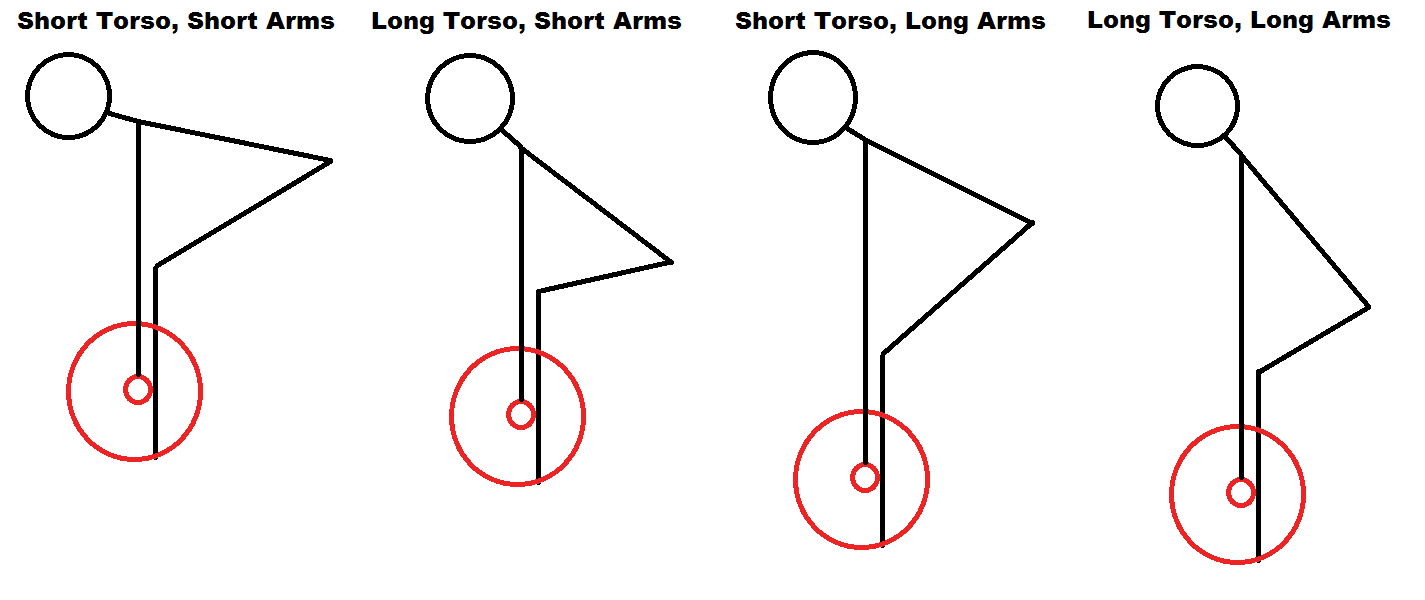
Let's break down the mechanics:
- Long Arms / Long Torso: This is the ideal structure for deadlifting (think of record-holder Lamar Gant). Long arms reduce the range of motion the bar must travel. A long torso allows the lifter to set up with a more vertical back angle and higher hips, creating powerful leverage for the initial pull.
- Short Arms / Short Torso: This is the most challenging structure. To reach the bar, the lifter must drop their hips very low and adopt a more horizontal back angle. This increases the moment arm for the spinal erectors and places the hips in a less powerful position to initiate the lift.
Application & Modification:
- For a short-armed lifter: Pulling a heavy deadlift from the floor may provide a poor stimulus-to-fatigue ratio, with excessive stress on the lower back.
- Solution: Modify the range of motion to create a more advantageous and safer starting position.
- Block/Rack Pulls: Elevating the bar by a few inches can dramatically improve the starting position, allowing the lifter to train the powerful lockout portion of the deadlift safely.
- Romanian Deadlifts (RDLs): Since RDLs don't require pulling from the floor, they are an excellent alternative for training the hip hinge pattern and developing the entire posterior chain (glutes, hamstrings, erectors) without being limited by arm length.
- Solution: Modify the range of motion to create a more advantageous and safer starting position.
Case Study 3: The Bench Press – All About Levers
In pressing movements, arm length is the dominant variable.
- Long Arms: Create a long range of motion, meaning more work is done per rep. This is a disadvantage for lifting maximal weight. The increased distance the bar travels also provides more opportunity for deviation from an optimal bar path and can sometimes lead to the shoulders and triceps taking over from the chest.
- Short Arms: Create a short, powerful range of motion. This is highly advantageous for bench pressing and means the chest is often effectively stimulated.
Application & Modification:
-
For a long-armed lifter: They may find it difficult to "feel" their chest working and may be prone to shoulder discomfort.
- Solution: Adjust programming and exercise selection to account for the poor leverage.
- Increased Pressing Volume: They might need more total sets of pressing to achieve the same hypertrophic stimulus as a short-armed lifter.
- Dedicated Pec Isolation: Adding flyes, cable cross-overs, or dips can help ensure the pecs receive a direct growth signal.
- Technique Adjustments: Using a slightly wider grip (while maintaining comfort and safety) can shorten the ROM.
- Partial ROM Lifts: Floor presses or Spoto presses overload the top half of the movement, which can build triceps strength to help with lockout.
- Solution: Adjust programming and exercise selection to account for the poor leverage.
-
For a short-armed lifter: The bench press is likely an effective chest builder. Their weakness will typically be in pulling movements, where their short arms create a mechanical disadvantage. They should ensure they are doing ample volume on rows and pull-ups to maintain structural balance.
Coach's Notes: Putting Theory into Practice
Understanding these principles is one thing; applying them is another. You don't need an MRI machine to tailor training. You need to observe, assess, and experiment.
To get a practical framework for this, please read the following article. It provides simple methods for assessing proportions and gives concrete programming recommendations based on them.
Body Proportions & Lifting – What You Need to Know
The article 'Body Proportions & Lifting – What You Need to Know' by Tom Sheppard for T NATION offers a superb, real-world guide to customizing training based on your anatomy. It reinforces our case studies with practical advice.
Please read the following sections: 'Why Are Body Proportions Important?', 'Upper Body Proportions' and its sub-sections on recommendations for long- and short-armed lifters, and 'Lower Body Proportions' and its sub-sections on recommendations for long- and short-legged lifters. Focus on the 'how-to' aspect: how to assess proportions and what programming adjustments to make.
The core of effective coaching lies in this process:
- Assess: Use visual cues. Watch your client squat and deadlift. Do they lean forward? Are their hips high or low? Use the simple measurements from the T-Nation article (e.g., wingspan vs. height).
- Hypothesize: Based on your assessment, form a hypothesis. "This client has long femurs, so I predict back squats will be more glute-dominant and hack squats will be better for their quads."
- Test: Program the exercises you believe are a better fit.
- Evaluate: Get feedback. Ask the client where they feel the exercise. Track their progress. Does their mind-muscle connection improve? Are they progressing in load and reps? The best exercise for someone is the one that is safe, feels right for them, and allows for progressive overload.
This iterative process of assessment and autoregulation is far more powerful than adhering to a rigid list of "best" exercises.
Conclusion
Today, we've dismantled the idea of a one-size-fits-all approach to exercise selection. By understanding how individual anatomy interacts with the physics of lifting, you can make informed decisions that lead to better results for your clients.
Key Takeaways:
- Anatomy is King: Individual limb and torso proportions are primary determinants of movement mechanics and muscle recruitment via the principle of neuromechanical matching.
- Leverage Dictates Stimulus: A lifter's proportions determine the moment arms at each joint, dictating which muscles bear the most load. A "squat" is not the same stimulus for a long-femured person as it is for a short-femured person.
- Observe, Don't Assume: The most crucial coaching skill is observing how a person moves and adapting the exercise to fit their body, not forcing their body to fit the exercise.
- Modify and Select: Use exercise modification (e.g., heel elevation, block pulls) and selection (e.g., front squat instead of back squat) to align the mechanical tension with the target muscle.
Preview of the Next Lesson
We have now explored how skeletal structure influences exercise selection. Next, we will go one level deeper, from the bones to the muscles themselves. Our next lesson will address the learning outcome: Analyze how a muscle's anatomical properties (e.g., size, fiber type, stretch susceptibility) influence its recovery profile and inform fatigue management. We will investigate why a large muscle like the glutes can be trained differently from a small muscle like the biceps, and how this knowledge helps us refine training frequency and volume.