Welcome to the final lesson in our module on thin-film interference. Over the past two lessons, we've explored how the wave nature of light leads to interference patterns when light reflects from the surfaces of thin films. We saw this in the colorful swirls of soap bubbles and the precise circles of Newton's rings. In both cases, the key ingredients were the path difference created by the film's thickness and the phase shifts occurring upon reflection.
Today, we will apply these exact principles to understand a crucial technology found in everything from your glasses to high-end camera lenses and solar panels: anti-reflecting coatings. Our goal is to explain the physical principle that makes these coatings work and to understand their purpose in improving the performance of optical devices. We'll see how engineers cleverly manipulate destructive interference to eliminate unwanted reflections.
The Purpose: Why We Need to Fight Reflections
Whenever light passes from one medium to another, like from air into a glass lens, a portion of it reflects off the surface. For a simple air-to-glass interface, this reflection accounts for about 4% of the light. While that might not sound like much, it has significant consequences in many optical systems.
A professional camera lens, for example, can have more than a dozen individual glass elements. If each of the many surfaces reflects 4% of the light, the cumulative loss can be substantial, leading to dimmer images. Worse, this stray reflected light can bounce around inside the lens system, creating "ghost" images and flare, which severely degrades image quality. The same problem affects scientific instruments, microscopes, and even solar panels, where every bit of reflected light is wasted energy that doesn't get converted into electricity.
To start, watch the introduction of the video "ANTI-REFLECTING FILM".
This short clip, from the beginning to the explanation, provides a clear overview of why reflection is a problem in optical instruments and solar cells, setting the stage for the solution.
Anti-reflecting coatings are designed to solve this problem by minimizing reflection and maximizing the amount of light that gets transmitted through the surface.
The Principle: Engineering Destructive Interference
How can we possibly add a layer to a surface and have it reduce reflection? The answer, as you might have guessed, is thin-film interference. The coating is a transparent film engineered with a specific thickness and refractive index to ensure that light rays reflecting off its surfaces interfere destructively.
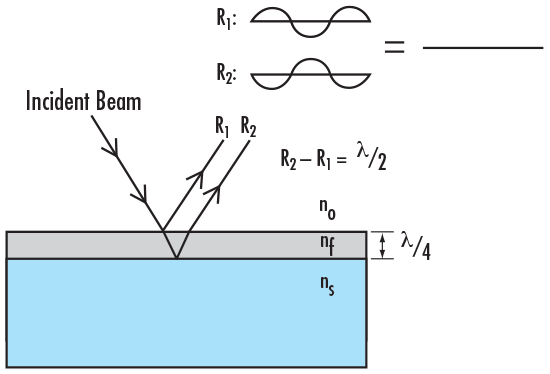
Let's break down how this works. Consider a layer of coating material applied to a glass surface, with light incident from the air. We now have three media: air (), the coating (), and the glass substrate (). For the coating to work, its refractive index is chosen to be between that of air and glass: .

When an incident light ray hits the lens, we get two main reflections to consider:
- Ray 1: Reflects at the first interface (air-to-coating).
- Ray 2: Reflects at the second interface (coating-to-glass).
For these two rays to cancel each other out, two conditions must be met: the Phase Condition and the Amplitude Condition.
1. The Phase Condition: Getting the Thickness Right
The two reflected rays must be 180° (or radians) out of phase to interfere destructively. Let's analyze the sources of phase shift, just as we did for Newton's rings:
- Reflection of Ray 1 (Air Coating): Light moves from a lower refractive index () to a higher one (). This reflection from a denser medium introduces a phase shift of 180° ().
- Reflection of Ray 2 (Coating Glass): Light moves from the coating () to the glass substrate (). Since we chose , this is also a reflection from a denser medium, which introduces another phase shift of 180° ().
Since both rays experience the same 180° phase shift upon reflection, their relative phase difference from this effect is zero. Therefore, the required 180° phase difference must come entirely from the optical path difference between the two rays.
Ray 2 travels an extra distance down and back through the coating. For light hitting the surface at a normal angle, this extra distance is twice the coating's thickness, . The optical path difference (OPD) is this distance multiplied by the coating's refractive index: .
To achieve destructive interference, this OPD must be equal to half a wavelength:
By rearranging this, we arrive at the first crucial condition for an anti-reflection coating:
The physical thickness of the film must be one-quarter of the wavelength of light inside the coating material. This is why it is often called a quarter-wave coating.
2. The Amplitude Condition: Getting the Refractive Index Right
For the two waves to cancel out completely, they must also have the same amplitude. Without diving into the complex mathematics of the Fresnel equations, the intuitive idea is that the amount of light reflected at an interface depends on the "jump" in refractive index.
To make the reflection from the air-coating interface have the same intensity as the reflection from the coating-glass interface, the refractive index of the coating () must be the geometric mean of the refractive indices of the air () and the glass ().
Since the refractive index of air is very close to 1, this simplifies to:
For typical glass with , the ideal coating would have a refractive index of .
The following webpage provides a great overview of these principles.
Quarter Wave Anti-Reflection Coating Calculator | FIRGELLI
This article from FIRGELLI Automations provides a clear, practical explanation of anti-reflection coatings.
Start by reading the introductory sections to solidify the concept. Focus on the simple explanation, which uses a great analogy. Then, read the sections on the theory and the physical principles to see how the conditions for thickness and refractive index are established.
Reality Check: Why Coatings Aren't Perfect
If you've ever seen a camera lens or a pair of glasses with an anti-reflection coating, you may have noticed it has a faint greenish or purplish tint. If the coating is meant to eliminate reflection, why does it have a color?
This happens for two main reasons, which are practical limitations of the ideal model:
-
Material Availability: It's difficult to find a material that is durable, easy to apply, and has the exact ideal refractive index. The most common coating material, Magnesium Fluoride (MgF₂), has a refractive index of . This is close, but not a perfect match for the ideal 1.22 for standard glass. Because the amplitudes of the two reflected waves don't perfectly match, their cancellation isn't total.
-
Wavelength Dependence: The quarter-wave thickness is calculated for a specific wavelength of light (). Coatings are typically optimized for the middle of the visible spectrum, around 550 nm (green light), where the human eye is most sensitive. For this wavelength, the cancellation is very effective. However, it is less effective for other colors (wavelengths), like blue and red at the ends of the spectrum. The faint color you see is the residual reflection of the light for which the coating is least effective.
This webpage section explains these limitations clearly.
Quarter Wave Anti-Reflection Coating Calculator | FIRGELLI
Let's return to the same article to understand the practical limitations.
Find the "Frequently Asked Questions" at the bottom and read the answer to the question "Why doesn't a quarter-wave coating eliminate all reflection?". This explains the trade-offs involved.
To see how these principles are applied in the real world, read about the following practical scenarios.
Quarter Wave Anti-Reflection Coating Calculator | FIRGELLI
Finally, let's look at some real-world applications to reinforce the purpose of these coatings.
Please read the entire section titled "Practical Applications". It gives three excellent examples—in camera lenses, solar panels, and laser safety—that show how these coatings are critical in modern technology.
Conclusion
In this lesson, we have seen a powerful and widespread application of the wave nature of light. By understanding and applying the principles of thin-film interference, we can engineer surfaces that perform a seemingly magical task: reducing reflections to let more light pass through.
Let's summarize the key takeaways:
- Purpose: Anti-reflecting coatings are used to increase the transmission of light through optical surfaces (like lenses and solar cells) by reducing reflection losses. This improves image brightness and quality and increases the efficiency of energy conversion.
- Principle: The coating works by creating two reflected light waves (one from the top surface, one from the bottom) that are designed to interfere destructively.
- Two Conditions: For a single-layer coating to be effective, two conditions must be met:
- Thickness: The optical thickness () must be a quarter of the target wavelength ().
- Refractive Index: The coating's refractive index should be the square root of the substrate's refractive index ().
- Limitations: The anti-reflection is optimal only for a specific wavelength and is limited by the availability of materials with the ideal refractive index.
This lesson concludes our module on Interference in Thin Films. You've now seen how a single set of physical principles can explain natural phenomena like the colors on a soap film, enable precise measurements with Newton's rings, and lead to essential technologies like anti-reflecting coatings.
In our next module, we will shift our focus to a completely different, yet equally fascinating, aspect of light and optics: Lasers. We'll begin by exploring the fundamental quantum processes of spontaneous and stimulated emission that are the heart of every laser.