Welcome to your first lesson in Applied Physics. This course is designed to help you master the key concepts for your first-year university exams, starting with the fascinating world of optics. Today, we will explore why thin films, like a soap bubble or an oil slick on a wet road, shimmer with vibrant colors.
Our goal for this lesson is to explain how interference patterns are created by thin films and to determine the conditions that cause the light to appear bright (constructive interference) or dark (destructive interference). Understanding this phenomenon will lay the groundwork for our next topics: Newton's rings and anti-reflecting coatings.
What is Interference?
Before we dive into thin films, let's quickly solidify what we mean by "interference." In simple terms, it's what happens when two or more waves overlap in space. The resulting wave is the sum of the individual waves.
[PDF] Wave Optics - I (Interference of light).pdf - JECRC Foundation
To begin, please read a short section from the "Wave Optics" notes from JECRC Foundation. This will provide you with the formal definitions of interference and coherent sources.
In the document, focus on the section titled "Interference of Light". Pay close attention to the definitions of constructive and destructive interference that follow. Also, read the definition of "Coherent Sources". These three concepts are the bedrock of everything we'll discuss today.
As you've just read, when waves are in phase, their crests and troughs align, creating a stronger wave (constructive interference). When they are out of phase, they cancel each other out (destructive interference). For this to create a stable pattern, the light sources must be coherent—meaning they emit waves with the same frequency and a constant phase difference.
You might wonder, how can we get two coherent sources of light? It's difficult to find two separate light bulbs that are coherent. The clever solution, which is central to thin-film interference, is to take a single light ray and split it into two.
How a Thin Film Creates Two Rays from One
Imagine a single ray of light hitting the surface of a thin film, like the layer of soap in a bubble. The film is surrounded by air.
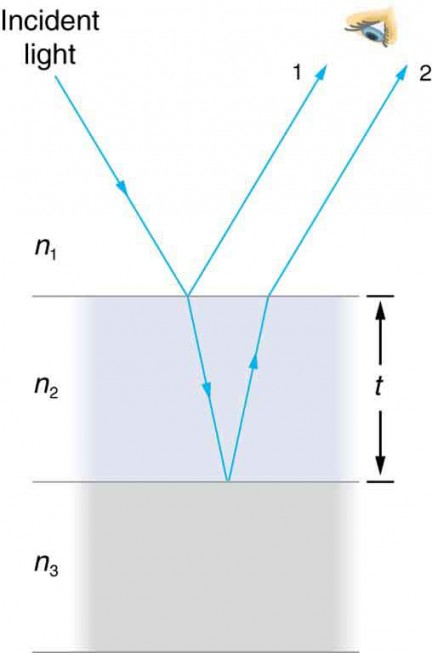
As the diagram shows:
- When the incident light ray hits the top surface of the film, some of it reflects immediately (Ray 1).
- The rest of the light refracts into the film, travels down to the bottom surface, and reflects off it.
- This ray then travels back up to the top surface and exits the film, emerging as Ray 2, parallel to Ray 1.
We now have two rays, 1 and 2, that originated from the same initial ray. They are therefore perfectly coherent and can interfere with each other. The beautiful colors you see are the result of this interference.
The Two Factors Governing Interference
Whether Ray 1 and Ray 2 interfere constructively or destructively depends on their phase difference when they meet our eyes. This phase difference is determined by two key factors.
1. Path Difference
As you can see from the diagram, Ray 2 travels a longer distance than Ray 1. It has to go down through the film and back up. This extra distance is called the path difference.
For a film of thickness and refractive index , when light enters at an angle of refraction , the optical path difference due to this extra travel is given by the expression:
Deriving this expression involves some geometry. The following video walks through the derivation step-by-step. You don't need to memorize the derivation for your exam, but watching it will help build your intuition for where this formula comes from.
Thin film of uniform thickness (conditions for maximum and minimum)
This video from Engineering Physics by Sanjiv provides a detailed geometric derivation of the path difference.
Watch the segment from the beginning of the derivation to its conclusion. Focus on the logic of how the total path inside the film is calculated and how the corresponding path in air is subtracted to find the difference.
2. Phase Shift on Reflection
The second, and more subtle, factor is a phenomenon that occurs during reflection itself. When a light wave reflects off the boundary of a medium with a higher refractive index (an optically denser medium), it undergoes an abrupt 180-degree phase shift. This is like flipping the wave upside down.
However, when light reflects off a boundary with a lower refractive index (an optically rarer medium), no phase shift occurs.
The video below gives an excellent analogy using a wave on a string. Reflecting from a fixed end (like a denser medium) inverts the wave, while reflecting from a free end (like a rarer medium) does not.
24.2 Thin Film Interference | General Physics
This video from Chad's Prep provides a very clear and intuitive explanation of phase shifts during reflection.
Watch the segment explaining phase inversion. This will help you visualize why some reflections cause a phase shift and others do not.
Let's apply this to our thin film (e.g., a soap bubble in air). The film (water, ) is denser than the air () it's in.
- Ray 1 reflects at the top surface (air-to-film). It is reflecting from a denser medium, so it undergoes a 180° phase shift.
- Ray 2 reflects at the bottom surface (film-to-air). It is reflecting from a rarer medium, so it experiences no phase shift.
This 180° phase shift is equivalent to adding an extra path difference of half a wavelength, . Therefore, we must add this term to our geometric path difference to find the total effective path difference.
This additional term is crucial and completely changes the conditions for interference.
Conditions for Maxima and Minima in Reflected Light
Now we have all the pieces to determine the final interference pattern.
Condition for Constructive Interference (Bright Fringes)
For constructive interference, the effective path difference must be a whole number of wavelengths (, where ).
Rearranging the equation, we get the condition for maxima (brightness):
A bright fringe appears when the optical path is equal to an odd multiple of half-wavelengths.
Condition for Destructive Interference (Dark Fringes)
For destructive interference, the effective path difference must be an odd multiple of half-wavelengths ( or , where ).
Rearranging the equation, we get the condition for minima (darkness):
A dark fringe appears when the optical path is equal to an integer multiple of whole wavelengths.
Notice how these conditions are the reverse of what you might expect from basic interference. This is entirely due to that crucial path difference added by the phase shift at the top surface.
The following reading summarizes these conditions clearly.
🌈 Parallel Thin Film Interference: A Powerful and Fascinating Optical Phenomenon - SmartStudyZone
This article from SmartStudyZone provides a concise summary of the interference conditions after accounting for the path difference and phase shift.
Start reading from the section "The 'Stoke’s Treatment' Correction". This will reinforce the equations we've just discussed for constructive and destructive interference.
Why Do We See Colors?
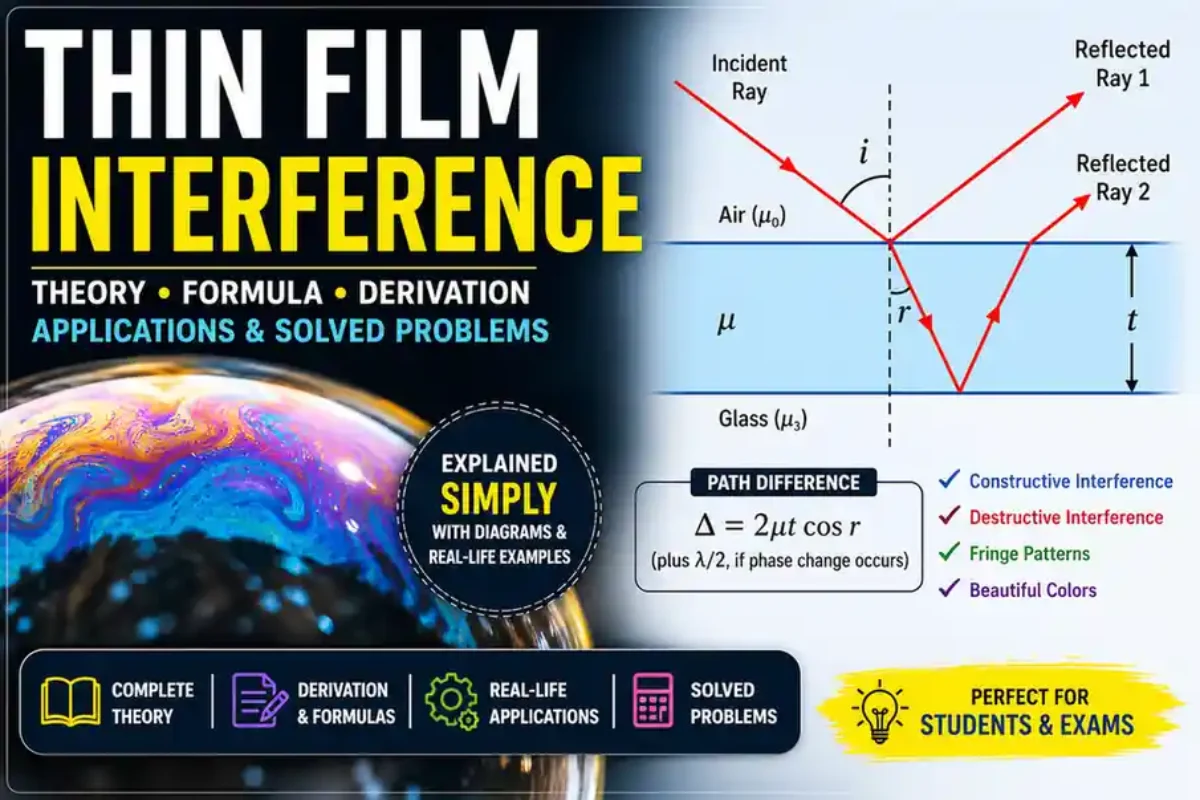
So, why the dazzling colors? When white light (which contains all wavelengths) shines on a thin film, the conditions for interference depend on the wavelength (), the thickness of the film (), and the angle you're viewing it from ().
For a given thickness and angle, only specific wavelengths will satisfy the condition for constructive interference. These are the colors you see strongly reflected. Other wavelengths will meet the condition for destructive interference and be cancelled out. As the film's thickness varies (like in a swirling soap bubble) or as you change your viewing angle, the colors that interfere constructively change, producing the beautiful, shifting patterns we observe.
Key Takeaways
Let's summarize what we've learned in this lesson:
- Mechanism: Interference in thin films arises from the superposition of two light rays originating from a single incident ray—one reflected from the top surface and one from the bottom surface.
- Path Difference: The ray reflecting from the bottom surface travels an extra distance, creating a geometric path difference of .
- Phase Shift: A crucial 180° phase shift (equivalent to a path difference) occurs when light reflects from an optically denser medium. For a film in air, this happens only at the top surface.
- Conditions for Reflected Light: Due to the phase shift, the conditions for interference are "flipped":
- Maxima (Bright):
- Minima (Dark):
You now have a solid conceptual foundation for thin-film interference. In our next lesson, we will apply these principles to understand a classic experiment known as Newton's rings, and explore a major practical application: anti-reflecting coatings used on camera lenses and eyeglasses.