Welcome to the final theoretical lesson in our module on Income and Employment. In our previous sessions, we've thoroughly explored how an economy finds its equilibrium income level where Aggregate Demand (AD) equals Aggregate Supply (AS). We also saw how a change in investment can have a magnified impact on income through the multiplier effect.
Today, we address a critical question: What if the economy's equilibrium income level is not the ideal one? We will introduce the concept of full employment income as a benchmark and then explore what happens when the actual equilibrium falls short of or exceeds this level. This lesson will explain the crucial concepts of deficient demand (deflationary gap) and excess demand (inflationary gap), which are frequently tested in your board exams.
1. The Idea of Full Employment Equilibrium
So far, we've focused on finding the equilibrium where planned spending matches the economy's output (AD = AS). However, this equilibrium can occur at any level of output, not necessarily the one where everyone who is willing and able to work has a job.
- Full Employment Equilibrium: This is an ideal situation where AD equals AS at a level of income where all available resources are fully and efficiently utilized. There is no involuntary unemployment.
- Under-employment Equilibrium: This is a more common scenario where AD equals AS, but at a level of income that is lower than the full employment level. Here, the economy is in balance, but there is involuntary unemployment and unused production capacity.
The mismatch between the actual equilibrium and the full employment equilibrium gives rise to the problems of deficient and excess demand.
2. Deficient Demand and the Deflationary Gap
When the planned aggregate demand in the economy is insufficient to support the full employment level of output, we have a situation of deficient demand.
Deficient Demand occurs when planned Aggregate Demand (AD) is less than Aggregate Supply (AS) at the full employment level of income. This shortfall in demand is called the deflationary gap.

To solidify your understanding of this concept and its graphical representation, let's watch a short video.
Recharge Chapter 9 | Excess Demand and Deficient Demand | Class 12 | Boards 2025
This clip from Rajat Arora clearly explains the concept of deficient demand and the resulting deflationary gap using the standard AD-AS diagram.
Please watch the section from deficient demand. Focus on how the AD curve is positioned below the level needed for full employment equilibrium.
Causes and Consequences of Deficient Demand
What causes demand to be deficient? It's simply a fall in one or more of the components of AD:
- Decrease in Consumption (C): People decide to save more and spend less.
- Decrease in Investment (I): Businesses are pessimistic and invest less.
- Decrease in Government Spending (G): The government cuts its expenditure.
- Decrease in Exports (X): Foreign demand for domestic goods falls.
- Increase in Imports (M): More income is spent on foreign goods.
- Increase in Taxes: Higher taxes reduce disposable income and thus consumption.
The consequences of deficient demand are significant and lead the economy into a slowdown:
- Unintended Accumulation of Inventories: Since demand is low, firms are unable to sell all they have produced. Their stocks of unsold goods pile up.
- Fall in Output: To clear their unwanted inventories and adjust to lower demand, firms cut production.
- Rise in Unemployment: When firms reduce output, they need fewer workers, leading to job losses and a rise in involuntary unemployment.
- Fall in Prices (Deflation): To sell their excess stock, firms may lower prices. A general fall in the price level is known as deflation.
The economy gets trapped in an under-employment equilibrium with low income, low output, and high unemployment.
3. Excess Demand and the Inflationary Gap
The opposite problem occurs when planned demand is more than what the economy can produce at full capacity.
Excess Demand occurs when planned Aggregate Demand (AD) is more than Aggregate Supply (AS) at the full employment level of income. This excess of demand is called the inflationary gap.
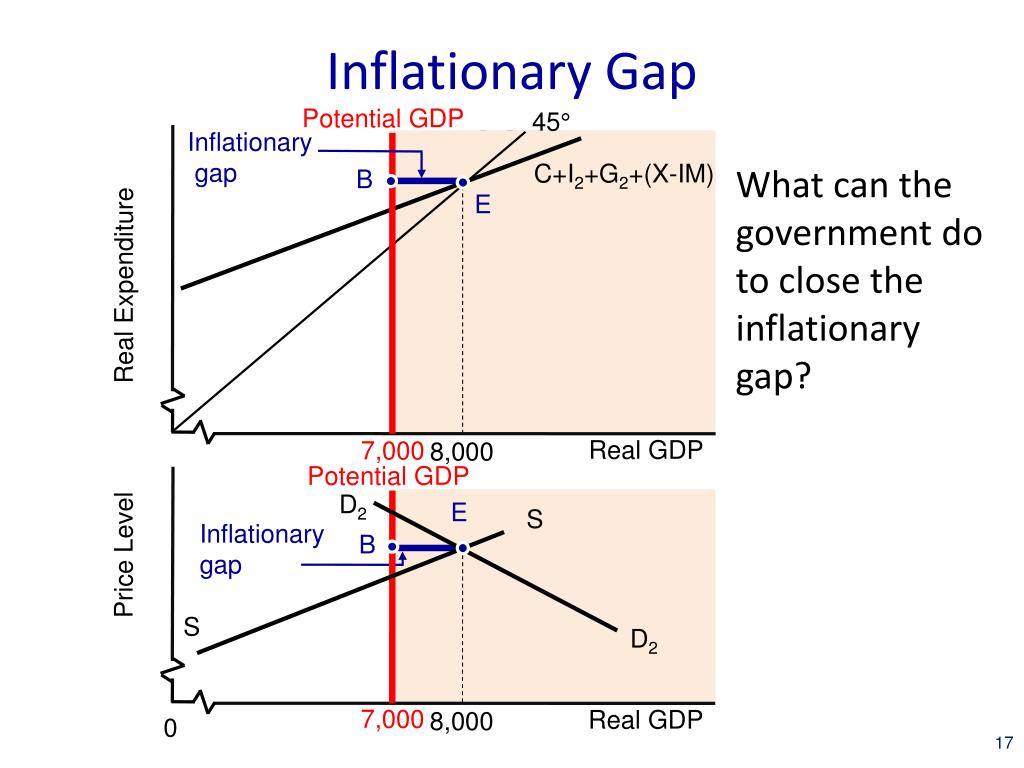
Let's watch a video explanation to see this on the AD-AS diagram.
Recharge Chapter 9 | Excess Demand and Deficient Demand | Class 12 | Boards 2025
We'll return to the Rajat Arora video to see his explanation of excess demand.
Watch the segment from excess demand. Notice how the AD curve is above the full employment equilibrium point and how this creates the inflationary gap.
Causes and Consequences of Excess Demand
Excess demand is caused by a rise in any of the components of AD:
- Increase in Consumption (C): A rise in the propensity to consume.
- Increase in Investment (I): Businesses are optimistic and increase investment.
- Increase in Government Spending (G): The government increases its expenditure.
- Increase in Exports (X): Foreign demand for domestic goods rises.
- Decrease in Imports (M): People switch from foreign to domestic goods.
- Decrease in Taxes: Lower taxes increase disposable income and consumption.
The consequences of excess demand are very different from those of deficient demand, and this is a crucial point to understand.
- No Change in Output or Employment: The economy is already at full employment. It is assumed that all resources are fully utilized. Therefore, in the short run, it's not possible to increase output or employment further.
- Rise in Prices (Inflation): Since output cannot increase, the excess demand puts pressure on the existing supply of goods and services. This leads to a general rise in the price level, a situation known as demand-pull inflation.
- Fall in Inventories (Initially): Firms will sell from their existing stocks to meet the high demand, but they cannot replenish them fast enough.
- Rise in Wages and Profits: With high demand and rising prices, there is high demand for labor, pushing wages up. Profits also tend to rise due to higher prices.
4. A Crucial Distinction for Your Exam
There is a very common point of confusion that you must be clear on. What is the difference between the situation "AD > AS" and "Excess Demand"? They sound similar, but their implications are different.
Most Important PYQs | Macro Economics | Chapter 7,8,9
In this video on past paper questions, Rajat Arora provides an excellent clarification on a point that trips up many students. This is a high-value explanation for acing your exam.
Watch this segment very carefully from the key distinction. The instructor explains why a general situation of AD > AS leads to an increase in output, but the specific case of Excess Demand does not.
To summarize the critical point from the video:
- If the economy is in an under-employment equilibrium and
AD > AS, firms will respond by increasing production and hiring more workers until a new, higher equilibrium is reached. Here, output and employment rise. - If the economy is already at full employment equilibrium, the situation
AD > ASis called Excess Demand. Since output and employment cannot be increased, the only outcome is a rise in the general price level (inflation).
Remembering this distinction is key to writing precise answers in your exam.
5. Summary: Deficient vs. Excess Demand
This table provides a quick summary for your revision.
| Feature | Deficient Demand (Deflationary Gap) | Excess Demand (Inflationary Gap) |
|---|---|---|
| Definition | AD < AS at the full employment level. | AD > AS at the full employment level. |
| Equilibrium | Leads to an under-employment equilibrium. | Does not change the full-employment level of output. |
| Impact on Output | Output falls. | Output remains constant (at the full employment level). |
| Impact on Employment | Employment falls (involuntary unemployment rises). | Employment remains constant (at the full employment level). |
| Impact on Price Level | General price level falls (deflation). | General price level rises (inflation). |
| Impact on Inventories | Unplanned accumulation of inventories. | Unplanned depletion of inventories. |
Conclusion
Today you've learned to evaluate the economy's equilibrium against the benchmark of full employment. You can now define, explain, and differentiate between the concepts of excess demand (inflationary gap) and deficient demand (deflationary gap).
Key Takeaways:
- Deficient Demand (Deflationary Gap): Occurs when planned AD is too low to support full employment. It leads to falling output, rising unemployment, and deflation.
- Excess Demand (Inflationary Gap): Occurs when planned AD is higher than what the economy can produce at full capacity. Since output cannot rise further, this leads to inflation.
- The Crucial Context: The impact of a mismatch between AD and AS depends entirely on whether the economy is at, or below, full employment.
These gaps represent serious problems for an economy. In future lessons, we will explore the monetary and fiscal policies that governments and central banks use to correct them. However, our immediate next step, as per your preference for active learning, is to solidify your understanding of this entire module by tackling numerical problems. Our next lessons will be dedicated to solving categorized board paper numericals on calculating equilibrium income, propensities (APC/MPC), and the investment multiplier.