Welcome back! In our last session, we honed your numerical skills by tackling schedule-based problems, which required you to systematically calculate consumption, savings, and various propensities. This was excellent practice for a very common exam question format.
Today, we will shift our focus from numerical calculation to economic policy. We'll explore how the government can actively intervene to manage the economy. Specifically, this lesson covers how fiscal policy—the government's budgetary tools—is used to correct imbalances in the economy. This is a crucial theoretical topic that frequently appears in board exams, often as a 4 or 6-mark question.
Our learning outcome for this lesson is to: Describe how fiscal policy instruments (changes in government spending and taxes) are used to correct inflationary and deflationary gaps.
1. The Problem: Gaps in the Economy
Before we can discuss the solution, we need to be crystal clear about the problem. In a previous module, you were introduced to the concepts of excess demand and deficient demand. These situations create "gaps" in the economy that require correction.
- Excess Demand (Inflationary Gap): Occurs when Aggregate Demand (AD) is greater than Aggregate Supply (AS) at the full employment level. There's "too much money chasing too few goods," which pushes prices up, causing inflation.
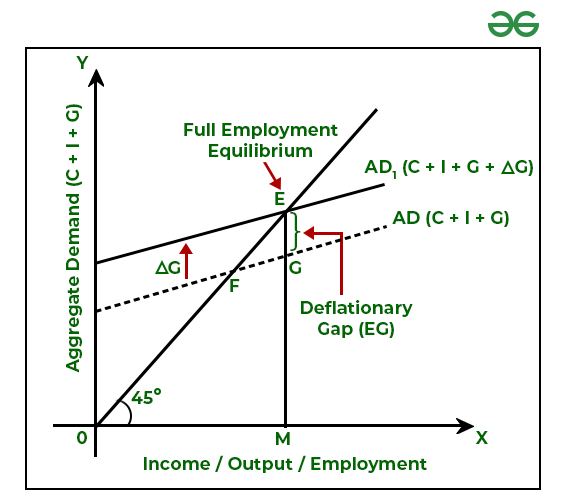
- Deficient Demand (Deflationary Gap): Occurs when AD is less than AS at the full employment level. There isn't enough demand to buy all the goods and services produced, leading to unsold stock, falling output, and unemployment.
To quickly refresh these concepts and their graphical representation, let's watch a short video.
Excess Demand and Deficient Demand | Chapter 9 | Class 12 | One Shot
This video from Rajat Arora provides a clear visual explanation of excess and deficient demand and their corresponding gaps.
Watch the segment from the beginning. Focus on how the AD curve shifts to create the inflationary gap (the vertical distance above the full employment equilibrium) and the deflationary gap (the vertical distance below it).
2. The Toolkit: Fiscal Policy
Now that we've redefined the problems, let's look at the tools the government uses to solve them. This toolkit is called Fiscal Policy.
Fiscal Policy refers to the use of the government's budget to influence the economy. Given your accounting background, you can think of this as the government strategically managing its revenue (income) and expenditure to achieve economic goals.
The two primary instruments of fiscal policy are:
- Government Expenditure (G): This includes all government spending on public works (roads, schools), defense, and administration. Since G is a direct component of Aggregate Demand (), changes in G have a direct impact on AD.
- Taxes (T): These are the primary source of government revenue. Taxes affect the disposable income () of households (). A change in taxes influences consumption (C) and, therefore, indirectly affects AD.
It's important to distinguish this from Monetary Policy, which involves the Reserve Bank of India (RBI) managing the money supply and credit conditions. Today, our focus is solely on the government's fiscal tools.
3. Correcting an Inflationary Gap (Excess Demand)
The Situation: The economy is "overheating." Aggregate Demand is too high, causing inflation.
The Goal: Reduce Aggregate Demand to bring it back to the full employment level.
The government will implement a contractionary fiscal policy.
a) Decrease Government Spending
The most direct way to reduce AD is for the government to cut its own spending.
- Mechanism: When the government reduces its expenditure (e.g., postpones a highway construction project), the total demand for goods and services in the economy falls directly.
- Effect: The AD curve shifts downwards, closing the inflationary gap.
b) Increase Taxes
By increasing taxes, the government reduces the purchasing power of the public.
- Mechanism: Higher income or consumption taxes leave households with less disposable income. With less money to spend, their consumption (C) decreases.
- Effect: A fall in C leads to a downward shift in the AD curve, helping to control inflation.
The following reading provides a concise, exam-oriented summary of these measures.
Excess Demand and Deficient Demand - CBSE Notes for Class 12 ...
This note from LearnCBSE clearly outlines the fiscal policy actions taken to combat excess demand.
Read the section titled (b) Fiscal Policy, focusing on the sub-points about Revenue Policy (Increase Taxes) and Expenditure Policy (Reduces Expenditure). Notice how the explanation links the policy action to its effect on purchasing power and liquidity.
4. Correcting a Deflationary Gap (Deficient Demand)
The Situation: The economy is in a slump. Aggregate Demand is too low, leading to unemployment and falling output.
The Goal: Increase Aggregate Demand to stimulate the economy and reach full employment.
The government will implement an expansionary fiscal policy.
a) Increase Government Spending
The government can directly boost demand by increasing its spending.
- Mechanism: When the government spends more (e.g., invests in new infrastructure projects), it directly increases the demand for goods and services. This also creates jobs, further boosting income and consumption.
- Effect: The AD curve shifts upwards, closing the deflationary gap.
The graph below provides a perfect illustration of this process.
b) Decrease Taxes
Cutting taxes is another way to encourage spending.
- Mechanism: Lowering taxes increases the disposable income of households. With more money in their pockets, people tend to spend more, leading to a rise in consumption (C).
- Effect: The increase in C shifts the AD curve upwards, helping the economy recover from the slump.
To see how these policies work in tandem and how they are explained for your exam, let's watch the final key segment of the video.
Excess Demand and Deficient Demand | Chapter 9 | Class 12 | One Shot
This part of the video explains how the fiscal policy instruments we've discussed are used to correct both excess and deficient demand.
Watch from this segment. The instructor clearly explains the logic: to control excess demand (too much money), reduce government spending and increase taxes. To fix deficient demand (too little money), do the opposite. Pay attention to the clear cause-and-effect chain he presents.
5. Practical Application: A Past Board Question
Let's see how this concept was tested. A past CBSE paper asked to explain two measures to solve the problem of deficient demand.
One of the correct answers was:
"To solve this situation, government can reduce the tax rate, which will lead to an increase in the disposable income and in turn, consumption expenditure and Aggregate Demand will also increase."
This shows that a clear, step-by-step explanation of the mechanism—from policy tool (tax cut) to final impact (AD increases)—is exactly what is expected.
Conclusion
In this lesson, we explored how the government uses its fiscal policy tools to steer the economy. By adjusting government spending and taxes, it can manage the level of aggregate demand to combat both inflation and unemployment.
Key Takeaways:
- Fiscal Policy: The government's use of its budget (expenditure and taxes) to influence the economy.
- To Correct an Inflationary Gap (Excess Demand): The government uses contractionary policy. It decreases government spending and/or increases taxes to reduce aggregate demand.
- To Correct a Deflationary Gap (Deficient Demand): The government uses expansionary policy. It increases government spending and/or decreases taxes to boost aggregate demand.
You've now covered the theory behind fiscal policy intervention. In our next lesson, we will return to numericals and begin our focused practice on solving categorized board paper questions (2019–2024) on propensities (APC/MPC), building directly on the skills from our previous session.