Hello! Welcome to your next lesson on the current challenges facing the Indian economy.
In our last session, we discussed how investments in education and health build a nation's human capital. A skilled and healthy population is a powerful asset. However, having skills and being healthy is only half the battle; people also need access to quality employment. This brings us directly to today's topic, where we will analyze the key employment challenges in India. This is a crucial chapter for your board exam, often appearing in both direct and case-based questions.
Our goal is to analyze the employment challenges in India, including formalization and unemployment types. We will break down the structure of the workforce, understand the problems of informal and casual work, and classify the different kinds of unemployment seen in the country.
1. Key Employment Concepts
Before diving into the challenges, we need to be precise with our terminology. In economics, terms like 'labour force' and 'workforce' have very specific meanings. Understanding these is essential for interpreting data and answering questions accurately.
Employment, Growth, Informalisation and other issues | Indian eco | Class 12 | One shot
This video by Rajat Arora provides a clear and quick explanation of the foundational concepts of employment.
Please watch the section from Worker and Workforce. Pay close attention to the distinctions between: Labour Supply: The amount of labour (in hours) offered at a given wage. Labour Force: The number of people who are either working or are willing and able to work. Workforce: The number of people who are actually working. Note the crucial relationship he explains: \text{Number of Unemployed} = \text{Labour Force} - \text{Workforce}
From this, we get the Worker Population Ratio, which tells us the proportion of the population that is actively engaged in productive activities. It's a key indicator used to analyze the employment situation in a country.
A higher ratio suggests greater participation of the population in economic activities.
2. The Structure of Employment and Its Challenges
Now, let's look at how employment is structured and the major problems associated with this structure in India: jobless growth, informalization, and casualization.
Jobless Growth
This refers to a situation where the country's GDP grows, but employment opportunities do not increase at the same pace. This often happens when growth is driven by technology-intensive industries that require fewer workers.
Casualization and Informalization
These are two significant trends in the Indian workforce. The video below explains the overall structure of employment and then delves into these challenges.
Employment, Growth, Informalisation and other issues | Indian eco | Class 12 | One shot
This video explains the types of employment, the phenomenon of jobless growth, and the dual challenges of casualization and informalization.
Please watch the following segments: First, understand the basic categories of employment from Types of Employment. This covers self-employed, regular salaried employees, and casual workers. Next, watch the segment on Jobless Growth to understand this concept. Finally, watch the detailed explanation of Casualization and Informalization. Focus on the definitions and the reasons behind these trends.
Let's break down the key ideas from the video.
A. Informalization: The Formal vs. Informal Sector Divide
This is perhaps the biggest structural challenge. The workforce is divided into two sectors:
- Formal (Organized) Sector: Includes all public sector establishments and private sector establishments that employ 10 or more workers. These workers have job security, regular salaries, and social security benefits.
- Informal (Unorganized) Sector: Includes all other enterprises and workers. This includes farmers, small shop owners, and most casual labourers. Workers here lack job security and social security benefits.
Informalization is the rising proportion of the workforce employed in the informal sector. A staggering 94% of India's workforce is in the informal sector.
To understand the difference clearly, let's review this reading. Given your background in accounting, the discussion of social security benefits like Provident Fund (PF) and Employee State Insurance (ESI) should be quite familiar.
[Class 12 Economics] Informalisation of Indian Workforce - Teachoo
This article from Teachoo provides a very clear, point-by-point comparison of the formal and informal sectors, including the social security benefits you're familiar with.
Read the sections titled "What are Formal Sector?", "What is Informal Sector?", "Write a Short Note on Formal Sector Employment", and "What are problems being faced in Informal Sector?". Pay attention to the clear criterion: an establishment with 10 or more hired workers is considered formal.
B. Casualization of Workforce
This refers to the process of workers moving from self-employment and regular salaried employment towards casual wage work. This is a negative trend because casual work is insecure, offers low wages, and provides no social security.
3. Types of Unemployment
Understanding the different types of unemployment is crucial as the causes and solutions for each are different. The main types are often categorized by where they occur (rural/urban) or their nature.
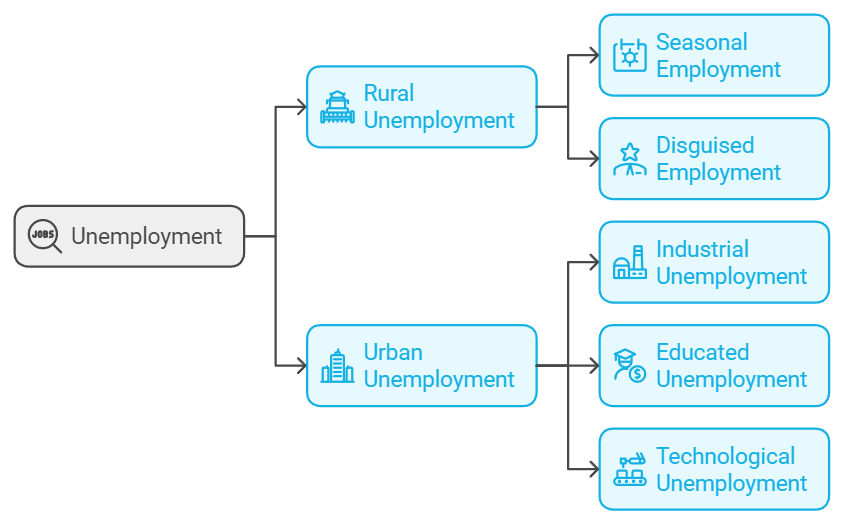
The video below explains these different types with relevant examples.
Employment, Growth, Informalisation and other issues | Indian eco | Class 12 | One shot
This segment of the video breaks down the various forms of unemployment shown in the flowchart above.
Watch from Types of Unemployment. Focus on understanding the core idea behind each type: Disguised Unemployment: More people are working than are actually needed. Marginal productivity is zero. Common in agriculture. Seasonal Unemployment: Employment is available only during certain seasons. Educated Unemployment: Educated people are unable to find jobs that match their skills. Frictional Unemployment: Temporary unemployment between changing jobs. Structural Unemployment: Unemployment due to a mismatch between the skills workers have and the skills demanded by employers (e.g., due to technological change).
4. Let's Practice
Time for a quick knowledge check to consolidate what you've learned. These are styled like typical CBSE 1-mark questions.
- A situation where the economy is able to produce more goods and services without a proportional increase in employment opportunities is termed as __________.
- The process of moving from self-employment and regular salaried employment to casual wage work is known as __________.
- An establishment with eight hired workers is part of the __________ (formal/informal) sector.
- In a family farm where 10 members are working, but the work only requires 6, the 4 extra members are considered to be in a state of __________ unemployment.
Click for Answers
1. Jobless Growth 2. Casualization 3. Informal 4. DisguisedConclusion
In this lesson, we dissected the major employment challenges plaguing the Indian economy. We have moved from the broad concepts of the workforce to the specific, structural problems that define India's employment landscape.
Key Takeaways:
- Employment Structure: The workforce is divided into the formal sector (with job security and benefits) and the vast informal sector (without them).
- Key Challenges: India faces informalization (most workers are in the informal sector), casualization (a shift to insecure casual jobs), and jobless growth (economic growth without job creation).
- Types of Unemployment: We identified key types, including disguised and seasonal unemployment (common in rural areas) and educated unemployment (a major urban challenge), alongside frictional and structural unemployment.
Now that we have a firm grasp of the problems, our next lesson will focus on the solutions. We will describe key government employment generation programmes, such as MGNREGA, and see how they attempt to tackle the challenges we've discussed today.