Welcome to our third lesson. In our previous session, we examined the functions of the Reserve Bank of India, focusing on how it uses tools like the Cash Reserve Ratio (CRR) and Statutory Liquidity Ratio (SLR) to control the supply of credit in the economy. You learned that together, CRR and SLR form the Legal Reserve Ratio (LRR).
Today, we shift our focus to the other side of the equation: the commercial banks themselves. We will explore the fascinating process of credit creation, where commercial banks effectively "multiply" the money deposited with them. You will learn how to explain this process using a numerical example and a given LRR, a skill that is crucial for answering one of the most common high-value questions in your board exam.
1. The Concept of Credit Creation
At its heart, credit creation is the process by which commercial banks generate loans that are many times larger than the initial cash deposits they receive. This might sound like they are printing money, but they are not. Instead, they are leveraging the fact that not all depositors will withdraw their money at the same time.
Let's start with a short video that introduces this core idea.
Macroeconomics | Banking | Class 12 | chapter 6 | Part 2
This clip from Rajat Arora's "Macroeconomics | Banking | Part 2" video will give you a quick overview of what we mean by credit or money creation.
Watch the segment from the beginning. Focus on the idea that an initial deposit gets multiplied through a process of lending and re-depositing.
2. The Process and Its Assumptions
To understand how this multiplication works in a simplified model, economists rely on two key assumptions. These are essential to state in an exam answer.
- The entire banking system is treated as a single unit. We refer to it simply as "the banks." This means a loan given by one bank is assumed to be deposited back into another bank within the same system.
- All transactions are routed through the banks. This means any payment made from a loan is not held as cash but is deposited into a bank account. This ensures there is no "leakage" of cash from the system.
The video below explains these assumptions and outlines the four-part structure you should use for a perfect exam answer:
- Meaning: What is credit creation?
- Assumptions: The two points mentioned above.
- Table: A numerical illustration of the process.
- Explanation: A narrative description of what's happening in the table.
Macroeconomics | Banking | Class 12 | chapter 6 | Part 2
This segment from the same video lays out the assumptions and the ideal structure for an exam answer.
Watch from this section. Pay close attention to the two assumptions, as they are the foundation of the entire process.
3. Credit Creation in Action: A Numerical Example
Now for the core of the lesson—the numerical process. This is where your accounting background will be helpful in tracking the flow of funds through deposits, reserves, and loans.
Let's assume:
- An initial deposit of ₹1,000 is made into the banking system.
- The Legal Reserve Ratio (LRR), set by the central bank, is 20%.
Here’s how the process unfolds:
-
Round 1:
- The bank receives a deposit of ₹1,000.
- It must keep 20% of this as a reserve: .
- It is free to lend the remaining amount: .
-
Round 2:
- The person who borrowed ₹800 uses it to make a payment. The recipient of that payment deposits the ₹800 into their bank account (as per our assumption).
- This creates a new deposit of ₹800 for the banks.
- The bank keeps 20% of this new deposit as a reserve: .
- It lends out the remaining amount: .
-
Round 3:
- The ₹640 loan is spent and re-deposited, creating a new deposit of ₹640.
- The bank keeps 20% (₹128) and lends out the rest (₹512).
This process continues, with each round adding a smaller amount to the total deposits. The following image and video provide a clear, step-by-step visualization of this process in a table format.
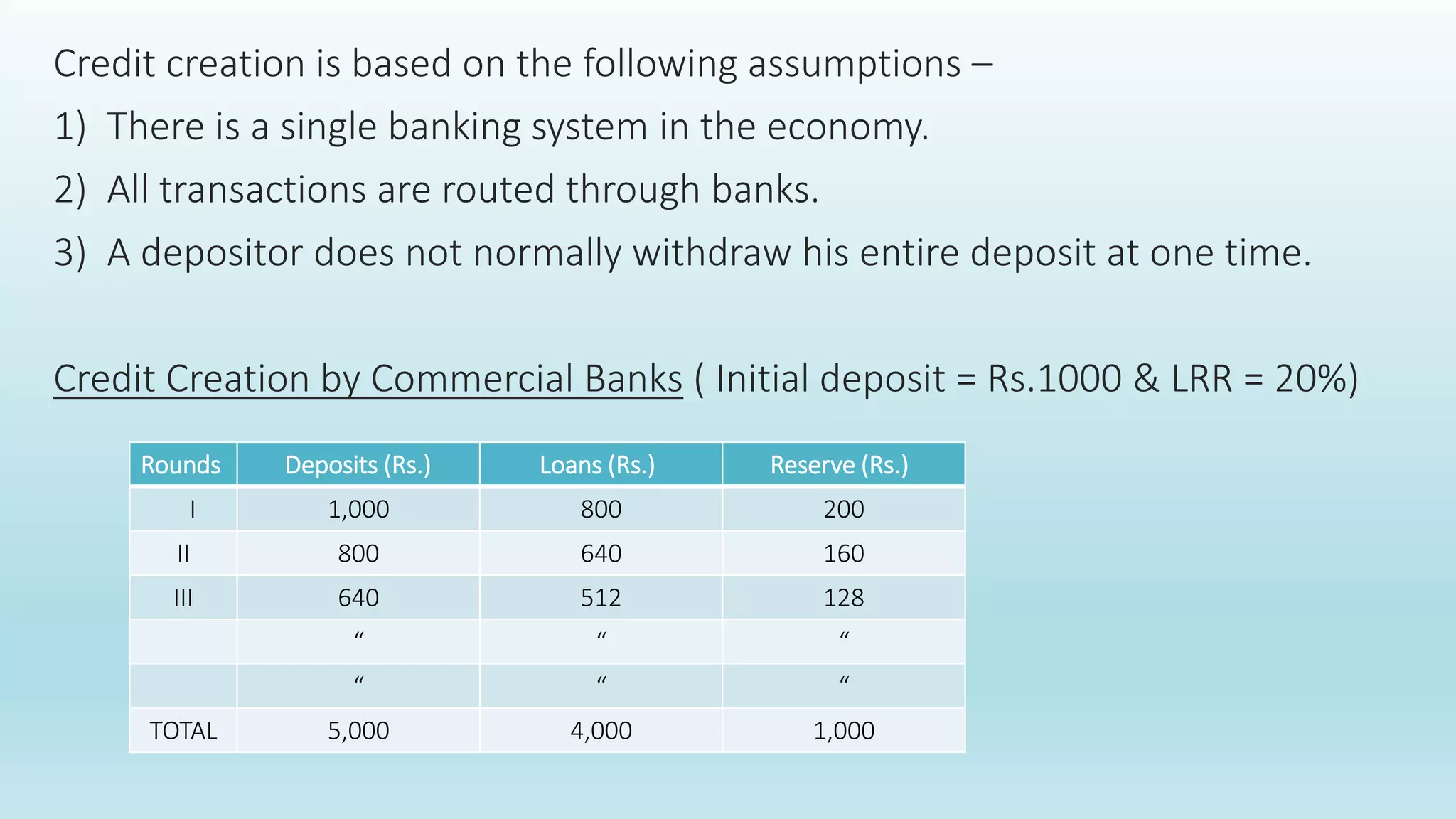
Macroeconomics | Banking | Class 12 | chapter 6 | Part 2
This part of the video walks you through the creation of the exact table we are discussing.
Watch from the table explanation. Follow how the deposits, loans, and LRR are calculated for each round. Notice that the video shows only a few rounds before jumping to the total. We'll see how to calculate that total next.
4. The Money Multiplier: Calculating the Total
You might be wondering: how do we know the total deposit will be exactly ₹5,000? We don't have to add up infinite rounds. We can use a simple formula for the Money Multiplier.
The Money Multiplier (K) tells us the maximum number of times the initial deposit can be multiplied. Its formula is:
In our example, with LRR = 20% or 0.20:
This means the initial deposit will be multiplied 5 times.
Now, we can find the total values:
- Total Deposits = Initial Deposit × K = ₹1,000 × 5 = ₹5,000
- Total Loans = Total Deposits - Total Reserves = ₹5,000 - ₹1,000 = ₹4,000
- Total Reserves = Total Deposits × LRR = ₹5,000 × 20% = ₹1,000
Notice the crucial check: The process of credit creation ends when the total reserves become equal to the initial deposit.
The following video explains how to use the multiplier formula to find the final values in the table. It also provides the narrative you would write in your exam to explain the process.
Macroeconomics | Banking | Class 12 | chapter 6 | Part 2
These clips from the same video connect the multiplier formula to the table and provide the required narrative explanation for an exam.
First, watch this segment to see how the money multiplier formula is used to calculate the totals. Then, watch the narrative explanation which describes the table's process in words. This is the final piece of your exam answer.
5. Application: Impact of a Change in LRR
To link this back to our previous lesson, what happens if the RBI decides to increase the LRR to control inflation?
- A higher LRR means banks must keep a larger fraction of deposits as reserves.
- This leaves less money available for lending in each round.
- A higher LRR leads to a smaller money multiplier.
- Therefore, the total credit created will be less.
Watch this short video where a hypothetical numerical example is used to show the effect of a rise in the reserve ratio on credit creation. This is a very common application-based question.
Money and Banking - Important Questions | Economics | PYQ'S | Class 12
This segment from "Money and Banking - Important Questions" by Rajat Arora demonstrates the inverse relationship between LRR and credit creation.
Watch from this example. The instructor compares a 20% LRR (multiplier = 5) with a 50% LRR (multiplier = 2) to show how increasing the reserve ratio reduces the bank's ability to create credit.
Conclusion
In this lesson, you've learned the mechanism of credit creation, a fundamental function of commercial banks. You can now explain this process logically, support it with a numerical table, and calculate the total impact using the money multiplier.
Key Takeaways:
- Commercial banks create credit by lending out the money they receive as deposits, after keeping a legally required reserve (LRR).
- The process works on the assumptions that all transactions are banked and the system is a single unit.
- The total amount of credit created is determined by the initial deposit and the Money Multiplier (K).
- The Money Multiplier formula is . It has an inverse relationship with the LRR.
- The credit creation process stops when the total reserves accumulated equal the initial deposit.
In our next lesson, we will build directly on this foundation by defining the money multiplier formally and practicing a variety of numerical problems related to deposit creation, which will sharpen your skills for the exam.