Welcome back! In our last lesson, we built a solid understanding of money supply, focusing on the M1 measure and its components. We established that money supply is the stock of money held by the public. Now, we will explore the institution responsible for managing and regulating this supply: the Central Bank.
In this lesson, we will delve into the key functions of India's central bank, the Reserve Bank of India (RBI). While we will cover its various roles, our primary focus will be on what is arguably its most critical function for economic stability: its role as the controller of credit and money supply. Mastering this topic is essential, as questions related to it frequently appear in the CBSE board examinations in various formats.
1. Introduction to the Central Bank and its Core Functions
Every country has a central bank, an apex financial institution that manages the country's currency, money supply, and banking system. In India, this institution is the Reserve Bank of India (RBI), established on April 1, 1935.
Let's begin by watching a video that outlines the main functions of the RBI. This will give us a complete picture before we zoom in on the credit control function.
Macroeconomics | Banking | Class 12 | chapter 6 | Part 1
The video "Macroeconomics | Banking | Class 12 | chapter 6 | Part 1" by Rajat Arora provides an excellent overview of the RBI's functions.
Please watch the following segments: Start with the introduction to the Central Bank to understand its position as the apex body. Next, watch the explanation of its role as the Currency Authority. Note how it has the sole right to issue currency notes (except for the ₹1 note and coins, which are issued by the Ministry of Finance). This directly relates to the 'C' component of the M1 money supply we discussed. Then, understand its function as the Banker to the Government, where it acts as a banker, agent, and financial advisor. Finally, learn about its role as the Banker's Bank and Supervisor. Pay close attention to the three key aspects of this function: Custodian of Cash Reserves: This is where commercial banks must keep a portion of their deposits with the RBI, known as the Cash Reserve Ratio (CRR). Lender of Last Resort: The RBI provides emergency funds to commercial banks when they cannot get help from any other source. Clearing House: The RBI facilitates the settlement of payments between different commercial banks.
To reinforce your understanding of the "Banker's Bank" function, you can refer to this solved question from a past CBSE paper.
CBSE Class 12 Economics Solved Question Paper 2020 - Set 5 (58 ...
This resource from GeeksForGeeks provides a well-structured answer to a past exam question about the 'Banker's Bank' function.
Read the answer to Question 15, which explains the function of the Central Bank as ‘Banker’s Bank and Supervisor’. This will give you a clear idea of how to structure your answer in the exam.
2. Controller of Credit: The Most Important Function
Now we arrive at the core of today's lesson. The RBI's most powerful role is managing the supply of money and credit in the economy. It does this to achieve economic stability—primarily to control inflation (a situation of rising prices, often caused by too much money chasing too few goods) and deflation (a situation of falling prices and economic slowdown).
The policy used by the RBI to control money supply and credit is called Monetary Policy. The instruments of this policy are broadly divided into two categories:
- Quantitative Instruments: These affect the overall volume of credit in the economy. They are general in nature and impact all sectors.
- Qualitative Instruments: These are selective tools that regulate the direction of credit for specific purposes or sectors.
This flowchart provides a clear map of the tools we are about to discuss.
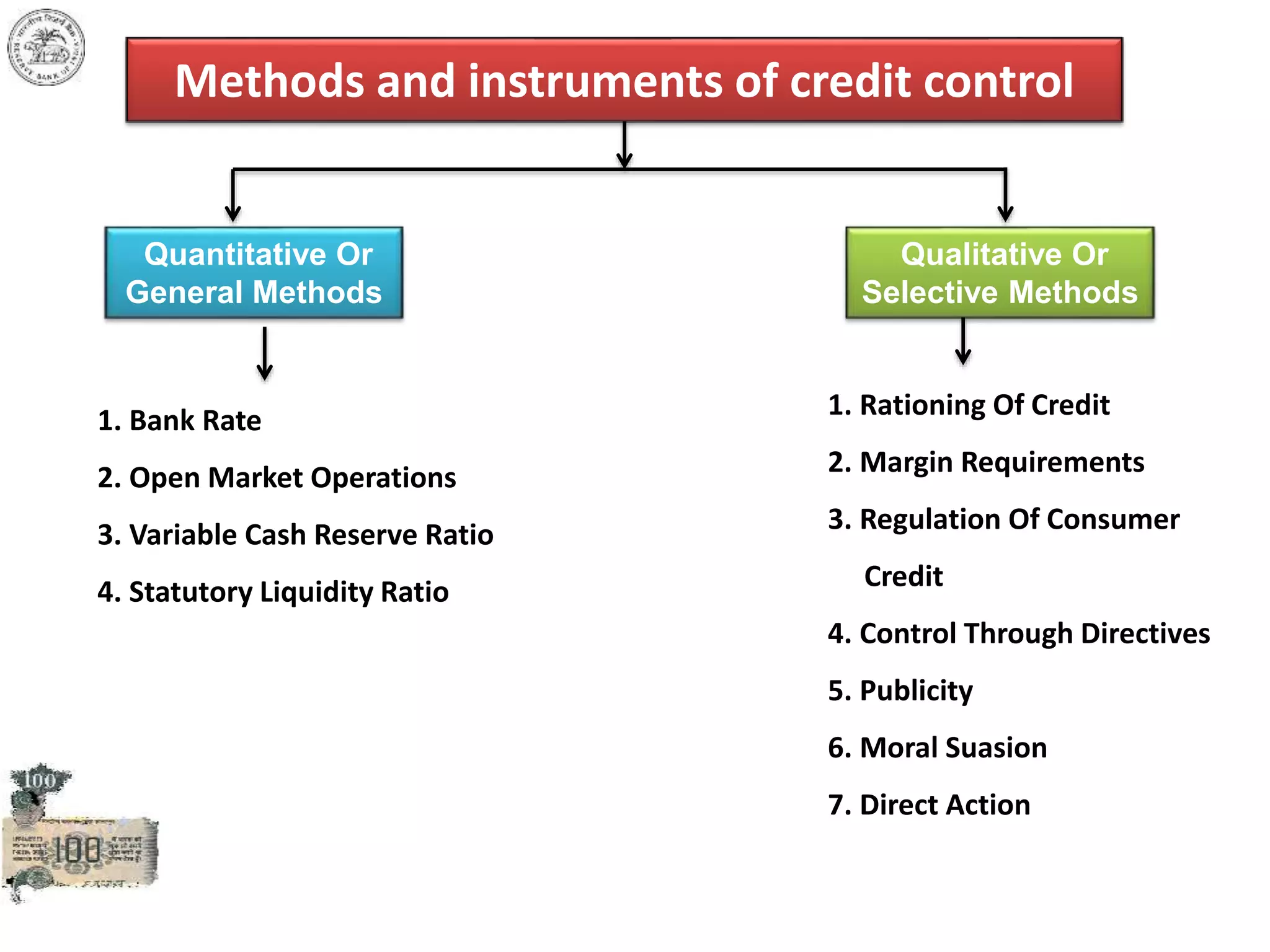
Let's dive deep into how these instruments work. The following video explains each tool and, crucially, how it is used to control credit (i.e., reduce money supply) during a period of inflation.
Macroeconomics | Banking | Class 12 | chapter 6 | Part 1
This video by Rajat Arora provides a detailed and intuitive explanation of all the credit control instruments.
Watch the following segments carefully: First, watch the introduction to credit control, which sets up the chart of Quantitative and Qualitative instruments. Next, watch the detailed explanation of Quantitative Instruments from this section. The instructor uses a simple analogy of 'Papa' (RBI), 'Child' (Commercial Bank), and 'Public' to make the concepts very clear. Focus on how increasing each of these rates or ratios helps reduce the money supply. Finally, watch the explanation of Qualitative Instruments from this part, covering Margin Requirements, Moral Suasion, and Selective Credit Control.
Summary of Credit Control Instruments (During Inflation)
Let's consolidate what you've just learned. To control inflation (reduce money supply), the RBI will:
| Instrument | Type | Action Taken by RBI | Effect |
|---|---|---|---|
| Bank Rate / Repo Rate | Quantitative | Increase | Makes borrowing by commercial banks from RBI more expensive, leading to higher lending rates for the public. |
| Reverse Repo Rate | Quantitative | Increase | Encourages commercial banks to park more funds with the RBI to earn higher interest, reducing funds available for lending. |
| Open Market Operations (OMO) | Quantitative | Sell Government Securities | Sucks excess money out of the economy as the public and banks use their money to buy these securities. |
| Cash Reserve Ratio (CRR) / Statutory Liquidity Ratio (SLR) | Quantitative | Increase | Reduces the lendable resources of commercial banks, thus curtailing their ability to create credit. |
| Margin Requirement | Qualitative | Increase | A higher margin means the borrower gets less loan against the same value of security, discouraging borrowing. |
| Moral Suasion | Qualitative | Advise/Persuade | RBI persuades banks to be stricter and discourage lending for non-essential purposes. |
Important Note: To combat deflation (increase money supply), the RBI does the exact opposite for each instrument (e.g., it decreases the Repo Rate, buys securities in OMO, etc.).
3. Application: Solving Past Board Questions
As you prefer, let's immediately apply this knowledge to questions similar to what you'll face in your exam.
Question 1: The Effect of CRR
A past CBSE paper asked: "It has been decided to increase the CRR... Analyze the impact of this step on total credit creation in the economy."
Think about it:
- What is CRR? It's the percentage of deposits commercial banks must keep with the RBI.
- If CRR increases, what happens to the money commercial banks have available to lend?
- What will be the final impact on the money supply?
Now, watch the explanation.
Money and Banking - Important Questions | Economics | PYQ'S | Class 12
This video "Money and Banking - Important Questions" by Rajat Arora breaks down the answer to a statement-based question on CRR.
Watch the explanation from this segment. The answer is that an increase in CRR reduces the available deposits with commercial banks, which curtails their lending capacity and thus adversely affects credit creation.
Question 2: Open Market Operations (OMO)
Another common question type is about OMO. For example: "Explain how Open Market Operations by the RBI help in regulating the money supply."
How would you answer this? Recall that OMO involves buying and selling government securities.
- To reduce money supply, what does the RBI do?
- To increase money supply, what does it do?
Check your thinking with this video explanation.
Money and Banking - Important Questions | Economics | PYQ'S | Class 12
This segment of the same video explains how OMO is used to control money supply.
Watch the explanation of Open Market Operations. The key is: selling securities reduces money supply, and buying them back increases it.
Conclusion
In this lesson, we have thoroughly examined the functions of the Central Bank, with a special focus on its critical role as the controller of credit. You are now equipped to explain not just what the RBI does, but how it uses its powerful tools to manage the economy.
Key Takeaways:
- The RBI's primary functions include being the Currency Authority, Banker to the Government, and Banker's Bank (custodian of reserves, lender of last resort, clearing house).
- The most important function is Controller of Credit, executed through Monetary Policy.
- Quantitative tools (Bank Rate, Repo Rate, RRR, OMO, CRR, SLR) affect the total volume of credit. During inflation, the RBI generally increases these rates/ratios or sells securities.
- Qualitative tools (Margin Requirement, Moral Suasion) are selective and direct the flow of credit.
In our next lesson, we will explore the other side of this process: credit creation by commercial banks. You will see exactly how banks "create" money and how the LRR (Legal Reserve Ratio = CRR + SLR) you learned about today acts as a direct limitation on this process, leading us to the concept of the money multiplier.