Introduction
Hello! In our last lesson, we explored Bagging (Bootstrap Aggregating) as a powerful ensemble technique to reduce the high variance of models like decision trees. We learned that by training multiple trees on different bootstrap samples of the data and averaging their predictions, we can create a more stable and robust model.
Today, we'll build directly on that knowledge to learn about one of the most popular and effective machine learning algorithms: the Random Forest. You will discover the simple yet brilliant tweak that Random Forest adds to Bagging, which makes it even more powerful at preventing overfitting. By the end of this lesson, you will be able to explain how a Random Forest improves upon a single decision tree and train your own Random Forest classifier using scikit-learn.
From Bagging to Random Forests
A Random Forest is essentially a specialized version of Bagging applied to decision trees, with one extra ingredient to improve performance. Let's recap the Bagging process for trees:
- Bootstrap Sampling: Create many random subsamples of the training data with replacement.
- Train Trees: Train a separate decision tree on each subsample.
- Aggregate: Combine the predictions of all trees (e.g., majority vote for classification).
This process helps because the individual trees are trained on different data, making them diverse. However, what if your dataset has one very strong, predictive feature? In standard Bagging, most of the trees would likely select this feature for their first split. This would make the trees highly correlated, and their combined prediction would not be as diverse or robust as we'd like.
Random Forest solves this with a simple trick.
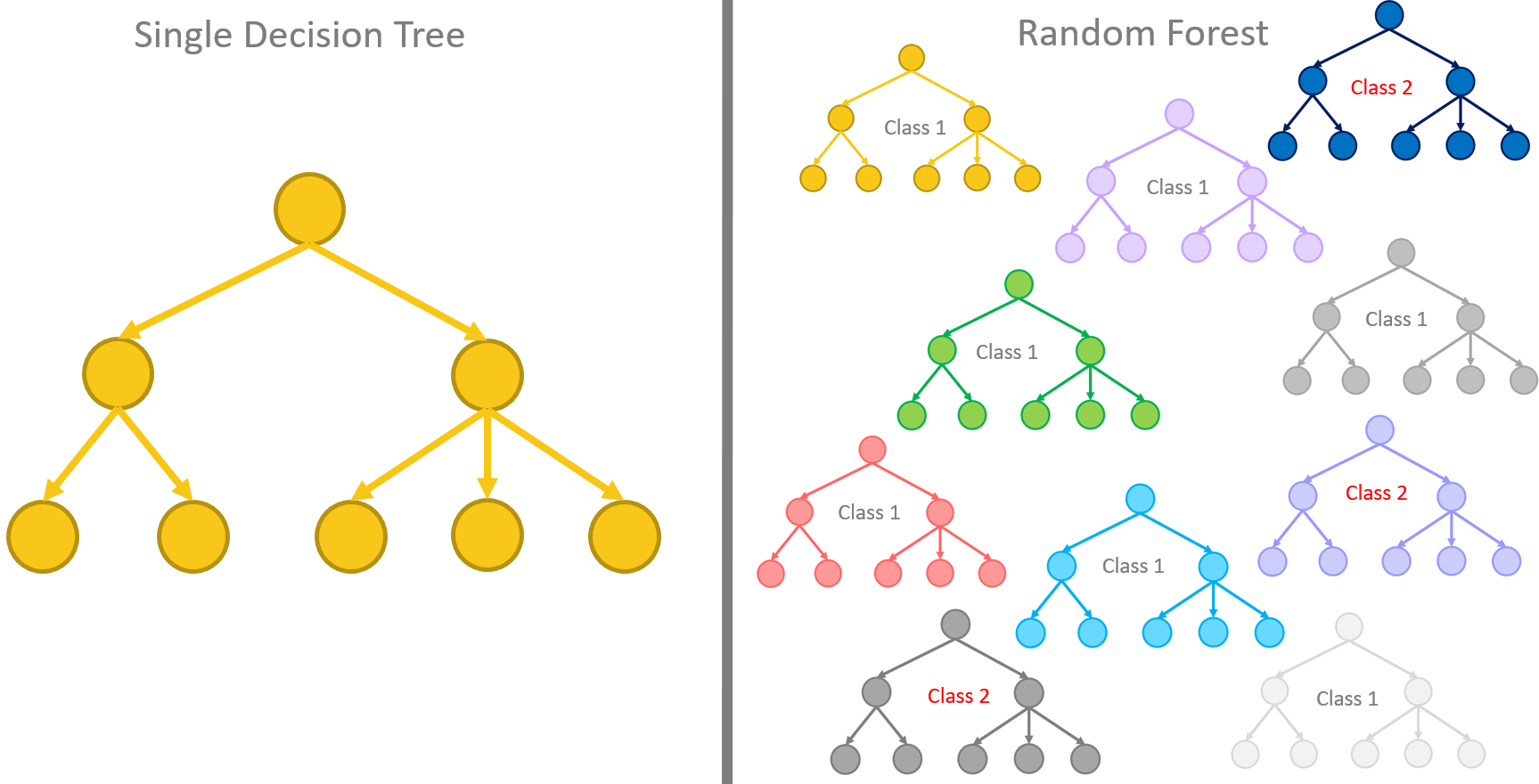
The Key Ingredient: Feature Randomness
The key innovation of Random Forest is to introduce randomness not just in the data sampling, but also in the feature selection process for building each tree.
When building each tree in the forest, at every split point, the algorithm does not consider all available features. Instead, it randomly selects a subset of features and only looks for the best split among that subset.
This has a powerful effect:
- It de-correlates the trees: By forcing some trees to use less-predictive features at certain splits, it prevents all trees from latching onto the same "strongest" features. This ensures the trees in the forest are more independent and diverse.
- It improves generalization: A more diverse "committee" of trees, where each member has a slightly different perspective, makes for a stronger and more generalized final model.
To see this idea explained, let's watch a segment from the StatQuest video we started in the previous lesson.
StatQuest: Random Forests Part 1 - Building, Using and Evaluating
This video from StatQuest with Josh Starmer clearly explains the concept of using a random subset of features at each split, which is the core idea that differentiates Random Forest from standard Bagging.
Watch the segment from 02:24 to 04:34. Focus on how, at each node, only a random subset of variables is considered for the split. This is the 'secret sauce' of Random Forests.
Now, let's watch another short video that puts it all together—the bootstrapping, the feature randomness, and the final voting—to give you a complete picture of how a Random Forest works.
Random Forest Explained Simply: Boost Accuracy with Python!
This video provides a quick, intuitive summary of the entire Random Forest process, from creating bootstrap samples to making a final prediction through voting.
Watch the segment from 01:12 to 02:16. It neatly summarizes the three key steps: creating bootstrap datasets, randomly selecting features for each split, and aggregating the votes.
Training a Random Forest in Python
Now that you understand the "why," let's move to the "how." Training a Random Forest classifier in scikit-learn is straightforward, thanks to the RandomForestClassifier class. It lives in the sklearn.ensemble module, right alongside the BaggingClassifier.
The most important hyperparameter you'll encounter is n_estimators, which simply defines the number of trees to build in the forest. A common starting point is 100.
Here is a complete, self-contained example. We will:
- Import the necessary libraries and create a synthetic dataset.
- Split the data into training and testing sets.
- Initialize
RandomForestClassifierwithn_estimators=100. - Fit the model on the training data and evaluate it on the test data.
from sklearn.ensemble import RandomForestClassifier
from sklearn.datasets import make_classification
from sklearn.model_selection import train_test_split
from sklearn.metrics import accuracy_score


# Create a synthetic dataset for demonstration
X, y = make_classification(n_samples=1000,
                           n_features=20,
                           n_informative=5,
                           n_redundant=0,
                           random_state=42)


# Split data into training and testing sets
X_train, X_test, y_train, y_test = train_test_split(X, y, test_size=0.2, random_state=42)


# 1. Initialize the Random Forest Classifier
# We specify the number of trees in the forest with n_estimators
rf_classifier = RandomForestClassifier(n_estimators=100, random_state=42)


# 2. Train (fit) the model on the training data
rf_classifier.fit(X_train, y_train)


# 3. Make predictions on the test data
y_pred = rf_classifier.predict(X_test)


# 4. Evaluate the model's accuracy
accuracy = accuracy_score(y_test, y_pred)
print(f"Random Forest Accuracy: {accuracy:.4f}")
This code trains a forest of 100 trees and uses their collective vote to make predictions. For a more detailed walkthrough of implementing a Random Forest on a real-world dataset, you can refer to the following guide.
Random Forest Classification in Python With Scikit-Learn
The following article from DataCamp provides a practical demonstration of training a Random Forest. Focus on the code blocks showing how to fit the model and make predictions.
Read the section titled 'Fitting and Evaluating the Random Forest Model'. It provides a clear, concise code example for training a RandomForestClassifier and evaluating its accuracy.
Why Random Forests are an Improvement
The combination of bootstrap sampling and feature randomness makes Random Forests highly effective and robust.
- Reduces Overfitting: By averaging the predictions of many de-correlated trees, the model's variance is significantly reduced. The individual errors of each tree tend to cancel out, leading to a model that generalizes much better to new, unseen data.
- Handles High-Dimensionality: The random feature selection makes it effective even when you have a very large number of features.
- Good Out-of-the-Box Performance: Random Forests often work well with default hyperparameters, making them a great baseline model to try on a new problem.
The visual below compares the decision boundary of a single decision tree with that of a Random Forest. Notice how the Random Forest boundary is much smoother and less jagged. This is a visual representation of lower variance—it's less sensitive to individual data points and captures the general trend more effectively.
Random Forest Models: Why Are They Better Than Single Decision ...
This article from Towards Data Science includes an excellent visualization comparing the prediction surfaces of a single decision tree and a Random Forest. This will give you a strong intuition for why the ensemble model is better.
Scroll down to the end of the article, just before the 'Conclusion'. You will find two graphs: 'Random Forest model prediction surface' and 'Single Decision Tree model prediction surface'. Compare them and notice how the Random Forest creates a smoother, more generalized boundary.
Conclusion
In this lesson, we demystified the Random Forest algorithm, seeing it as a clever and powerful extension of the Bagging technique we learned previously.
Key Takeaways:
- A Random Forest is an ensemble of decision trees that combines bootstrap aggregating (bagging) with feature randomness.
- The key improvement is that at each split in a tree, the algorithm considers only a random subset of features, which de-correlates the trees and makes the ensemble more robust.
- This combination drastically reduces variance and protects against overfitting, making Random Forest one of the most reliable and widely used machine learning models.
- You can easily train a Random Forest using
RandomForestClassifierfrom scikit-learn.
Preview of the Next Lesson
We've now covered decision trees and powerful ensemble methods built upon them. We'll now shift our focus to a completely different approach to classification. In the next module, we will explore instance-based learning with the K-Nearest Neighbors (K-NN) algorithm and dive into probabilistic models with Naive Bayes. These models make predictions based on fundamentally different principles than the rule-based splitting we've seen in trees.