Hello and welcome back.
In our last lesson, we delved into Prefactual thinking. We left the hinge character suspended in a moment of intense indecision, mentally simulating the potential consequences of either confronting her husband or giving him more space. This forward-looking thought experiment highlighted the difficulty and risk of her situation.
Today, we're going to flip the script. Instead of trying to guess the correct path forward from where we are, we will use Backcasting to start at our destination—the consented resolution—and work our way backward. This powerful technique will allow us to reverse-engineer the plot, ensuring that every point of friction and character decision logically and inevitably leads to the ending you've envisioned.
Your learning outcome is to apply Backcasting to reverse-engineer the consented resolution, identifying necessary friction points for each character. This will give you a clear, actionable roadmap for your story's emotional arc.
1. The Backcasting Method: Starting with the End
Backcasting is a strategic planning method that begins with defining a desirable future and then works backward to identify the policies and programs that will connect that specified future to the present. While often used in business and policy, it's a perfect tool for storytellers.
Given your background in statistics and research, you can think of this as defining the final state of a system and then methodically determining the sequence of events and variable changes required to achieve that state.
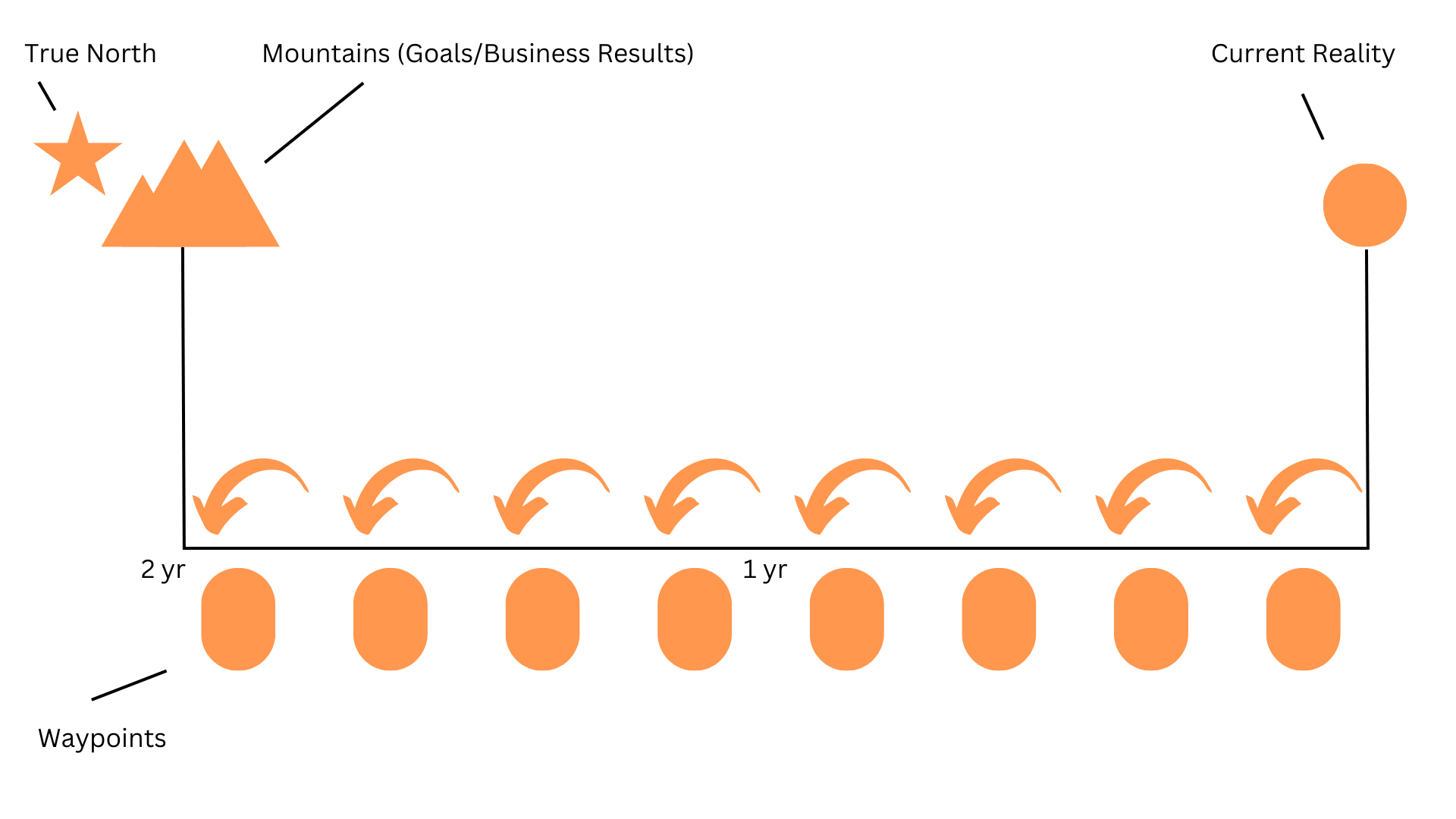
This first resource explains the core methodology. While it's framed for personal or business goals, the step-by-step process is exactly what we need.
Backcast Your Future - Donna Lichaw
The article 'Backcast Your Future' by Donna Lichaw provides a clear, actionable framework for this technique. We will adapt her questions for narrative purposes.
Please read the following sections: Start with the introduction and the section 'Start with the ending.' Read through the section 'Map your journey,' noting the logic of the questions. Pay close attention to question #4 under 'What challenges did you face along your journey?' Lichaw's advice to 'make it hurt!' is the key to identifying the necessary friction for our plot.
The key insight here is identifying the gap between where the characters are now and where they need to be, and then strategically filling that gap with challenges—the very friction that will make the story compelling.
2. Backcasting Your Characters' Journeys
A plot is driven by character change. For your resolution to feel earned, each character must arrive at that final scene as a person who could plausibly make the choices that lead to it. Backcasting helps us build that psychological plausibility. We start with who they are at the end and trace backward to discover the experiences that shaped them.
The following resources will help you apply this technique specifically to character arcs.
How to Write Your Book Backwards and Build a Stronger Plot
The video 'How to Write Your Book Backwards' by Shirley Jump offers a series of fantastic questions to guide this process. It's a very practical take on applying backcasting to plot and character.
Watch the following segments: (00:32 - 01:59) Focus on the first two questions: 'What lesson do you want your character to learn?' and 'What does my character need to go through to learn this lesson?' (01:59 - 03:55) This part on failure and success is crucial. The 'failures' are your friction points, and the 'glimmer moments' of success are what keep the characters moving forward. (03:55 - 05:24) Pay close attention to the discussion of weaknesses (which get characters into trouble) and strengths (which get them out). This is the engine of character development.
To deepen this idea, let's look at how to trace a character's final traits back to their origins.
Working Backward to Create Fully Fleshed, Compelling Protagonagists
The article 'Working Backward to Create Fully Fleshed, Compelling Protagonists' by Tiffany Yates Martin brilliantly explains how to create rich characters by reverse-engineering their traits.
Please read these key sections: Start at 'Digging Down to Build Up.' This explains the core technique. Read 'Putting It into Practice,' which discusses how a protagonist's traits should be uniquely suited to make their journey maximally difficult—this is how we create tension. Finally, read the section that begins 'For instance, an upbringing or society in which men are expected to be stoic...' This demonstrates how the same 'origin story' can lead to different behaviors, giving you, the writer, the power to craft a character who perfectly fits the needs of your plot.
These resources give us a powerful framework. For each character, we will define the lesson they must learn to reach the resolution, the failures (friction) that will teach them this lesson, and the weaknesses and strengths that will drive their journey.
3. Writing Exercise: Mapping the Path to Consent (30 minutes)
It's time to build the blueprint for your story's arc. Instead of writing prose, your task is to create a structured outline by answering the following questions. This is a planning document that will guide your writing in later lessons.
Step 1: Define the Resolution (The "A" grade)
- Start by writing a single paragraph describing the final scene. Write it in the past tense, as if you are looking back on the accomplished story. This is your "True North."
- Example: "It was a quiet evening. The three of them had shared a meal, the conversation easy for the first time in months. When the hinge and her lover stood up, the husband met his wife's eyes, and in his gaze there was no fear, only a deep, quiet trust. He nodded, a simple gesture that held the weight of everything they had been through. He was not just tolerating this; he was consenting, freely and completely..."
Step 2: Backcast the Journey for Each Character
Answer the following questions for the husband, the hinge, and the new lover. Be specific and think in terms of scenes or moments of conflict.
Character: The Husband
- The Lesson: What fundamental belief must he change to give genuine consent? (e.g., from "My security depends on control" to "My security depends on trust").
- Key Weakness: What is his core weakness that resists this lesson and creates conflict? (e.g., Insecurity, jealousy, fear of abandonment).
- Necessary Failures: Describe two specific moments where his weakness causes him to act, and this action backfires, making the situation worse and forcing him to confront the failure of his old belief system.
- Key Strength: What underlying strength allows him to finally learn the lesson and give consent? (e.g., A deep, foundational love for his wife; an ability to be rational when his emotions cool).
Character: The Hinge
- The Lesson: What must she learn to successfully navigate this? (e.g., from "I must manage everyone's feelings" to "I must be honest and allow others to manage their own feelings").
- Key Weakness: What is her core weakness that makes this lesson hard to learn? (e.g., A tendency toward people-pleasing, avoidance of direct conflict, a belief she can fix everything).
- Necessary Failures: Describe two moments where her attempt to "manage" the situation fails, creating more friction. (e.g., She tells a white lie for reassurance that is later exposed; she tries to mediate an argument but makes both men feel misunderstood).
- Key Strength: What strength allows her to ultimately succeed? (e.g., Emotional intelligence, resilience, unwavering commitment to her desired life).
Character: The New Lover
- The Lesson: What must he learn to become a sustainable part of this dynamic? (e.g., from "I need to win her away from him" to "I need to trust their process and my place in it").
- Key Weakness: What is his core weakness that creates tension? (e.g., Impatience, a possessive streak, a misunderstanding of the established marital bond).
- Necessary Failures: Describe one moment where his weakness leads to a setback for the vee relationship.
- Key Strength: What strength makes him a worthy partner for the hinge in the end? (e.g., Genuine empathy, patience once he understands the stakes, respect for the hinge's autonomy).
Take your time with these questions. The answers will form the foundational pillars of your entire plot.
Conclusion
Today, we've transformed the daunting task of plotting into a logical, manageable process. By starting with a clear vision of the end and working backward, you can ensure that every element of your story—every character trait, every conflict, every failure—serves a specific purpose in building toward a satisfying and inevitable resolution.
Key Takeaways:
- Backcasting provides a roadmap for your story by starting at the end and identifying the necessary steps to get there.
- For a character's final transformation to be believable, it must be earned through a series of failures that challenge their core beliefs.
- Character weaknesses are the engine of conflict, while their strengths are the key to the resolution. Reverse-engineering these traits is essential for a cohesive plot.
In our next lesson, we will begin Module 4, "Ideas Come From LAPS SEE." Now that we have a high-level map of the journey, we'll start with Liquid Networks, using the characters' interconnected backstories to add rich, specific texture to the friction points and turning points we've just outlined.