Welcome back. In our last lesson, we used Backcasting to create a high-level roadmap for your story. By starting with the final scene of consented intimacy and working backward, you identified the core lessons each character must learn and the "necessary failures" that will teach them. You now have the beginning and the end of their journeys.
Today, we will build the bridge between those two points. We'll focus on crafting the tension arc—the sequence of events that builds conflict, raises the stakes, and makes the final resolution feel both earned and inevitable. To do this, we will synthesize the thought experiment techniques we've explored in this module: Counterfactual, Semifactual, and Prefactual thinking.
Your learning outcome is to outline a tension arc for the vee story using at least three thought experiment techniques to create turning points. By the end of this lesson, you will have a structured outline of the rising action that leads to your story's climax.
1. What is a Tension Arc?
Think of a story's plot not as a straight line, but as a journey with hills and valleys. The tension arc is the path of rising action, where the conflicts become more intense and the stakes get higher, leading to the story's peak moment—the climax.
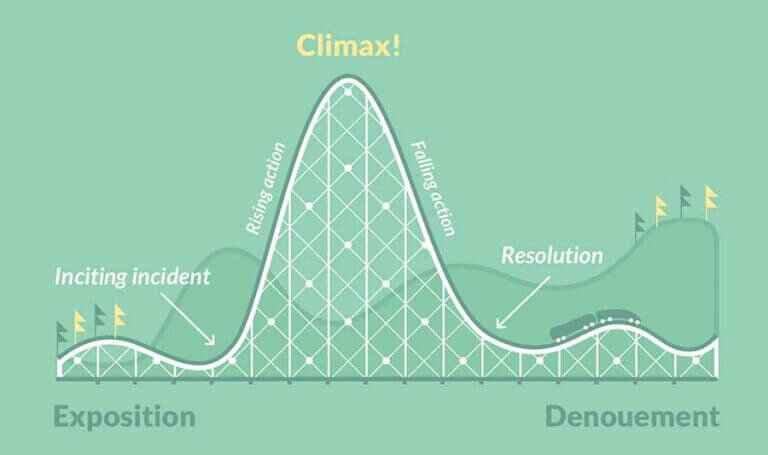
The thought experiments from this module are the specific tools you'll use to engineer the turning points along this incline.
- Backcasting gave you the destination.
- Counterfactual, Semifactual, and Prefactual thinking will help you lay the tracks, scene by scene.
2. The Thought Experiment Toolkit for Plotting
Before we build, let's review our tools. The following resource offers a brilliant perspective on how narrative creativity emerges from moving between thinking about why something happened (causal thinking) and what if it had been different (counterfactual thinking).
[PDF] Angus Fletcher and Mike Benveniste Narrative Creativity
The paper 'Narrative Creativity' by Angus Fletcher and Mike Benveniste provides excellent exercises for using these thought experiments in storytelling. It explains how our brains naturally use stories to explore possibilities.
Please read the following two sections: Start with the section titled 'The Method of Narrative Creativity: From Why to What if.' It begins after the sentence, 'And it attunes us to the deeper method of narrative creativity.' This section frames how stories emerge from the process of questioning reality. Then, read the section titled 'Sharpening Counterfactual Thinking.' Focus on the exercises 'Rescript a Narrative' and 'Branching Pathways.' These are practical methods for applying 'what if' thinking to a plot.
As the paper suggests, thought experiments allow you to "rescript" reality and explore "branching pathways." Let's formalize how to use them to create your tension arc:
- Counterfactual Thinking ('What if...'): Use this to create major plot forks. These are the big, story-altering questions. What if the husband finds out accidentally? What if the new lover gives an ultimatum? These create high-stakes turning points.
- Semifactual Thinking ('Even if...'): Use this to deepen a character's internal conflict at a turning point. It's perfect for exploring doubt and psychological friction. Even if I tell him I love him, he won't believe me. Even if he agrees, he'll resent me.
- Prefactual Thinking ('If I were to...'): Use this to dramatize a character's decision-making process. It puts the reader inside the character's head as they weigh the potential consequences of their next move, creating suspense.
To add more psychological depth, especially to the husband's journey, it's useful to understand how counterfactuals shape our emotions.
Counterfactual Thinking and the Psychology of “What If”
This article, 'Counterfactual Thinking and the Psychology of “What If”', explains how imagining alternatives can lead to either regret or relief. This is a powerful mechanism for driving a character's emotional arc.
Please read these two key sections: 'The Psychology of Regret and Relief': Focus on the distinction between 'upward' and 'downward' counterfactuals. 'How the Mind Builds Alternate Realities': Note the concepts of 'mutability' (what we choose to change) and 'proximity' (the near-miss effect).

3. Writing Exercise: Outlining the Tension Arc (35 minutes)
Now, let's build the rising action for your story. You will outline three key turning points that connect the story's beginning to its climax. Each turning point will be designed using a specific thought experiment. Refer back to the "necessary failures" you identified in the Backcasting exercise from our last lesson—those are excellent candidates for these turning points.
Instructions:
For each turning point below, describe a specific scene or event. Explain how the thought experiment shapes the conflict and what each character's reaction is.
Turning Point 1: The Inciting "What If" (Counterfactual Thinking)
This is the event that truly ignites the central conflict. Use Counterfactual thinking to design a high-stakes scenario.
- Describe the scene: What happens? Instead of a calm, planned conversation, what if something unexpected forces the issue? For example: What if the husband sees a text message he wasn't supposed to see? or What if the new lover shows up at the house unexpectedly?
- The Hinge's Dilemma: How does this event force a difficult choice upon her?
- The Husband's Reaction: Is his counterfactual thinking upward ("If only she had told me from the start...") or downward ("At least I found out now...")? How does this set his emotional trajectory?
Turning Point 2: The Spiral of Doubt (Semifactual Thinking)
This scene should deepen the psychological tension, especially for the husband. Use Semifactual thinking to explore his internal conflict after an attempt at reassurance.
- Describe the scene: The hinge tries to smooth things over or set a boundary. For example, she reassures her husband of her love for him after the event in Turning Point 1.
- The Husband's Internal Conflict: Write out his semifactual thought process. "Even if she says she loves me, how can I trust her when she's also with him? Even if I try to be okay with this, I feel like I'm losing her." This reveals the gap between his rational understanding and his emotional reality.
- Impact on the Hinge: How does her husband's lingering doubt create a new problem for her, escalating the tension?
Turning Point 3: The Moment of Decision (Prefactual Thinking)
This scene should place the hinge at a critical crossroads where she must make a choice that will propel the story toward its climax. Use Prefactual thinking to dramatize her thought process.
- Describe the scene: The hinge is alone, contemplating her next move. The pressure from both relationships is at a peak.
- The Hinge's Prefactual Simulation: Write out her "if I... then..." calculations. "If I ask my husband for a weekend to spend with my lover, he might leave. But if I don't, my lover will feel devalued and I'll resent my husband. What is the path that has the best chance of getting me what I truly want?"
- The Decision: What action does she decide to take as a result of this internal debate? This decision should lead directly into the story's climax, where the final consent is negotiated.
Conclusion
In this lesson, you have moved from a high-level map to a detailed blueprint of your story's emotional core. You've seen how a tension arc is not an abstract concept but a concrete structure built from carefully designed turning points. By using thought experiments, you can systematically create scenes that escalate conflict, deepen character psychology, and build suspense.
Key Takeaways:
- A tension arc is the sequence of turning points in the rising action that builds conflict toward a climax.
- Counterfactual thinking ('what if...') is ideal for creating major, high-stakes plot forks.
- Semifactual thinking ('even if...') is a powerful tool for exploring a character's internal, psychological friction.
- Prefactual thinking ('if I were to...') creates forward-looking tension by dramatizing a character's decision-making process.
This concludes Module 3. You now have a robust framework for your plot's structure and its key emotional beats.
In our next lesson, we will begin Module 4: "Developing Plot from Core Ideas (LAPS SEE)." We'll start with Liquid Networks, looking at how to connect the three characters' separate backstories into rich, believable sources for the present-day friction and turning points you've just designed.