Welcome back. In our last lesson, we analyzed the tension-resolution arc in the novel All Fours, seeing how an author can structure a story around evolving desires and fears to make a non-monogamous resolution feel earned. We identified how escalating crises and a focus on psychological reality can create a compelling narrative.
Today, you will move from analysis to creation. The goal is to design the architectural blueprint for your own story. You will outline a complete tension-friction-resolution framework for the vee relationship involving the woman (the hinge), her husband, and her new lover. This framework will serve as the narrative roadmap for the rest of the course, ensuring that the final scene of consented intimacy is the logical and satisfying culmination of everything that comes before it.
To do this, we'll use a powerful, systematic plotting method that should resonate with your background in statistics and modeling: the Seven-Point Story Structure. Its key advantage is that it encourages you to work backward from your desired outcome, a process not unlike backcasting.
1. Defining the Core Conflict: The Hinge's Dilemma
Before we build the plot structure, we need to solidify the psychological engine that will drive it. Your story's central dynamic is the "Vee," where the woman acts as the "hinge" connecting her two partners.
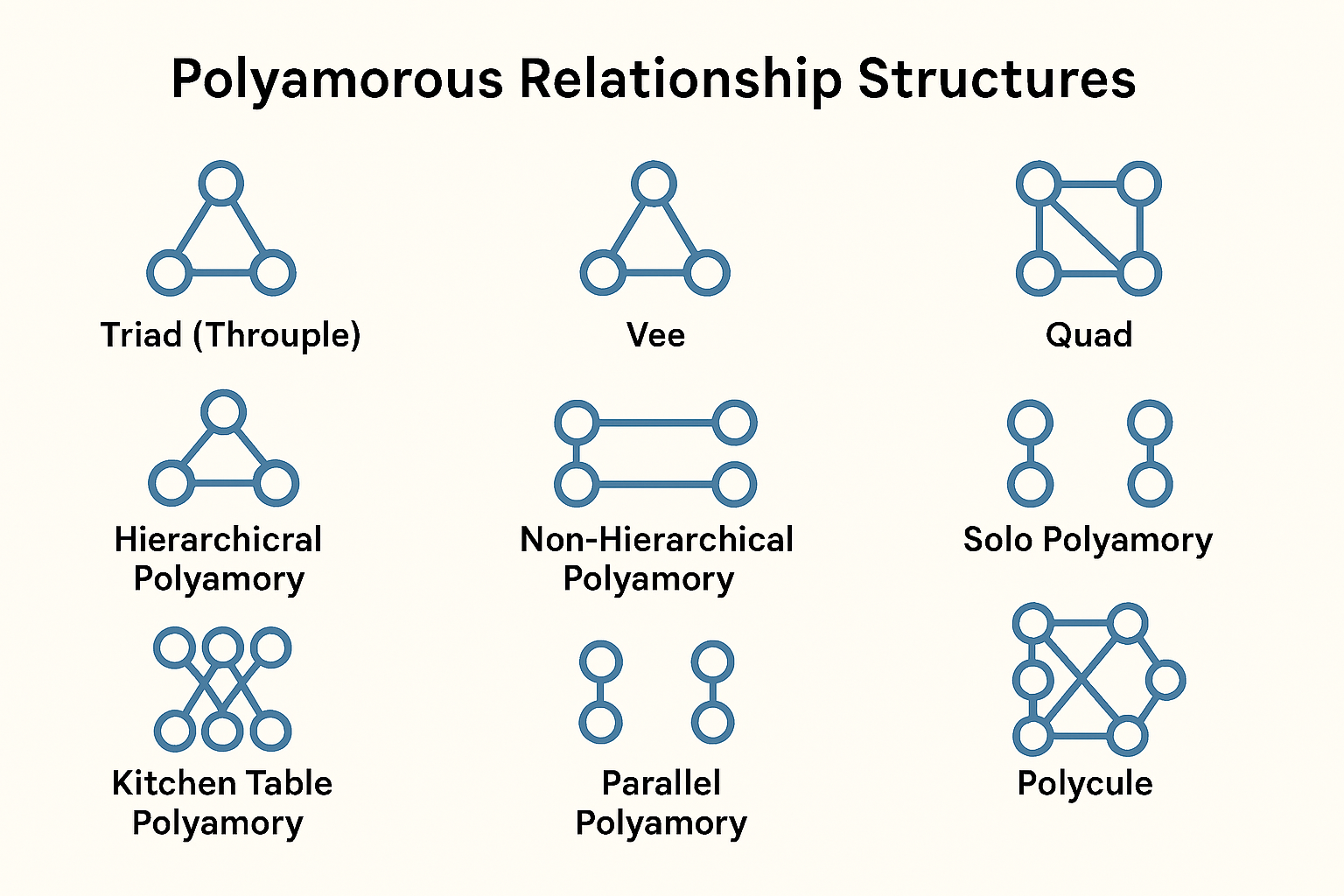
The tension in a Vee often originates from the hinge's position. Let's explore the common pitfalls of this role, which are a rich source of narrative friction.
The following resource from the podcast Making Polyamory Work provides a clear and insightful look into the internal and external pressures on a hinge partner. This will help define your protagonist's core struggle.
Please read the first two sections of the transcript: Start from the beginning and read through the example of Ruby, Erin, and Blake. This sets up the classic hinge problem. Continue through the next section, 'I know, right? Okay. You may think I'm being ridiculous...'. Focus on why the strategy of trying to please everyone backfires, creating insecurity and competition.
As the article explains, the central friction often arises when the hinge tries to manage everyone's happiness, losing their own agency in the process. This creates a "fulcrum" effect where one partner's gain is perceived as the other's loss, leading to competition. This is the perfect engine for your story's conflict.
A compelling story, however, must explore the internal conflicts of all characters involved, not just the protagonist.
HOW TO DO LOVE TRIANGLES (the right way)
This video from Abbie Emmons, while about 'love triangles,' offers a crucial insight: for the dynamic to be compelling, it must force all three characters to confront their internal fears.
Watch the section from 01:11 to 03:11. Pay attention to the idea that external events are only interesting if they engage with a character's internal conflict and force them to face their fears.
Your First Task: Define the Core Conflicts
Based on these resources, take a moment to define the primary internal conflict for each of your three characters. This is the battle between what they want and what they fear.
- The Hinge (Woman): Her desire for a fulfilling connection with a new person vs. her fear of disrupting the stability of her marriage and causing pain (The classic hinge dilemma).
- The Husband: His desire for marital security and trust vs. his fear of loss, inadequacy, or being replaced.
- The Lover: His desire for a genuine connection with the hinge vs. his fear of being a "homewrecker" or navigating the complexities of an existing marriage.
These conflicting desires are the fuel for your story. Now, let's build the structure that will set them on fire.
2. Building the Story's Blueprint: The Seven-Point Structure
We will use the Seven-Point Story Structure to outline your plot. A key feature of this method is that you don't plot chronologically. Instead, you build the story around key structural pillars, ensuring the beginning and end are perfectly mirrored and the midpoint provides a meaningful turn.
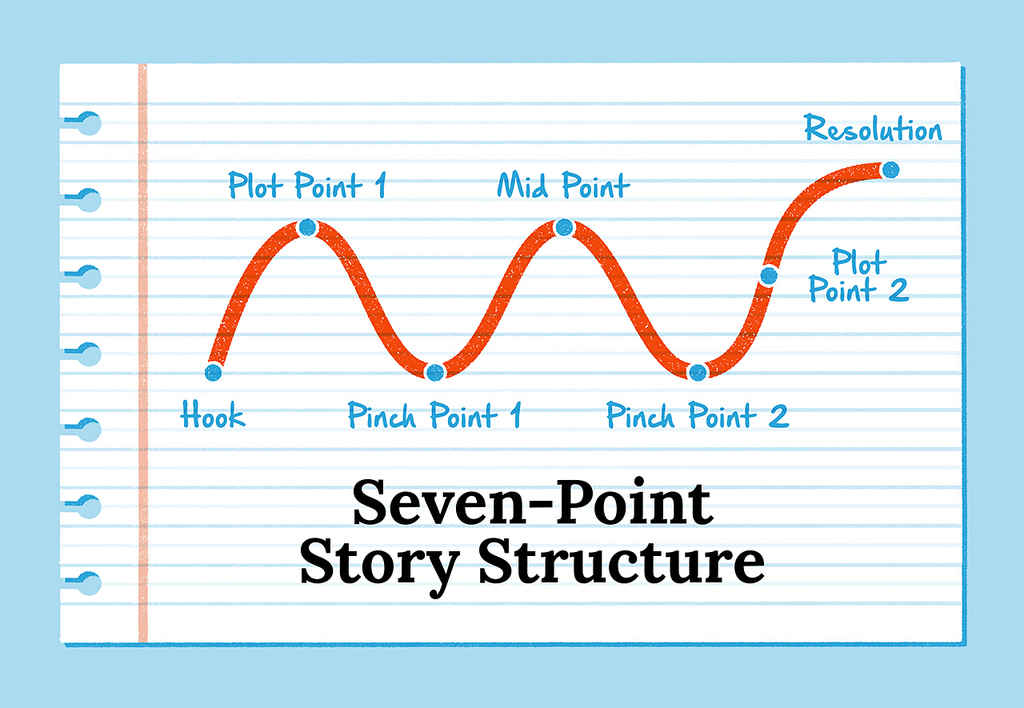
Let's begin. For this section, you'll be guided by the logic from a Reedsy blog article that breaks down this process.
Step 1: The Resolution (Point 7)
The Seven-Point Story Structure
We'll use Dan Wells's method as explained in the Reedsy article, 'The Seven-Point Story Structure'. The first, most crucial step is to define the end of the story.
Please read 'Step 1. Decide on your Resolution first'. Notice the emphasis on giving your writing process a clear sense of direction by knowing your destination.
Your resolution is already defined: The hinge and her new lover share their first intimate experience, with the husband's full, knowing, and uncoerced consent.
This isn't just a plot event; it's the story's emotional destination. It signifies that the characters have achieved a new state of trust, communication, and emotional honesty that was absent at the beginning. The resolution is satisfying because this new state has been earned through conflict.
Step 2: The Hook (Point 1)
Now, we create the starting point by juxtaposing it with the end.
The Seven-Point Story Structure
Let's continue with the Reedsy article to define the story's opening.
Read 'Step 2. Create a Hook that juxtaposes with the ending'. The goal is to start your characters in the opposite position of where they'll end up.
If your resolution is a state of radical honesty and trust, your Hook must be a moment that establishes the opposite.
- Hook Idea: A scene where the hinge is hiding her growing feelings for the other man. Perhaps she lies about a text message or conceals an emotionally charged interaction. The husband is oblivious, or perhaps vaguely suspicious, but the core dynamic is defined by secrecy and avoidance—the very things that must be overcome.
Step 3: The Midpoint (Point 4)
The Midpoint is the pivot of the entire story. It's where your protagonist stops reacting to events and starts acting to change her situation.
The Seven-Point Story Structure
Now for the story's turning point, guided by the Reedsy article.
Read 'Step 3. Break the story into two with the Midpoint'. This is where your protagonist shifts from being reactive to proactive, often triggered by a 'false victory' or a significant event.
In the first half of the story, the hinge is likely reacting to the pressures from both men, trying to keep them happy. The Midpoint is the moment she realizes this strategy is failing catastrophically and decides to claim her own agency, as described in the "Hinges, Let's Talk" article.
- Midpoint Idea: A lie she told to appease her husband comes to light, causing a major fight that nearly ends the marriage. She wins the "battle" (the fight ends, they don't break up), but she realizes the cost of her people-pleasing strategy is the destruction of trust with everyone, including herself. Her new goal is no longer "keep everyone happy" but "build something honest, whatever the cost."
Step 4: The Turns and Pinches (Points 2, 3, 5, 6)
Now we fill in the gaps. These points create the rising and falling action, escalating the tension you established in the Hook.
-
Plot Turn 1 (Point 2 - Inciting Incident): This is what kicks off the story. It's the event that introduces the core conflict.
- Idea: The hinge has a chance encounter with the new man that sparks an undeniable connection, moving him from a background character to a central figure in her emotional life. She is now forced to react to this new, destabilizing element.
-
Pinch 1 (Point 3 - Applying Pressure): The conflict becomes tangible. The antagonist force (in this case, the husband's fear and the threat to the marriage) makes itself known.
- Idea: The husband directly confronts the hinge about the time she's spending with the new man or her emotional distance. The abstract threat is now a real, verbalized conflict. The stakes are raised.
-
Pinch 2 (Point 5 - The "All Is Lost" Moment): This is the lowest point for the protagonist, where the new goal she set at the Midpoint seems impossible to achieve.
- Idea: Following her decision to be honest, the hinge confesses the depth of her feelings for the new man. Instead of leading to a mature conversation, her husband reacts with deep hurt and anger, giving her an ultimatum: "It's him or me." All hope for an honest, open dynamic appears to be destroyed.
-
Plot Turn 2 (Point 6 - The Key): Having hit rock bottom, the protagonist discovers the key to the resolution. This isn't a magical solution, but a piece of knowledge or a new approach she (or another character) has gained.
- Idea: After the ultimatum, instead of choosing, the hinge stands her ground, fully owning her feelings but also reaffirming her commitment to the marriage in a new, honest way (using the skills from the "Hinges" article). Her demonstration of agency, refusing to be put in a "him or me" box, forces the husband to see the situation not as a competition, but as a fundamental crisis of trust that they must solve together. This is the turn that opens the door to his eventual consent.
Your Final Exercise: The Tension Framework
You have now defined all seven beats of your story. This is your tension-friction-resolution framework. Let's organize it into a clear outline. Please spend the final 15 minutes of our lesson filling this out for your story.
| Story Beat | Your Plot Point | Purpose in the Narrative |
|---|---|---|
| 1. Hook | Example: The hinge hides an emotional text from the new man, feeling a mix of guilt and excitement, while her husband remains unaware. | Establishes the initial state of secrecy and avoidance, the opposite of the resolution. |
| 2. Plot Turn 1 | Example: The hinge and new man have a deep, unexpected conversation that solidifies their powerful connection. | The central conflict is introduced, forcing the hinge out of her status quo. |
| 3. Pinch 1 | Example: The husband notices the hinge's emotional shift and confronts her, expressing his jealousy and insecurity for the first time. | Applies the first real pressure; makes the conflict explicit and raises the stakes. |
| 4. Midpoint | Example: A major fight erupts over a lie the hinge told to keep the peace, pushing the marriage to a breaking point. She decides to stop managing others' feelings and pursue honesty. | The hinge shifts from reactive (people-pleasing) to proactive (seeking an authentic solution). |
| 5. Pinch 2 | Example: The hinge confesses her feelings, and the husband delivers an ultimatum: 'Choose him or me.' All hope for a consensual, non-monogamous arrangement seems lost. | The "all is lost" moment. The protagonist's new goal seems impossible to achieve. |
| 6. Plot Turn 2 | Example: The hinge refuses the ultimatum, asserting her agency and reframing the problem as a crisis of trust they must solve together, rather than a choice between two men. | Provides the key to the resolution. The protagonist uses what she's learned to unlock the path forward. |
| 7. Resolution | Example: Following a series of difficult but honest conversations, the husband gives his genuine consent. The hinge and her lover share their first intimate moment, grounded in this new foundation of trust. | The story's central conflict is resolved, and a new, more honest emotional reality is established for all three characters. |
Completing this table provides you with the complete emotional and structural arc of your story.
Conclusion
You have successfully outlined a comprehensive framework for your short story. By starting with the resolution and working backward, you've ensured that every major plot point serves the central goal: to make the final scene of consented intimacy feel both inevitable and hard-won.
Key Takeaways:
- A strong plot framework is built on the internal conflicts of its characters.
- The Seven-Point Structure provides a logical method for plotting non-linearly, connecting the beginning, middle, and end in a thematically resonant way.
- The journey from Hook to Resolution should be a journey from the opposite state (e.g., secrecy to honesty).
- The Midpoint is crucial for character agency, marking the shift from reacting to problems to proactively solving them.
In our next lesson, we will take the first point of your new framework—the Hook—and use it as the foundation to write an opening scene that establishes your characters and seeds the story's initial tension.