Introduction
Welcome back. In our last lesson, you constructed a complete, sequential plot outline for your story using the 6-Arc model. You've now mapped out the key external events and determined which narrative techniques will drive the conflict at each stage. This is the blueprint for your story's architecture.
Today, we take on a crucial task of validation. The learning outcome for this lesson is to review the complete tension arc to ensure the husband's consent feels earned and psychologically plausible.
The resolution you're aiming for—the husband's genuine, willing consent—is emotionally complex. If it feels sudden or unmotivated, the entire story will lose its impact. Your background as a social researcher gives you a unique advantage here; you're accustomed to analyzing the intricate motivations that drive human behavior. Today, we'll apply that same analytical rigor to your character, Alex, to ensure his journey from resistance to acceptance is not just plotted, but deeply felt and believable.
The Engine of Change: Internal Conflict
First, let's establish a core principle: external plot events are only catalysts. The real story happens inside your characters. A satisfying character arc isn't about what happens to a character, but how they are changed by what happens. This internal journey is what makes the plot meaningful.
This is the Secret to Writing Juicy *INTERNAL CONFLICT*
To explore this idea, let's watch a few clips from the video 'This is the Secret to Writing Juicy INTERNAL CONFLICT' by Abbie Emmons. It clearly explains why internal conflict is the key to creating relatable, human characters.
Please watch these three segments: What Makes Readers Care? (00:24 - 03:06): This section explains that internal conflict is the universal human experience that allows readers to connect with a character, regardless of their external situation. Plot vs. Story (04:11 - 04:45): This part draws a vital distinction. The plot is what happens; the story (driven by internal conflict) is why it matters. Revealing Internal Conflict (05:19 - 11:05): This is the most critical part. It explains how a character's internal conflict is a battle between their desires, fears, and misbeliefs, and demonstrates how to reveal this struggle subtly through action and thought, rather than overt explanation.
For your story, Alex's journey is the perfect embodiment of this. His internal conflict is the engine that will drive the narrative to its resolution. The external events you've plotted—the dates between his wife (Vera) and her lover (Leo), the arguments, the moments of jealousy—are all designed to force Alex to confront his deepest fears and desires.
Deconstructing Motivation: The Four-Stage Model
To make Alex's internal conflict concrete and trackable, we can use a structured model. Given your background in statistics and formal systems, a clear framework for analyzing motivation should be particularly useful.
Character Goals and Motivations (Writing Advice)
The video 'Character Goals and Motivations' by writer Brandon McNulty provides an excellent four-stage model for digging into a character's psyche. This will help us move beyond surface-level wants to the core beliefs that drive Alex's decisions.
Please watch these two key sections: Goals vs. Motivation (00:36 - 02:04): This part distinguishes between a tangible goal (what a character wants) and the emotional motivation (why they want it). The Four Stages of Motivation (04:39 - 07:56): This introduces a powerful framework: Goal -> Motivation -> Deep Dark Belief -> Origin. This is the tool we'll use to analyze Alex's psychology.
This four-stage model allows us to build a complete psychological profile for Alex:
- Goal (The What): A tangible, external objective.
- Motivation (The Why): The emotional driver behind the goal.
- Deep Dark Belief (The Fear): The flawed worldview or core fear that fuels the motivation.
- Origin (The Backstory): The past event that created this belief.
By defining these four layers for Alex, we can create a consistent psychological baseline to test his actions against throughout the plot.
Building a Psychologically Plausible Character
With a model for Alex's motivation, our final step is to ensure his character feels nuanced and his transformation feels authentic. Fictional characters, like real people, are complex. Their change over time must follow a believable trajectory.
How to create and interpret characters in fiction and film
Let's read selections from two excellent articles that provide practical techniques for achieving this plausibility.
From the Psyche article, please read the following sections: Start with 'Personality psychology offers another way' and read through the introduction of the 'Big Five' model. This links character creation to established personality psychology. Read the section 'Audit your character on the Big Five dimensions'. This details the five traits (extraversion, agreeableness, neuroticism, conscientiousness, openness) and provides a powerful, systematic way to define Alex's core personality. Finally, read 'If your character transforms, ensure that this transformation is believable'. This directly addresses our goal, explaining how major life events and emotional intensity can realistically precipitate personality change.
How to pack an emotional punch in your writing
Next, let's turn to an article by romance author Sierra Simone, who is a master of earned emotional resolutions.
In this Authors A.I. article, focus on these key ideas: Read the section starting 'So I think that really emotional texts start out with an emotional premise...' This covers the idea that characters must earn their endings through challenges. Read the section about creating nuanced characters using the 'two circles' method (starts around 'Sierra: Yeah. So I usually know sort of very loosely...'). This is a great way to ensure Alex isn't one-dimensional. Read the final section starting 'I will say that I have found that I can personally almost always justify a lot of bad things...' It discusses the strategy of working backward from the desired resolution (what she calls 'Justice Ever After') to ensure every preceding step is justified and necessary.
These resources give us our complete toolkit:
- An understanding of internal conflict as the story's engine.
- The Four-Stage Model to map Alex's core motivation.
- The Big Five personality traits to ground his character in psychological reality.
- The principle of "earning the ending" and the strategy of "working backward" to ensure the plot justifies the resolution.
Your Task: Stress-Test the Husband's Arc
Now it's time to apply these tools to the 6-arc plot outline you created in the last lesson. This exercise is about putting Alex's internal state under a microscope at every stage of the story.
Part 1: Define Alex's Core Psychology (10 minutes)
Before reviewing the plot, establish a clear psychological profile for Alex. Answer these questions in your notes:
-
The Four Stages:
- Goal: What is Alex's tangible goal in this story? (e.g., To keep his marriage to Vera intact.)
- Motivation: Why does he want this? What is the emotional state he hopes to achieve? (e.g., He loves her and believes his happiness depends on their shared life; he fears being alone.)
- Deep Dark Belief: What is the core fear or misbelief that drives his motivation? (e.g., "If I can't make Vera happy, she will leave me, which will prove I am inadequate." or "Love is conditional, and I must perform perfectly to keep it.")
- Origin: What event in his past cemented this belief? (e.g., A past partner leaving him unexpectedly? His parents' acrimonious divorce?)
-
The Big Five Traits:
- Where does Alex fall on each of the five spectrums? Be specific. For example, is he high on Agreeableness (making him conflict-avoidant) but also high on Neuroticism (making him prone to anxiety and jealousy)? How might his Openness to Experience (or lack thereof) influence his reaction to the vee?
Part 2: Audit the Tension Arc (20 minutes)
Now, review the 6-arc outline you previously wrote. This time, look at it exclusively through Alex's eyes.
A great way to visualize this is to create a simple chart, similar to the one in the image below, tracking the external plot points alongside Alex's internal journey.
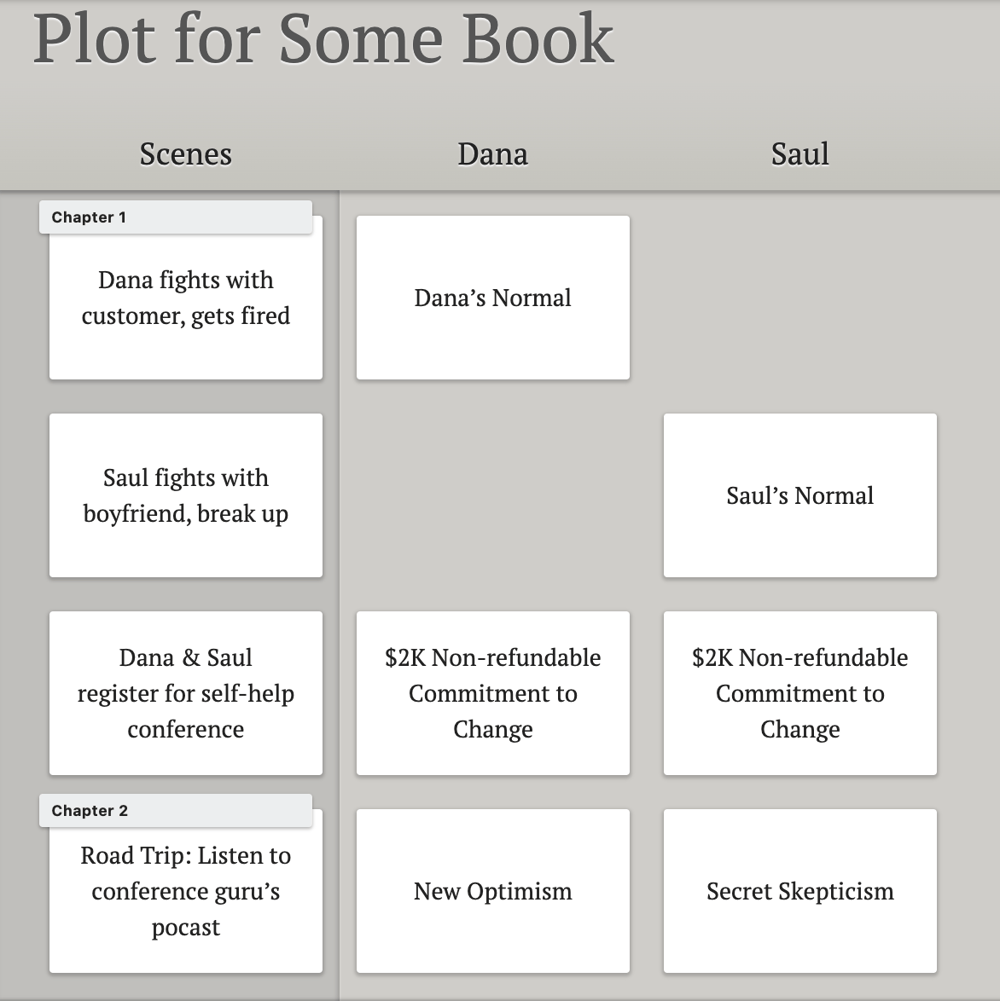
For each of the six arcs in your outline, answer the following questions:
- The Event: What is the key external event in this arc that impacts Alex?
- The Internal Impact: How does this event challenge his Goal, Motivation, or Deep Dark Belief?
- The Reaction: How does his personality (his Big Five traits) shape his reaction to this event? Is his response consistent with the profile you built?
- The "Therefore...": Does his reaction create a believable "therefore..." that pushes the story into the next arc?
- The Tipping Point: Where in the arc does the balance of his fears begin to shift? When does the fear of losing Vera by resisting start to outweigh the fear of losing Vera by consenting? This is the crucial transformation.
Your goal is to pinpoint any moments where Alex's change feels too abrupt. The final consent should be the logical conclusion of a series of smaller, painful, but necessary psychological shifts. Use the "working backward" strategy: if the consent in Arc 5 feels unearned, what emotional realization or event do you need to add to Arc 3 or 4 to justify it?
Conclusion
By completing this rigorous review, you have done more than just plan a plot; you have chartered a soul's journey. You've ensured that your story's most critical moment—the husband's consent—is not an event that simply happens, but is the earned, inevitable outcome of a deep and authentic internal struggle. This psychological plausibility is what will elevate your story from a sequence of events to a powerful emotional experience for the reader.
Key Takeaways:
- A plausible character arc is driven by the resolution of a core internal conflict (desire vs. fear/misbelief).
- Using psychological frameworks like the Four-Stage Model of Motivation and the Big Five personality traits provides a systematic way to build and validate a character's journey.
- A powerful resolution must be "earned." The character's transformation must be a direct result of the trials they face in the plot.
- Stress-testing your plot from a specific character's perspective is essential to identify weak links and ensure their emotional arc is consistent and believable.
Preview of the Next Lesson
In our next lesson, we will begin the exciting process of drafting. With your plot now fully sequenced and psychologically validated, we are ready to write the opening scenes. Our next learning outcome will be: Draft the setup and inciting incident of the plot outline, establishing initial character dynamics and the core conflict. You will transform your outline into living prose, bringing Vera, Alex, and Leo to life on the page for the first time.