Introduction
In our last lesson, we explored the Preparedness Paradox. You wrote a fantastic scene where Henry, after successfully managing a minor bout of jealousy, became overconfident. His success led him to believe he had "solved" the problem of jealousy, prompting him to suggest a significant leap forward in the relationship that Vera was clearly not ready for.
This overconfidence is the perfect catalyst for our current topic. When a character believes they have mastered a key emotional challenge, they often seek a "final solution" to eliminate all future problems. For Henry, this solution is total, unfiltered honesty.
Today, your learning goal is to apply the 'Transparency Paradox' to generate conflict when full openness between all three characters creates new vulnerabilities. We will see how Henry's push for radical honesty, intended to create unbreakable trust, ironically begins to poison the well, making genuine connection even harder to achieve.
1. Understanding the Transparency Paradox
At its core, the Transparency Paradox is the counterintuitive idea that more information or greater openness doesn't always lead to better understanding, trust, or outcomes. In fact, it can sometimes make things worse by causing confusion, anxiety, or, in the context of relationships, new forms of suspicion.
To explore this, let's start with a clear definition and some examples.
The following article from the Sustainability Directory provides an excellent overview of the Transparency Paradox. It explains the core concept and gives relatable examples, including how it applies to relationships.
Please read the 'Fundamentals' and 'Intermediate' sections of this article. Pay close attention to the statement, 'relentless openness might actually erode intimacy rather than build it.' Also, note the examples of open-plan offices and social media, where intended transparency leads to unintended negative consequences like disconnection and anxiety.
The key insight for our story is that transparency isn't a simple positive. While it can be a tool for connection, raw, unfiltered openness can create harsh shadows.
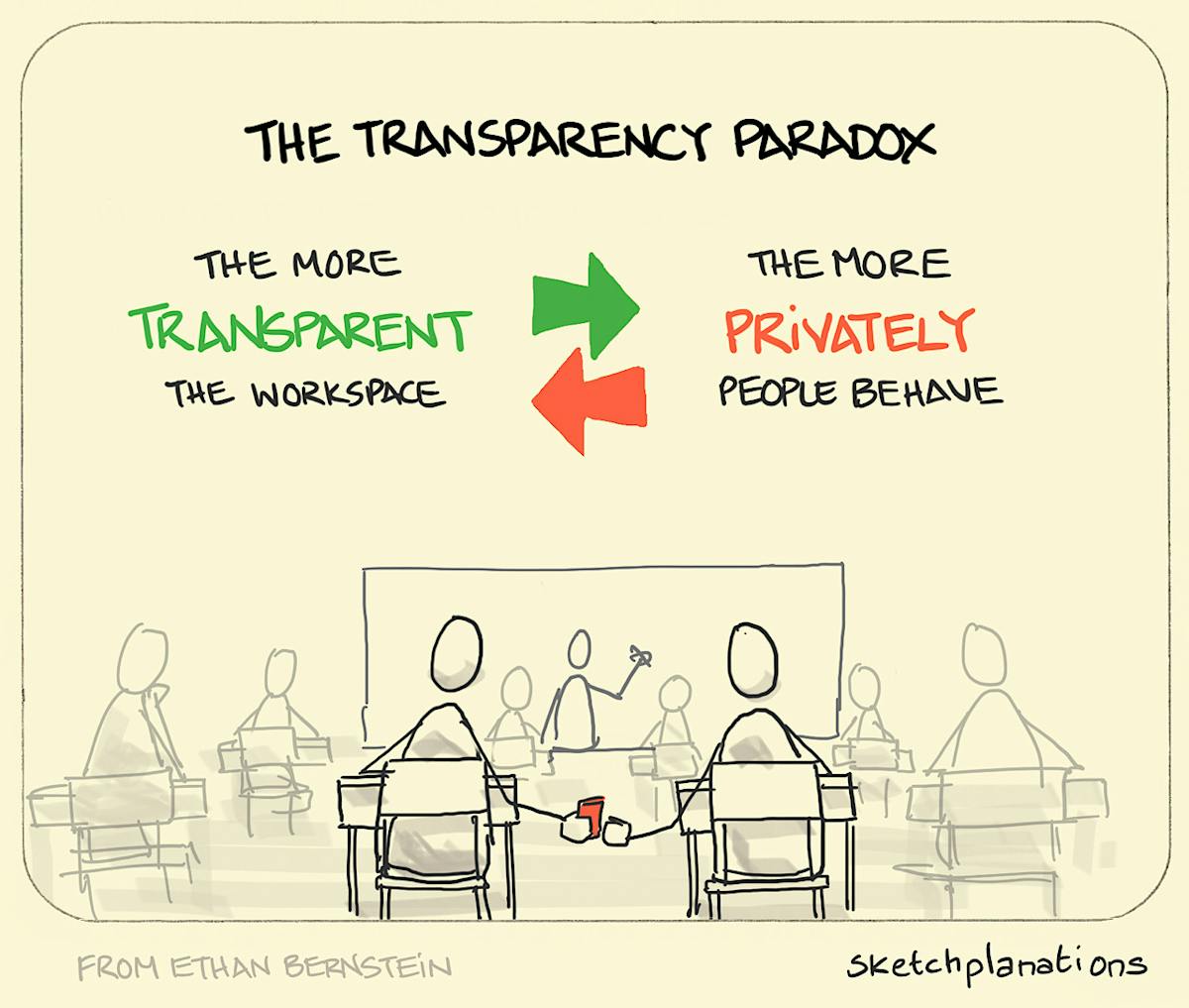
In our story, Henry, buoyed by his recent "success," now believes the only remaining obstacle is secrecy itself. He's about to propose a policy of total transparency, not realizing that this very policy can become a trap.
2. The Backfire Effect: How Openness Creates Suspicion
Why does transparency sometimes fail? In relationships, one of the most powerful mechanisms is a psychological process where expressing vulnerability makes a person doubt the authenticity of the comfort they receive in return. Your background as a social researcher will find the following model particularly interesting. It provides a formal structure for this paradoxical effect.
How Expressing Relationship Insecurities Perpetuates Them
This academic paper, 'Walking on Eggshells,' by Lemay and Clark, details the specific cognitive process that drives the Transparency Paradox in relationships. It explains how expressing insecurity can lead a person to believe their partner is no longer being genuine.
Read the introduction and the sections detailing the 'Expression-Based Authenticity Doubts Model' (Paths c and d). Focus on these key concepts: Reflected Appraisals of Vulnerability: The belief that your partner now sees you as fragile or insecure because you've shared a vulnerability. Authenticity Doubts: The suspicion that your partner's positive reassurances are now insincere—that they are 'walking on eggshells' to avoid hurting you. Discounting and Augmenting: How this doubt leads you to discount their positive words ('they're just being nice') and amplify any minor negative signals. \nDon't worry about the statistical methods; focus on the psychological model itself.
This model gives us the "how" and "why" for our story's next conflict. When Henry decides to be "radically honest" about his deepest fears, he isn't just sharing information. He is also creating a new lens through which he will interpret Vera and Leo's responses.
The process looks like this:
- Henry's "Honest" Confession: He shares a deep-seated fear (e.g., "I worry I'm just an obstacle to your happiness now").
- Vera's Genuine Reassurance: She responds with love and support, telling him he is essential and loved.
- Henry's Paradoxical Interpretation: He thinks, "She's saying that because I just told her how insecure I am. She's walking on eggshells. Is this what she really feels, or is she just trying to manage my fragility?"
The very act designed to bring them closer has planted a seed of profound doubt. Henry has created a scenario where Vera's kindness becomes evidence of her insincerity. This is a far more complex and dangerous conflict than simple jealousy.
To fully grasp the philosophy Henry might be adopting, the following video provides a good summary of "Radical Honesty," the concept he is likely clinging to.
Radical Honesty – What If We All Told The Truth?
This video from Like Stories of Old explores the concept of Radical Honesty as proposed by Brad Blanton. It will help you understand the mindset Henry is adopting—the belief that lying is the source of all stress and that absolute truth-telling is the path to intimacy.
Watch the sections from 03:58 to 11:37. Pay attention to the three levels of truth-telling and the idea that honesty, while potentially destructive at first, is necessary for true intimacy and breaking down walls.
Henry is latching onto the promise of radical honesty without understanding its paradoxical dangers. He wants the catharsis and intimacy without recognizing how his own psychology will twist the results.
3. Writing Exercise: The Honesty Trap (25 minutes)
Goal: Write a scene where Henry's attempt to use "radical honesty" to build trust backfires, creating a new and deeper vulnerability for him and the relationship.
Scenario: Building on his overconfidence from the last lesson, Henry has convinced Vera and Leo to participate in a "radical honesty" session. He believes this is the final hurdle to creating a perfectly trusting vee.
Instructions:
-
Set the Scene. Start with Henry initiating the conversation. He should be confident, even a bit self-congratulatory, framing this exercise as a sign of their collective strength and his own personal growth. Vera might be apprehensive, while Leo could be cautiously open.
-
The Vulnerable Confession. Have Henry share a deep, authentic insecurity that goes beyond simple jealousy. This is his attempt at Level 2 or 3 honesty (emotional/existential truth). It should make him truly vulnerable.
- Example: "I want to be completely honest. Since we started this, there's a part of me that feels...obsolete. I see the joy you two have, and I worry that I'm not a part of Vera's future happiness, but a remnant of her past that she's kindly managing."
-
The Reassurance. Vera and Leo should respond with genuine care. They validate his feelings but firmly and lovingly reassure him of his importance. Their response should be, by all objective measures, supportive and kind.
- Example Dialogue (Vera): "Henry, hearing you say that hurts because it's so far from the truth. You're not my past. You're my foundation. This new chapter with Leo doesn't replace what we have; it's built upon it."
-
The Internal Backfire. Now, show the Transparency Paradox in action through Henry's internal monologue. He hears their words, but the "walking on eggshells" effect takes over his perception.
- Possible Inner Monologue for Henry: He watched Vera's face, her expression of earnest care. It was perfect. A perfect response. Exactly what someone would say to a fragile man who just confessed he felt obsolete. The words were right, but they felt...calibrated. Now that they knew his deepest fear, how could he ever trust that their reassurance wasn't just a tactic to keep him from breaking?
-
The Aftermath. End the scene with the chilling disconnect between Henry's outward behavior and his new internal reality. He might nod and say, "Thank you, that means a lot," while inwardly, the seed of suspicion has taken root. The session designed to eliminate all doubt has just created the most unshakeable doubt of all.
Conclusion
In today's lesson, you've weaponized honesty itself. By applying the Transparency Paradox, you've moved beyond external conflicts and created a deeply psychological trap for Henry. His very attempt to secure his place in the relationship has made him unable to trust any confirmation he receives.
Key Takeaways:
- The Transparency Paradox: Full, unfiltered openness can create new vulnerabilities by making the recipient of information suspicious of the giver's motives.
- The "Walking on Eggshells" Effect: When one person expresses deep insecurity, they may start to perceive their partner's reassurances as inauthentic management of their feelings rather than genuine expressions of love.
- Layering Conflict: This paradox creates a sophisticated internal conflict that is much harder for the characters to solve than a simple disagreement. It pits a character's desire for trust against their ability to accept it.
Preview of the Next Lesson
We have now explored several individual system traps and decision paradoxes. You've created scenes where these concepts drive the conflict in nuanced ways.
In our next lesson, we will begin the work of synthesis. You will be asked to outline a scene where a character's decision is complicated by the interplay of at least two different paradoxes. This will challenge you to weave these conceptual threads together to create even more complex and realistic character dilemmas, paving the way for outlining the full story.