Introduction
In our last lesson, you did an excellent job exploring the Transparency Paradox. We saw how Henry's well-intentioned push for "radical honesty" ironically poisoned the well, making him suspicious of the very reassurance he sought. His demand for total openness created a new, more insidious form of doubt.
Today, we're going to build on that foundation by weaving multiple conceptual threads together. Your learning goal is to outline a scene where a character's decision is complicated by the interplay of at least two different paradoxes. Specifically, we will combine the Prevention Paradox with the Transparency Paradox to create a difficult, no-win decision for Vera. This layering of conflicting principles is a powerful technique for generating the kind of deep, realistic tension that makes a story's resolution feel truly earned.
1. Layering Conflict: The Goalkeeper's Dilemma
So far, we've treated each paradox as a discrete tool. Now, we'll see how they can interact to create a system of conflict. Think of it as moving from analyzing single variables to understanding their covariance. In our story, Vera is about to get caught in the crossfire between two powerful, opposing forces she helped create.
Let's call her situation The Goalkeeper's Dilemma.
First, let's briefly review the Prevention Paradox. As a social researcher, you're familiar with the difficulty of proving the value of an intervention that results in a "non-event." This is the core of the paradox.
The Prevention Paradox: Why Success Looks Like a Waste of Money
To refresh your memory on the Prevention Paradox, let's revisit the excellent article 'The Prevention Paradox: Why Success Looks Like a Waste of Money'.
Please reread the first section, 'Executive Summary: The Curse of the Goalkeeper,' to re-familiarize yourself with that core analogy. Also, review 'Part 1: The Y2K Lesson' and 'Part 7: Geoffrey Rose and the Population Strategy.' Focus on how a successful prevention strategy can destroy the evidence of its own necessity, and how a measure that benefits the collective can feel like an unnecessary burden to an individual.
In our story, Vera is the goalkeeper. She has been subtly managing emotions, navigating tricky social situations, and performing preventative maintenance to keep the complex machinery of her relationships running smoothly. Her success means that Henry, the "team owner," doesn't see the shots being saved. He only sees a quiet field and concludes the game is easy.
This brings us to the Transparency Paradox. Because Henry perceives the situation as stable and low-risk (thanks to Vera's invisible work), his logical next step was to demand total, radical honesty. He believes that secrecy is the only remaining threat.
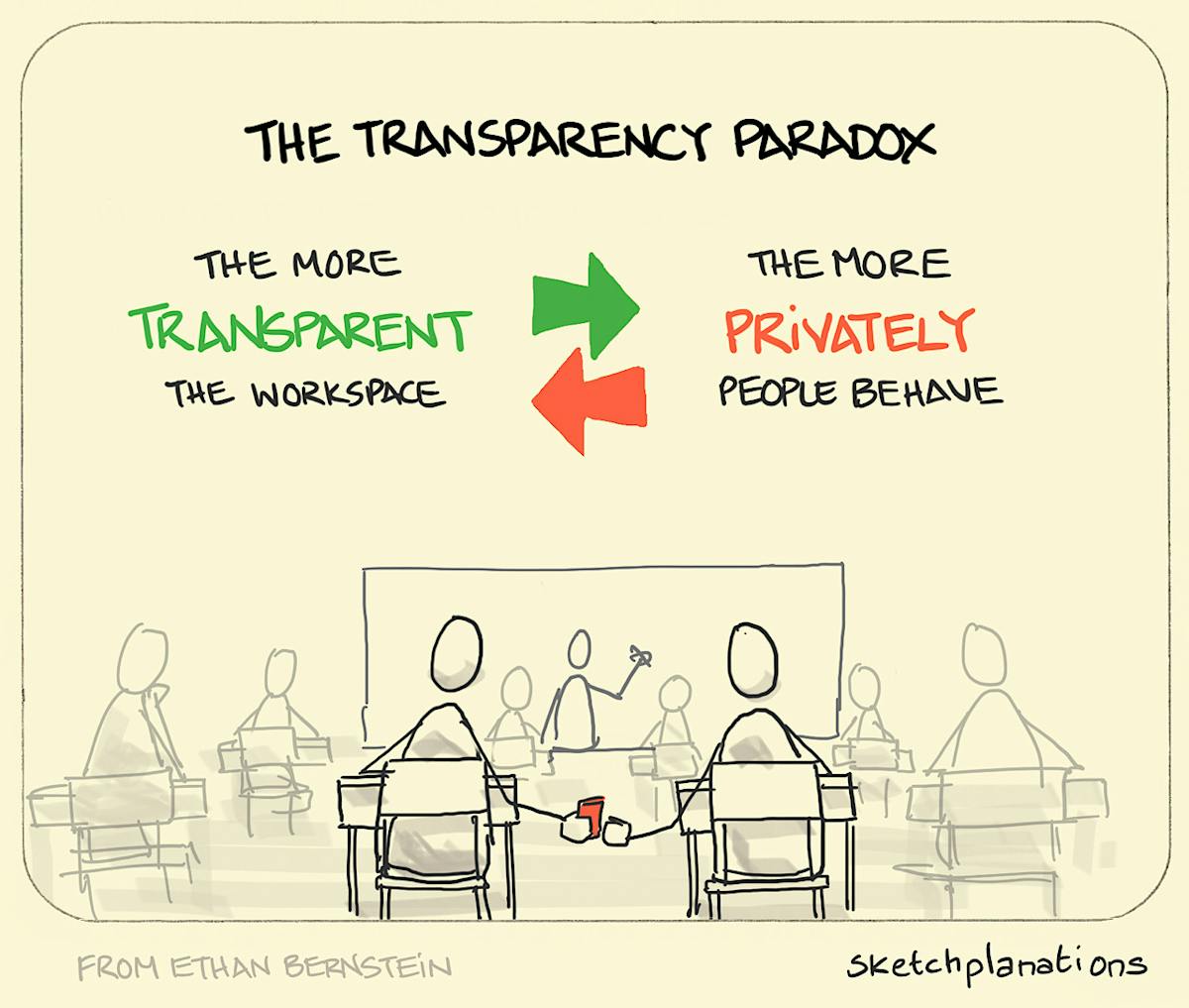
Here is where the two paradoxes collide to create Vera's dilemma:
A new, minor issue arises—perhaps a small insecurity expressed by Leo, or a scheduling conflict that reveals underlying friction. Vera, the expert goalkeeper, knows she can handle it discreetly and prevent it from escalating.
-
If she uses her old, successful strategy (Prevention): She handles the issue quietly. The relationship remains stable. However, she now violates Henry's "radical honesty" rule. If he discovers she withheld this information, he won't see her actions as skillful prevention; he will see them as a damning betrayal and proof that he is being "managed." Her preventative success becomes evidence of deceit.
-
If she adheres to the new rule (Transparency): She tells Henry about the minor issue. By doing so, she risks triggering the "walking on eggshells" effect we explored in the last lesson. Henry may overreact, see the problem as larger than it is, or become suspicious that Vera is testing him. The very act of being transparent may destabilize the peace she has worked so hard to maintain.
Vera is trapped. Her past success has created the conditions for her current predicament. Both paths are fraught with risk, and the decision itself reveals the deep cracks forming in their relational foundation.
2. Outlining Exercise: A No-Win Decision (35 minutes)
Your task is to outline the scene where Vera faces this dilemma and makes a choice. Remember, this is an outline, not a full prose scene. Focus on the structural beats of the decision and its immediate fallout.
Scenario: After a pleasant evening all together, Leo privately mentions a minor concern to Vera. It's not a crisis, but it's a small sign of friction. For example, he might say, "I felt a little like a guest in your life tonight, not a part of it," or he might express anxiety about meeting her parents next month. Vera now has to decide whether to share this with Henry, per his "radical honesty" policy.
Instructions:
Structure your outline using the following four sections. Be specific about the character's internal thoughts and the potential consequences.
-
The Catalyst:
- Briefly describe the scene. What is the minor issue Leo raises with Vera? Make it something that is genuinely small—a problem that, under normal circumstances, a simple conversation could resolve.
-
Vera's Internal Conflict (The Paradoxes Collide):
- Map out her thought process as she weighs her options. This is the heart of the outline.
- Path A (Transparency): Write down her specific fears about telling Henry. How might the Transparency Paradox manifest? (e.g., She considers telling him but remembers how he reacted last time. He'll see this not as information, but as a problem she's failing to solve. He'll analyze her tone, his tone, Leo's imagined tone. The honesty will become a trial.)
- Path B (Prevention): Write down her specific fears about not telling Henry. How is the Prevention Paradox working against her? (e.g., She knows she can reassure Leo and fix this in five minutes. It's what she does. But the new 'rule' hangs over her. If Henry finds out she had this conversation and didn't report it, he'll see it as a conspiracy. Her attempt to keep the peace will be the thing that shatters it.)
-
The Decision:
- State which path Vera chooses: to tell Henry or to handle it herself.
- Briefly explain her final rationale. What tips the scales for her in that moment?
-
The Immediate Consequence (The Hook):
- Outline the immediate result of her decision. This should be the hook that leads into the next scene.
- If she tells him: Describe Henry's immediate verbal and non-verbal reaction. Does he become suspicious? Does he try to "solve" the problem in a way that makes it worse?
- If she doesn't tell him: How does the secret immediately create tension? Does she have a close call where Leo almost mentions it? Does her own behavior toward Henry change subtly because she's holding something back?
Conclusion
In this lesson, we've taken a significant step forward by layering narrative tools. By combining the Prevention Paradox and the Transparency Paradox, you've engineered a sophisticated character dilemma for Vera that is both psychologically complex and deeply tied to the story's central theme of consent and trust.
Key Takeaways:
- Layering Paradoxes: Combining conceptual frameworks creates multi-dimensional conflicts where there are no easy answers for your characters.
- Invisible Labor: The Prevention Paradox is a powerful tool for exploring the "invisible labor" in relationships, where one person's successful management is taken for granted.
- Weaponized Virtues: A virtue like "honesty" can be weaponized or become a trap when applied rigidly, leading to the opposite of the intended outcome (the Transparency Paradox).
- Character-Driven Plot: This intricate dilemma is not an external event; it emerges directly from the characters' psychology and their past decisions, making the plot feel organic and inevitable.
Preview of the Next Lesson
You now have a robust outline for a pivotal scene. In our next session, you will put pen to paper and bring it to life. Your learning goal will be to write the scene you've just outlined, focusing on how the layered paradoxes create both internal and external conflict. We will focus on translating your outline's structural beats into compelling dialogue, subtext, and character action.