Hello! Welcome to the first lesson in our new module, "Conflict, Tension, and Stakes."
In our previous module, we explored how narrative voice and point of view shape an audience's perception of a brand. You learned to distinguish between a brand's core voice and its adaptable tone, and practiced tailoring a message for different audiences. Now, we shift our focus to the engine that drives every compelling story: conflict.
Without conflict, there is no story. A narrative without struggle is merely a statement. For branding, this is the difference between a forgettable product description and a memorable story that creates an emotional connection. This lesson will define the two primary types of conflict most relevant to your work: the internal conflict of a customer's personal dilemma and the external conflict of a tangible market challenge. Understanding this distinction is fundamental to positioning your brand as the solution your customer has been searching for.
1. What is Conflict and Why Does it Matter?
At its core, conflict is the struggle between opposing forces. In storytelling, it’s what stands in the way of a character achieving their goal. This struggle is what creates narrative tension, raises the stakes for the audience, and ultimately makes a story engaging.
For a concise introduction to the role of conflict in narrative, please watch the beginning of the following video.
External vs Internal Conflict | Does your story need both?
This video from the YouTube channel Reedsy, titled 'External vs Internal Conflict', provides a clear overview of why conflict is essential to any story.
Watch the first 50 seconds of the video, which introduce the concept of conflict and its role in creating tension and fueling a character's journey.
In the world of branding and marketing, this principle is your most powerful tool. As research has shown, compelling narratives that include a struggle and resolution can increase oxytocin levels in the brain, fostering trust and empathy. An emotionally charged story is far more memorable than a list of facts. Therefore, to build a brand that people connect with, you must learn to effectively frame and resolve conflict.
2. External Conflict: The Tangible Problem
The most straightforward type of conflict is external conflict. This is a struggle between a character and an outside force. This could be another person, a force of nature, or a societal convention.
To understand this concept more deeply, let's return to the Reedsy video.
External vs Internal Conflict | Does your story need both?
This segment of the video 'External vs Internal Conflict' defines external conflict and provides classic literary and film examples.
Please watch the section from 01:16 to 02:37. Pay attention to how external conflict is described as an 'objective obstacle' that drives the plot forward.
Now, let's translate this into a branding context. For your customer, the external conflict is the tangible, physical, or logistical problem they are trying to solve. It's the "market challenge." This is the reason they are looking for a product or service in the first place.
Marketing expert Donald Miller, creator of the StoryBrand framework, argues that the single most important thing a brand can do is clearly identify this external problem.
the StoryBrand Framework Explained In 7 Minutes
In this short clip, 'the StoryBrand Framework Explained In 7 Minutes', Donald Miller explains why focusing on the customer's problem is the most effective marketing strategy.
Watch from 01:14 to 02:11. Notice his emphasis on how brands must 'own a problem' to capture the market's attention.
So, in branding, the external conflict isn't a dragon to be slain, but a problem to be solved.
- For a busy professional, the external problem might be not having enough time to cook healthy meals.
- For a startup, it might be the need for a professional website to attract investors.
- For a traveler, it might be the impersonal and expensive nature of hotel chains.
This last example is exactly the external conflict that Airbnb identified and built its entire brand story around.
3. Internal Conflict: The Customer's Dilemma
While external conflict drives the plot, internal conflict gives it emotional weight. This is the struggle that takes place within a character's heart and mind. It's a battle with their own doubts, fears, values, or desires.
Let's see how the Reedsy video explains this crucial concept.
External vs Internal Conflict | Does your story need both?
This final segment from the Reedsy video defines internal conflict and explains why it's key to creating emotional stakes and a meaningful character arc.
Watch the section from 02:37 to 04:24. Focus on how the internal conflict (Katniss's reluctance to kill) makes the external conflict (the Hunger Games) so impactful.
In branding, the internal conflict is the customer's dilemma. It’s about how the external problem makes them feel. This is where you connect with your audience on an emotional level. Great brands don't just sell a solution to an external problem; they sell the resolution to an internal feeling.
The following resource provides clear, practical definitions for these concepts within the StoryBrand framework.
The StoryBrand Framework: A Complete Step-by-Step Guide
The article 'The StoryBrand Framework: A Complete Step-by-Step Guide' from Creativeo clearly breaks down the three levels of problems customers face.
Please read the section titled 'Principle 2: What are your customer's external, internal, and philosophical problems?'. Focus on the definitions provided for 'External' and 'Internal' problems. Note how the internal problem is described as a feeling like frustration, embarrassment, or confusion.
Let's revisit our earlier examples:
- External Problem: Not having time to cook healthy meals.
- Internal Feeling: Feeling guilty, stressed, and like a failure for not taking better care of oneself or one's family.
- External Problem: Needing a professional website.
- Internal Feeling: Feeling overwhelmed, amateurish, and insecure about the company's legitimacy.
- External Problem: Hotels are impersonal and expensive.
- Internal Feeling: Feeling disconnected, unadventurous, and like just another tourist.
Nike's "Find Your Greatness" campaign is a masterclass in addressing internal conflict. The campaign wasn't about the external problem of needing better running shoes. It was about the internal conflict of self-doubt and the fear that one isn't a "real" athlete.
4. How Internal and External Conflict Work Together
The most effective brand narratives link the external and internal conflicts. The message is simple: our product solves your practical problem, and in doing so, resolves your negative feelings and helps you become the person you want to be.
This chart provides a great visual summary of the key differences:
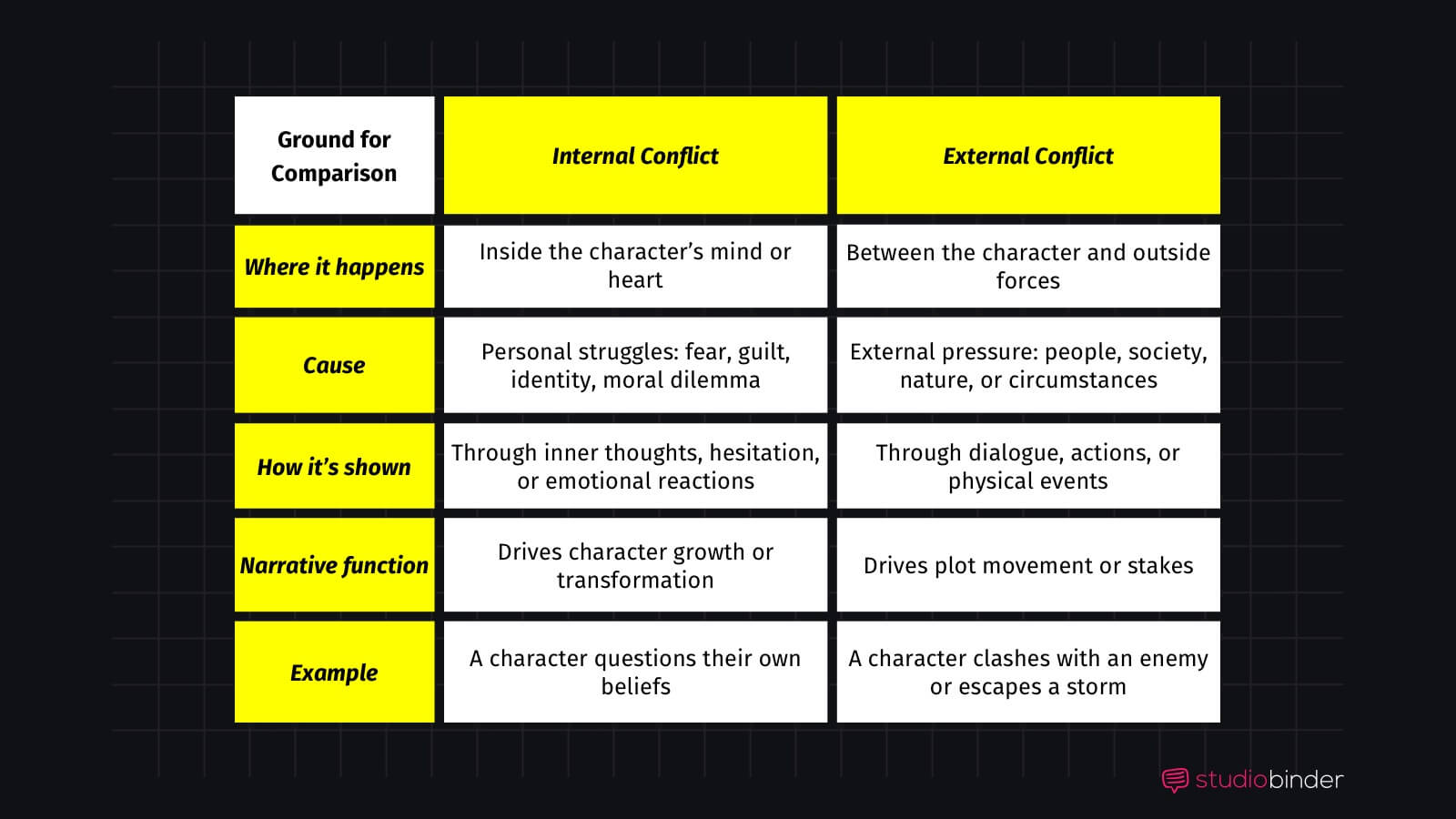
In essence, your brand should:
- Identify the external problem your customer faces.
- Acknowledge the internal frustration that problem causes.
- Position your product or service as the solution that resolves both.
Test your understanding!
For each of the following businesses, identify a plausible external conflict (the tangible problem) and a corresponding internal conflict (the customer's dilemma or feeling) that the brand could address in its storytelling.
- A cybersecurity software for small businesses.
- A brand of premium, comfortable, and stylish work-from-home apparel.
- A subscription box service for dog toys and treats.
Show answer
Here are some possible answers. Your interpretations may differ, which is perfectly fine!
-
Cybersecurity Software:
- External Conflict: Small businesses lack the IT resources and budget to defend against sophisticated cyberattacks.
- Internal Conflict: The business owner feels constantly anxious, vulnerable, and fearful that one mistake could destroy everything they've built.
-
Work-From-Home Apparel:
- External Conflict: Traditional work clothes are uncomfortable for home, but casual clothes look unprofessional on video calls.
- Internal Conflict: The remote worker feels sloppy, unmotivated, and struggles to create a mental boundary between work and personal life.
-
Dog Toy Subscription Box:
- External Conflict: It's hard to constantly find new, durable, and engaging toys to keep a dog entertained.
- Internal Conflict: The dog owner feels guilty that their beloved pet is bored or destructive while they are busy, and worries they aren't being a "good" pet parent.
Conclusion
You have now begun to explore one of the most fundamental elements of narrative. By defining conflict not just as a literary device but as a strategic branding tool, you can start to build stories that truly resonate.
Key Takeaways:
- Conflict is the engine of story and is essential for creating an engaging brand narrative that builds trust and is memorable.
- External conflict in branding refers to the tangible, practical problem your customer is facing (a market challenge).
- Internal conflict is the customer’s emotional dilemma—the frustration, fear, or insecurity caused by that external problem.
- The most powerful brand stories position their product as the solution to the external problem, which in turn resolves the customer's internal conflict.
Preview of the Next Lesson:
Simply having a conflict isn't enough; the audience needs to care about the outcome. In our next lesson, we will explore how raising the stakes for the customer maintains audience engagement. We'll discuss how to make the resolution of the conflict feel urgent and important, turning passive listeners into active, invested followers of your brand's story.