Hello! Welcome to the final lesson in our module on Narrative Voice and Point of View.
In our last session, we drew a clear line between brand voice and tone. We established that voice is the consistent, core personality of your brand, while tone is the adaptable mood or emotional inflection used in specific situations. This distinction is the key to creating communication that feels both authentic and context-aware.
Today, we move from theory to practice. Our goal is to adapt a single brand message into different tones for two distinct audience segments. You will learn how to modulate your narrative style to connect with different groups of people without ever losing your brand's core identity. For someone with your background in both marketing and writing, this lesson bridges the gap between audience strategy and creative execution.
1. The Dimensions of Tone
If voice is the core personality, tone is the set of "sliders" you adjust to suit a conversation. These sliders represent spectrums of emotional expression. The key is knowing which sliders to adjust, and by how much, for each specific audience and context.
Here are a couple of useful visuals that illustrate these dimensions:

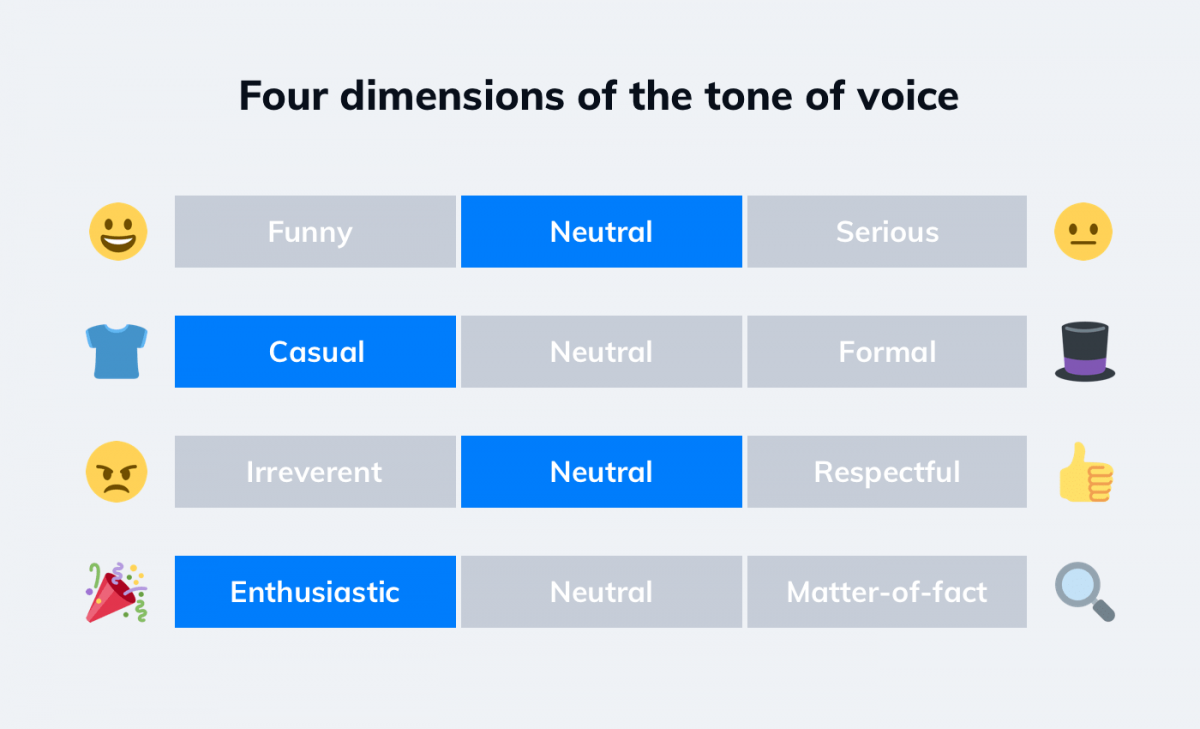
When adapting a message, you are making conscious choices along these spectrums. The primary factors influencing these choices are:
- The Audience: Who are you talking to? What is their relationship with your brand? What do they value?
- The Channel: Where is the conversation happening? LinkedIn, TikTok, and a customer support email all have different expectations.
- The Context: What is the purpose of the message? Is it a product launch, a public apology, or an informal community update?
Today, we'll focus primarily on the first factor: the audience.
2. How Brands Adapt Tone: Case Studies
Let's look at how successful brands put this into practice. The following article from Shopify provides excellent real-world examples.
What Is Brand Tone? How To Craft Your ...
This article, 'What Is Brand Tone?', demonstrates how and why brands adjust their tone for different channels and situations.
Please read the following sections: 'Brand tone vs. brand voice': Focus on the Girlfriend Collective example, noting how their casual welcome email differs from their humorous Instagram tone. 'Factors that influence brand tone': This section reinforces how channel and content dictate tonal shifts. 'Examples of brand tone': Pay close attention to the examples of Great Jones and Death Wish Coffee. Notice how Great Jones shifts from a cheeky tone for a hiring question to a serious tone for a safety question. See how Death Wish Coffee balances its irreverent homepage copy with a more authoritative tone on its 'About Us' page.
As you can see, these brands aren't being inconsistent. They are being relationally intelligent. They maintain their core voice (e.g., Girlfriend Collective is always eco-conscious and friendly; Death Wish is always bold and edgy) but adjust their tone to fit the specific needs of the moment. Great Jones understands that a customer asking about safety needs reassurance, not cheekiness. This builds trust.
Another powerful way to think about audience segmentation is by looking at internal vs. external audiences. Let's examine a guide from the University of British Columbia (UBC).
This 'Voice and Tone Guide' from UBC provides a clear example of adapting tone for two major audience segments: the general public (external) and the university community (internal).
Please read section 3.0, 'how our tone shapes feelings'. Focus on the two text boxes titled 'external tone example' and 'internal tone example', as well as the paragraph just below them that explains the distinction.
UBC's voice remains consistent: it is an authoritative, inspiring, and inclusive academic institution. However, its tone shifts:
- External Tone (for prospective students, the public): More confident, supportive, and aspirational. It aims to inspire and build the university's reputation. The language is about potential and global impact ("shape a better world").
- Internal Tone (for current staff and faculty): More collaborative, conversational, and welcoming. It aims to foster a sense of community and shared purpose. The language is about the internal culture ("we are open-minded and learn from each other").
This is a perfect illustration of our learning outcome: the core message ("UBC is a place of learning and growth") is adapted with a different tonal emphasis for two distinct audiences.
3. Your Turn: Adapting a Message
Now it's time to apply these concepts yourself. This exercise will challenge you to take a single message and filter it through two different tonal lenses for two different audiences.
The Scenario:
- Brand: "Terra," a sustainable outdoor gear company.
- Brand Voice: Adventurous, eco-conscious, innovative, and authentic.
- Core Message: The launch of a new backpack, the "Geo-25," made from 100% recycled ocean plastic.
The Audiences:
- Audience A: "The Hardcore Hiker." This is a seasoned outdoors enthusiast who follows many gear blogs. They are highly knowledgeable about technical specs, value durability above all else, and are skeptical of "greenwashing." They are likely reading this on a specialized gear review website.
- Audience B: "The Conscious Commuter." This person is environmentally aware and looking for a stylish, practical, and ethical backpack for daily use (work, gym, weekends). They value brand story and mission as much as product features. They are likely seeing this as a sponsored post on Instagram.
Adapt the message!
Write a short (50-70 word) announcement for the new "Geo-25" backpack, adapting it for each audience. Try to maintain Terra's core voice (adventurous, eco-conscious, innovative, authentic) while flexing the tone.
For Audience A (The Hardcore Hiker), what tone would you use? Think about the tonal dimensions: Formal/Casual, Serious/Funny, Respectful/Irreverent, Enthusiastic/Matter-of-fact.
For Audience B (The Conscious Commuter), how would your tone shift?
Once you have your drafts, compare them to the examples in the "Show answer" section below.
Show answer
Here are some example answers. Your versions might be different, and that's perfectly fine! The key is the strategic thinking behind your choices.
Version for Audience A (The Hardcore Hiker)
-
Chosen Tone: Matter-of-fact, technical, and respectful (of their expertise).
-
Example Text: "Introducing the Geo-25. Built for the long haul with a 420D recycled nylon ripstop shell, derived entirely from certified ocean plastics. We integrated our load-bearing suspension system for superior comfort on multi-day treks. This isn't just a pack; it's a statement of durability and a commitment to cleaner trails. Put it to the test."
-
Analysis: The tone is direct and prioritizes information. It uses technical language ("420D recycled nylon ripstop," "load-bearing suspension") to build credibility. It acknowledges the audience's values ("cleaner trails," "durability") without being overly emotional. The challenge "Put it to the test" respects their adventurous spirit.
Version for Audience B (The Conscious Commuter)
-
Chosen Tone: Enthusiastic, inspiring, and casual.
-
Example Text: "Your new everything-bag is here! Meet the Geo-25. Every pack is crafted from 100% recycled ocean plastics, helping you make a difference with every carry. With a padded laptop sleeve and smart compartments, it's designed for your daily adventures—from morning coffee to evening workout. Carry a story of change on your back."
-
Analysis: The tone is much warmer and more lifestyle-oriented. It opens with an enthusiastic, benefit-driven hook ("Your new everything-bag"). It highlights practical features relevant to this audience ("padded laptop sleeve"). The focus shifts from technical durability to the emotional benefit and story ("make a difference," "carry a story of change"). The language is simpler and more conversational.
Conclusion
Mastering the art of tonal adaptation is what separates generic brand messaging from truly resonant storytelling. It allows a brand to speak to different communities in a way that feels personal and respectful, all while reinforcing a single, unified identity.
Key Takeaways:
- Tone is a set of strategic choices made along dimensions like formal/casual, serious/funny, and matter-of-fact/enthusiastic.
- The most effective communicators adapt their tone based on the audience, channel, and context.
- You can maintain a consistent brand voice (your core personality) while flexing your tone (your mood) to build stronger connections with diverse audience segments.
Preview of the Next Lesson:
We have now completed our module on voice and point of view. In the next module, we will dive into one of the most powerful engines of any story: conflict. Our first lesson will focus on defining the primary types of conflict relevant to branding, specifically the internal dilemma of a customer and the external challenges of the market. You'll see how framing a customer's problem as a story's central conflict is a foundational technique in compelling brand narrative.