Hello! Welcome to your next lesson in the "Developing Compelling Characters" module.
In our last lesson, we established the core roles in a brand story: the customer is the protagonist, their problem is the antagonist, and your brand is the guide. But a story doesn't just happen; it needs a driving force. What makes the protagonist—your customer—start their journey in the first place?
Today, we'll explore the engine that powers every great narrative. Our learning outcome is to explain how character motivations and goals drive a narrative forward. Understanding this will help you craft stories that feel urgent, purposeful, and deeply relatable to your audience.
1. The "Why": Understanding Character Motivation
A character without motivation is just a puppet being moved around by a plot. A character with motivation has agency, desire, and a reason to act, which is the very foundation of a compelling story.
To start, let's watch a short video that defines character motivation and explains why there is no story without it.
The Secret to a Great Character — How to Write Character Motivation
The video 'The Secret to a Great Character' from StudioBinder clearly defines character motivation as the internal reason that moves a character through a story.
Watch the first 1 minute and 23 seconds of the video. Pay attention to the core idea that every action a character takes must have a reason.
Motivation isn't random; it's rooted in fundamental human needs. A powerful framework for understanding these needs comes from psychologist Abraham Maslow's Hierarchy of Needs. This model organizes human needs into five categories, from the most basic (like food and safety) to the most advanced (like self-fulfillment). In storytelling, a character's primary motivation almost always stems from one of these needs.
The next segment of the same video breaks down this hierarchy with excellent examples from well-known films.
The Secret to a Great Character — How to Write Character Motivation
This next section of the StudioBinder video uses Maslow's Hierarchy of Needs as a tool to categorize and understand the different sources of character motivation.
Please watch from 01:44 to 05:44. As you watch, think about how these needs (physiological, safety, belonging, esteem, self-actualization) could apply to a customer in a branding context.
In branding, your customer's journey begins with an unmet need. For example:
- A person buying a home security system is motivated by safety needs.
- Someone joining a new social network is motivated by the need for love and belonging.
- An entrepreneur taking a business course is motivated by esteem (respect from others) or self-actualization (achieving their full potential).
By identifying the core need your product or service addresses, you find the emotional heart of your customer's story.
2. From "Why" to "What": Defining a Tangible Goal
An abstract motivation like "wanting to belong" is a great start, but it doesn't create a plot. To drive a story forward, motivation must be channeled into a concrete, actionable goal. This is the "what" the character is actively trying to achieve.
A common pitfall in writing is to give a character a motivation but no active drive to pursue it. Let's explore this distinction.
Being a Better Writer: Character Drive and Motivation
The article 'Being a Better Writer' by Maxonwriting makes a sharp distinction between 'motivation' (a desire) and 'drive' (the action taken to fulfill that desire).
Read from the beginning down to the line, 'However, motivations are just flavor unless paired with drive to achieve those things they are motivated toward.' Focus on the 'Scientist Kai' example, which clearly illustrates the difference between a passive character and one who drives the plot.
The key takeaway is that the protagonist must do something. Their goal must be visible and active. A story about a character who wants "to be happy" is vague. A story about a character whose goal is "to win the baking competition to save their family's bakery" is specific, active, and full of potential for conflict and action.
This next video reinforces this crucial point.
How to Write Compelling Characters: The Hero’s Goal [Screenwriting Tips]
In 'How to Write Compelling Characters', James A. Hurst explains why a visible, external goal is the engine that powers a great story.
Watch the segment from 01:27 to 02:42. Note the difference between an internal state ('redemption') and a visible goal ('Get the wives to the green place').
To bring these concepts together, this infographic provides a clear visual map connecting the universal "need" to the specific "motivation" and the actionable "goal."

3. Application in Branding: The Customer's Goal is the Story's Destination
Now, let's bring this squarely into your field of branding. The framework of Need -> Motivation -> Goal is the blueprint for your customer's story.
- Need: A universal human desire (e.g., to feel competent).
- Motivation: The specific problem a customer faces (e.g., "I feel overwhelmed and unproductive at work because my software is so clunky").
- Goal: The specific outcome they want to achieve (e.g., "I want to finish my daily reports in under an hour so I can focus on more creative tasks").
This is where your brand enters as the guide. Your product or service is the tool that helps the customer achieve their goal.
The following article does an excellent job of translating these literary concepts into brand strategy, using language that will be familiar from your business background.
The art of brand storytelling with character. - Ghost
The article 'The art of brand storytelling with character' from the agency Ghost directly connects character purpose to brand purpose. It provides a simple framework and then draws compelling parallels between famous fictional characters and major brands.
Please read from the section 'A good brand strategy...' down to '...care deeply for the natural world and are in their element exploring its wonders.' Pay close attention to how it defines Vision (Goal), Mission (How), and Purpose (Motivation). Then, study the brilliant comparisons it makes, like connecting Luke Skywalker to Nike and Moana to Patagonia.
As the article demonstrates, the most powerful brands tell stories that resonate with a customer's fundamental motivations and help them achieve a meaningful goal. Nike doesn’t just sell shoes; it helps you achieve your goal of becoming the hero of your own athletic story. Airbnb doesn’t just rent rooms; it helps you achieve your goal of "belonging anywhere."
Remember the StoryBrand framework from our previous discussions? The character's motivation is what propels them from being "a character" with "a problem" (Steps 1 & 2) towards the action and resolution that follow.
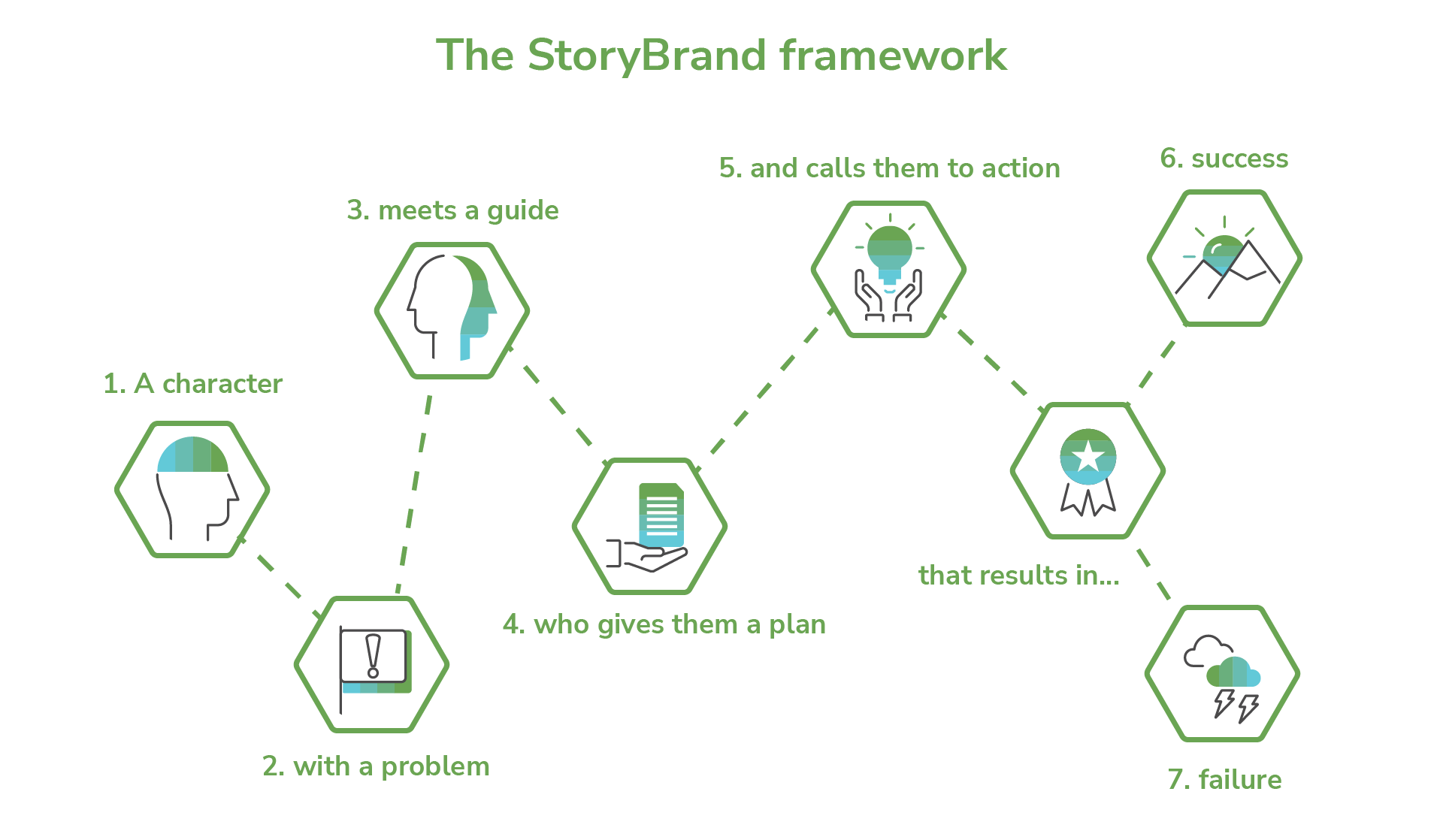
Test your understanding!
In the last lesson, we used the meditation app 'Calm' as an example.
- Protagonist: A young professional feeling overwhelmed by stress.
- Antagonist: The feeling of being constantly "on," mental clutter, and anxiety.
Based on what you've learned today, answer the following:
- What is the protagonist's core motivation? (Try to link it to one of Maslow's needs).
- What is a specific, tangible goal this protagonist might have?
Show answer
-
Motivation: The protagonist's motivation likely stems from the need for Safety—not physical safety, but psychological safety, security, and peace of mind. You could also argue it relates to Self-Actualization, as they are seeking personal growth and to be the best version of themselves.
-
Goal: The goal needs to be specific and measurable. Instead of "to be less stressed," a good goal would be:
- "To be able to sleep through the night without waking up from anxiety."
- "To successfully meditate for 10 minutes every day for 30 days."
- "To feel calm and focused before my big weekly presentation."
The app's brand story is about helping the hero achieve that specific goal.
Conclusion
Today we've unpacked the engine of narrative. Without a clear "why" (motivation) and a tangible "what" (goal), a story has no momentum. By understanding your customer's deepest needs and framing your brand as the guide to their desired destination, you create stories that are not just ads, but compelling journeys.
Key Takeaways:
- Motivation is the "why" behind a character's actions, often rooted in universal human needs.
- A Goal is the visible, actionable "what" that a character pursues, giving the story a clear direction and purpose.
- Motivation without a goal is passive; a goal without motivation feels hollow. The two must work together.
- In brand storytelling, the narrative is about helping the customer (the hero) achieve their goal, which stems from a problem they are motivated to solve.
Preview of the Next Lesson:
A character who starts a journey is rarely the same person who finishes it. The process of pursuing a goal changes them. In our next lesson, we will explore this transformation by learning how to define a character arc and describe its importance for transformation and audience connection.